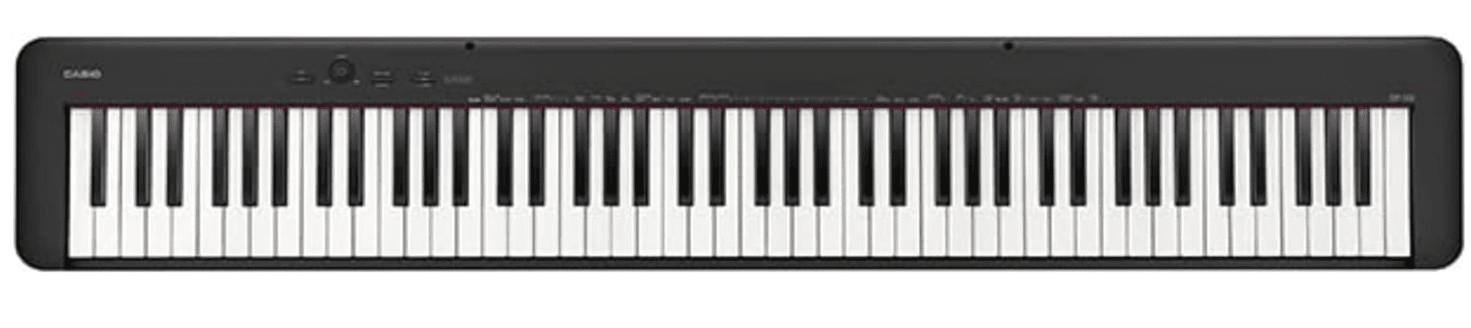
Weighted keys explained simply means understanding how digital pianos replicate the mechanical resistance and touch response of acoustic piano hammers striking strings—the fundamental difference separating real piano-playing instruments from basic electronic keyboards. The confusing terminology around hammer action, graded weighting, semi-weighted keys, and touch sensitivity creates legitimate confusion about which specifications actually matter, what different weighting technologies feel like, and how key action quality impacts your technique development and playing satisfaction.
This comprehensive guide reveals exactly how weighted key mechanisms work, why proper resistance matters for building finger strength and control, which weighting types suit different playing levels and musical styles, and how to evaluate key action quality when comparing digital pianos across various price ranges.
Did you know that weighted keys make your touch transfer up to 60% more accurately to dynamics than synth-action? If you’re chasing expressive control, you’ll feel the difference in every keystroke and rehearsal. You’ll want to know what to look for, how action affects tone, and why cheap substitutes can stall technique. Stay with me as we break down what truly matters in a keyboard’s feel—so you don’t settle for less than real weight and authentic response.
What Weighted Keys Are (And How They Differ From Synth-Action)
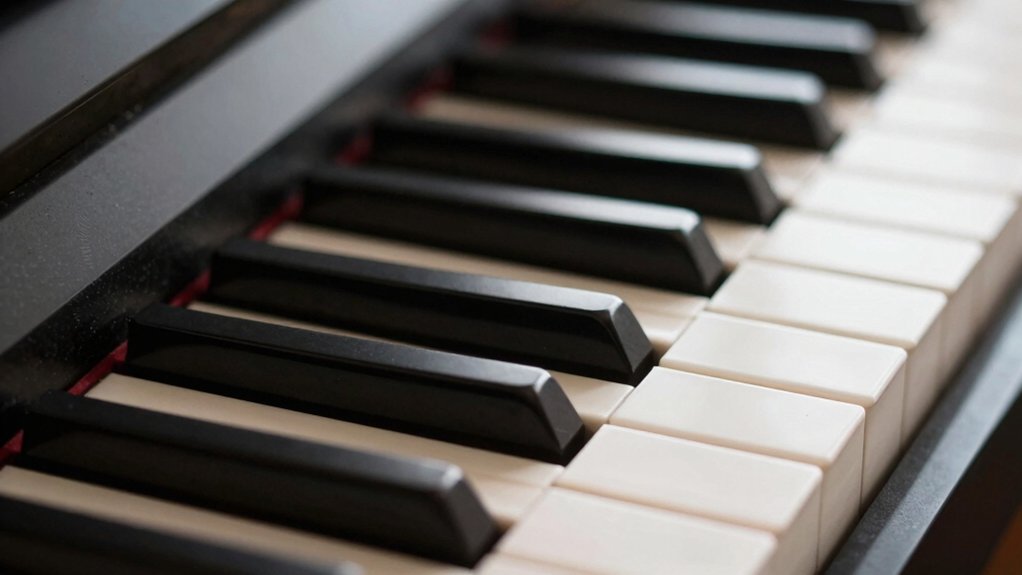
Weighted keys are piano-action keys that simulate the feel of an acoustic piano by applying varying resistance across the keybed. You’ll notice this makes heavier, more gradual weight toward the bottom, mimicking real hammer action.
In contrast, synth action keyboards use springs or plastic mechanisms that keep keys light and uniform, prioritizing speed and portability over gravity-like resistance.
The distinction matters for touch response, dynamics, and control in performance. When you compare weighted keys vs synth action keyboards, you’re evaluating realism versus accessibility, and expressive nuance versus session efficiency.
For genres demanding subtle articulation, weighted keys help you translate your finger strength into phrasing. If you value authentic piano feedback without sacrificing modern features, this choice directly shapes your playing technique and keyboard preference.
How the Weight of the Keys Shapes Feel in Real Playing
As you move from understanding what weighted keys are, you’ll notice how their mass distribution directly shapes your playing feel. The weight profile influences key resistance, rebound speed, and dynamic response, dictating how you approach touch, attack, and release.
Heavier actions demand deliberate finger control and can slow rapid passages, while lighter actions enable quicker tracing of melodies but may reduce perceived control at the extremes. You’ll sense a subtle continuity between tactile feedback and audible result, since consistent weight across keys sustains even phrasing and nuance.
In practice, the choice affects your digital interface interaction, from velocity sensing to expressiveness, and it informs how you gauge acoustic authenticity during performance. Prioritize a balance that supports reliable response without sacrificing musical precision.
Key Variables That Define a Good Keyboard Action
You’ll assess how Action Weight, Balance, and Traveling Weight Consistency shape the feel of a keyboard action.
You’ll map how Keypress Sensitivity Range interacts with these factors to produce predictable, expressive response.
You’ll use this framework to guide adjustments, aiming for a cohesive, reliable playing experience.
Action Weight Balance
Action weight balance is the core for a responsive keyboard action: it defines how the keys feel under your fingers by balancing the forces of attack and release. You assess how evenly the mechanism responds across the entire keybed, ensuring no harsh peaks or sluggish troughs.
The interplay between key weight and flow transition determines repeatability, control, and fatigue avoidance during extended play. A well-tuned balance minimizes perceptible lag while preserving expressive nuance, so you can execute subtle dynamics without compensating with technique.
Favor designs that maintain consistent resistance as you travel down and up, avoiding abrupt passages. In practice, evaluate how the action handles rapid repetitions versus long, legato lines.
Prioritize consistent key weight distribution and predictable action balance for dependable, professional-grade performance.
Keypress Sensitivity Range
Keypress sensitivity range defines how much force the keyboard requires to register a note and how that response scales across the keybed. You assess where the action lands on the spectrum from light to firm, and how consistent it remains from low to high keys.
A narrow range yields uniform feel, aiding precise control, while a broader range offers dynamic nuance at the expense of predictability. In practice, you want a responsive baseline with measurable repeatability, so you can trust musical expression without chasing inconsistency.
Consider how the range interacts with tactile feedback, debounce, and velocity curves, since these shape your playing style. Effective keys support keyboard ergonomics by reducing strain, enabling longer sessions with clear articulation and confident phrasing.
Traveling Weight Consistency
Traveling weight consistency refers to how the force required to move a key changes as you move from the bottom to the top of the keybed. You’ll notice fluctuations that affect velocity response, control, and touch accuracy. A consistent profile minimizes heavier initial engagement and abrupt resistance mid-stroke, enabling steadier phrasing across registers.
In practice, this means engineering that balances spring rates, leverage, and damping so the keystroke feels uniform from bottom-out to top. For piano pedagogy, predictable movement accelerates learning and reduces fatigue, letting technique drive musical outcomes.
In terms of ergonomic design, uniform travel supports healthier wrists and shoulders by preserving neutral motion rather than forcing compensatory grip. The result is a responsive action that fosters precise articulation without sacrificing dynamic nuance.
Digital vs. Hammer-Action: What You’re Really Paying For
Digital pianos and hammer-action models trade accuracy for accessibility: you get environments that feel closer to real pianos without the maintenance, but you also trade some expressiveness and tactile nuance. In this comparison, you’re evaluating cost versus realism.
Hammer-action keys simulate weighted movement, appealing to technique transfer in keyboard ergonomics and long-term muscle memory, yet some models soften touch sensitivity at the top end. Digital options often prioritize consistency, software voices, and portability, which helps with music education by offering affordable practice and clear feedback.
The key decision is what you value: authentic touch or reliable, low-setup versatility. If you prioritize classroom and home practice integration, digital pianos win on practicality; if you chase expressive nuance, hammer-action wins, with a trade-off in maintenance and expense.
How Weighted Keys Influence Tone and Dynamic Response
Weighted keys don’t just feel different; they shape how a piano responds. Your touch translates into more or less velocity, which directly affects tonal output and dynamic range.
Heavier action typically emphasizes lower overtones and sustain, while lighter action can yield quicker articulation but less perceived tonal density. This dynamic transfer matters for consistent phrasing across registers, so you aren’t surprised by sudden volume jumps or uneven response.
The result is improved tonal consistency when you pair weighted action with appropriate finger strength and technique. From a keyboard ergonomics standpoint, a well-balanced action reduces fatigue and allows you to maintain expressive control over long practice sessions.
In short, the contact you establish with the keys defines both timbre and responsiveness.
How to Test Weighted Keys Like a Pro
To test weighted keys like a pro, you’ll apply consistent methodologies across build, action, and touch sensitivities.
Assess each register for uniform response, focusing on keybed feel, hammer weighting, and gradualness of the spring or, if applicable, synthetic alternatives.
Use practical evaluation techniques that compare digits’ input, velocity curves, and repeatability to validate consistency across the full keyboard.
Testing Methodologies For Keys
When evaluating weighted keyboards, you should establish a rigorous testing framework that isolates key feel from other variables. You’ll compare models by controlling action type, key weight, and plunger consistency, then record results objectively.
Start with a baseline measurement of touch sensitivity across the full keybed, noting how velocity input translates to output force and musical response. Use repeatable, instrumented tests to quantify travel, spring resistance, and return timing, avoiding subjective impressions alone.
Document discrepancies between nominal and actual key weight, and assess how these deviations affect dynamic accuracy. Cross-verify with both light and heavy playing styles to ensure stable performance.
Present results concisely, focusing on reproducible metrics, and emphasize how key weight and touch sensitivity interact to shape perceived feel.
Consistency Across Registers
Registers can vary in feel, so test across the full keybed to confirm consistency rather than assuming uniform response.
Consistency across registers hinges on how weighted keys reproduce resistance and travel. You should quantify both touch and repeatability, listening for drift in velocity response as you move up or down the keyboard.
Focus on linearity: does a given force yield the same output across ranges, or do you notice abrupt changes near the ends?
Use repeatable playing techniques to compare segments, not just a single note.
Consider keyboard ergonomics: finger reach, hand position, and column stiffness can alter perceived consistency.
Document observations, then weigh results against your preferred touch profile.
Achieve reliable, repeatable feel that supports expressive control across the entire instrument.
Practical Evaluation Techniques
Weighted Keys weight and feel aren’t just about raw sensation; they’re about measurable response. To evaluate effectively, standardize your test setup: use the same keyboard, same keys, and identical pressing velocity.
Focus on key weight as the primary metric, then assess feel accuracy by comparing actual with expected responses at multiple dynamic levels. Use a precision velocity range (e.g., soft, medium, hard) and record onset time, travel, and rebound consistency.
Employ objective tools when possible—digital force meters, MIDI velocity curves, and repeatable timing tests—to minimize subjectivity. Document deviations, note any hysteresis, and repeat tests to confirm stability.
Conclude with a concise verdict on playability, noting whether the weight aligns with musical intent and performance needs.
Choosing the Right Keyboard for Your Use Case
Choosing the right keyboard starts with your use case, because different activities demand distinct feel, travel, and noise profiles. You’ll prioritize key weight and action feel to align with your goals, whether composing, coding, or gaming.
First, assess travel: compact layouts reduce wrist strain for long sessions, while full-size boards offer external controls that speed up workflows.
Next, consider noise: quieter switches suit shared environments, louder options suit tactile feedback without distraction.
Durability matters if you travel or type heavily, so look for reinforced stabilizers and high-quality keycaps.
Compatibility is nonnegotiable— verify software, macros, and profiles transfer across devices.
Finally, don’t overlook typing comfort: an ergonomic angle and stable, precise actuation minimize fatigue.
When your use case maps to these factors, key weight and action feel become reliable tuning knobs.


Common Myths About Weighted Keys Debunked
Common myths about weighted keys can skew your expectations, so you’ll assess claims against actual feel and response. We’ll compare the realism of weighted keyboards, address how weight translates to playability, and separate performance from perception to avoid over- or underestimating capability.
This sets the stage for clear, evidence-based choices about touch, response, and technique.
Debunking Key Myths
Many myths about weighted keys persist, but separating fact from fiction is simple when you test claims against how a keyboard’s feel influences playability and technique. You’ll find that “heavy equals better” isn’t universal; feel matters more than mass alone, and response can vary by switch, action type, and key material.
Misconceptions about one-size-fits-all realism ignore how touch translates into phrasing, dynamics, and control. Another common belief—that maintenance negates nuance—overlooks how proper keyboard maintenance preserves consistent keyweight and responsiveness, which support accurate technique.
Debunking isn’t about dismissing physics, it’s about aligning expectations with your goals, whether practicing music theory drills or performing. Focus on real, tangible cues: gradation of resistance, repeatable return, and smooth sensitivity.
Your assessment should prioritize reliable feel over marketing claims, and integrate thoughtful keyboard maintenance as a baseline.
Realistic Weighted Feel
Weighted keys aren’t a uniform metric; realism comes from how the touch feels in use, not from mass alone. You’ll find that a realistic weighted feel hinges on fine-grained key travel, not just spring resistance or weight specs.
The term key feel captures how the keyboard responds to your input across velocity, acceleration, and release. A convincing tactile response emerges when action geometry translates your finger motion into consistent resistance, smooth return, and audible context that matches the expected piano or synth feel.
Beware oversimplified specs: similar weights can yield very different sensations if the switch, hammer, or let-off are misaligned. In practice, assess real touch samples, not charts, and prioritize cohesive tactile response over isolated metrics for durability and expressive control.
Performance vs Perception
Performance vs perception is where truth meets expectation: what you feel at the keyboard often diverges from what specs promise, and understanding why helps you avoid misleading conclusions. You’ll notice that perceived responsiveness and tactile cues shape your judgments more than raw numbers. By separating feel from measurements, you can evaluate two realities: sound quality and aesthetic appeal, and how they influence confidence in a product.
- Sound quality can mask mechanical realities; a smooth action doesn’t guarantee tonal clarity.
- Aesthetic appeal drives preference even when performance metrics align, yet it may mislead long‑term value judgments.
- Perceived nuance often stems from context, setup, and playing style rather than true capability.
Trust objective tests, then weigh impressions against function to avoid biased conclusions.
Budget Guide: Real-Weight Action Without Overspending
If you’re aiming for authentic real-weight action without wrecking your budget, you’ll want a pragmatic setup that balances feel, durability, and cost.
For real-weight keyboards, prioritize graded-weight keys or well-tested mechanical action that doesn’t spike price. Look for a sturdy chassis, reliable switch feel, and proven keybed fatigue resistance, so you won’t pay again soon.
You’ll keep a tight focus on return policies and common-sense upgrades rather than wholesale swaps. In a digital sound-friendly world, choose a compact unit with responsive aftertouch and consistent key weighting across the range.
Also consider a simple external controller or app-enabled calibration to support future refinements. Your home setup benefits from modular components, straightforward maintenance, and predictable resale value.
Budget-conscious precision without compromising playability.
Long-Term Care and Calibration: Keeping the Feel Consistent
Regular maintenance and precise calibration are essential to preserve consistent weighting over time. You’ll protect feel by scheduling periodic checks and resisting wear-induced drift that undermines response.
In practice, long-term care means tracking key indicators, like harmony tuning and tonal balance, so you detect shifts before they compound. You don’t want subtle changes to erode the weight profile you rely on during performance and practice.
- Schedule routine action inspections and adjust springs or weights as needed
- Monitor keyboard balance across octaves to maintain even response
- Calibrate after major temperature or humidity changes to prevent drift
Maintaining consistency isn’t cosmetic; it preserves your tactile fingerprint and musical intent, ensuring the action remains faithful to your technique over years.
Quick Troubleshooting: What to Check If the Action Feels Off
When the action feels off, start with a quick, methodical check of setup and wear. Begin by confirming your keyboard is properly mounted and stable, since wobble or misalignment alters perceived action.
Inspect key weighting and coupling components for wear, fraying, or looseness, replacing any damaged parts. Check keybed lubrication and dust buildup, which can add friction and mute response.
Review your input method: switch to a lighter touch if the action seems heavy, or adjust velocity curves for more dynamic control.
Consider ergonomics: improper height, angle, or wrist posture affects timing and accuracy, reducing musical expression.
Finally, test calibration with a known pattern to isolate mechanical from perceptual issues, ensuring consistent keyboard ergonomics supports precise performance.
Conclusion
You want feel you can rely on, not gimmicks you’ll outgrow. Weighted keys deliver consistent touch, dynamic control, and real hammer-action nuance that synth-weighted setups can’t match. Skeptics say it’s “just feel,” yet the payoff shows up in phrasing, velocity, and musical expressivity. Yes, it costs more upfront, but you gain durable realism and long-term technique development. Invest where it matters most: authentic key action that actually elevates your playing, not just the price tag.