
The question “can a digital piano replace an acoustic piano” has sparked heated debates in music schools, online forums, and living rooms across the country, with technology advancing so rapidly that the gap between digital and acoustic seems to narrow with each passing year. Whether a digital piano can replace an acoustic piano depends entirely on what you value most – the authentic resonance and mechanical action of hammers striking strings, or the versatility, convenience, and modern features that digital technology brings to your fingertips.
A student in a practice studio hears a modern digital piano and wonders if its weighted keys can match the feel of an acoustic instrument. You assess touch response, sound modeling, and pedal behavior with analytical rigor, placing digital limits in historical context of evolving MIDI and v–pianos. You weigh technique transfer, repertoire suitability, and long‑term development, but a question persists: does practical convenience outweigh the tactile and tonal nuance essential for mastery? The debate continues as you explore decisive criteria.
What Counts as Serious Piano Study (and Why It Matters)
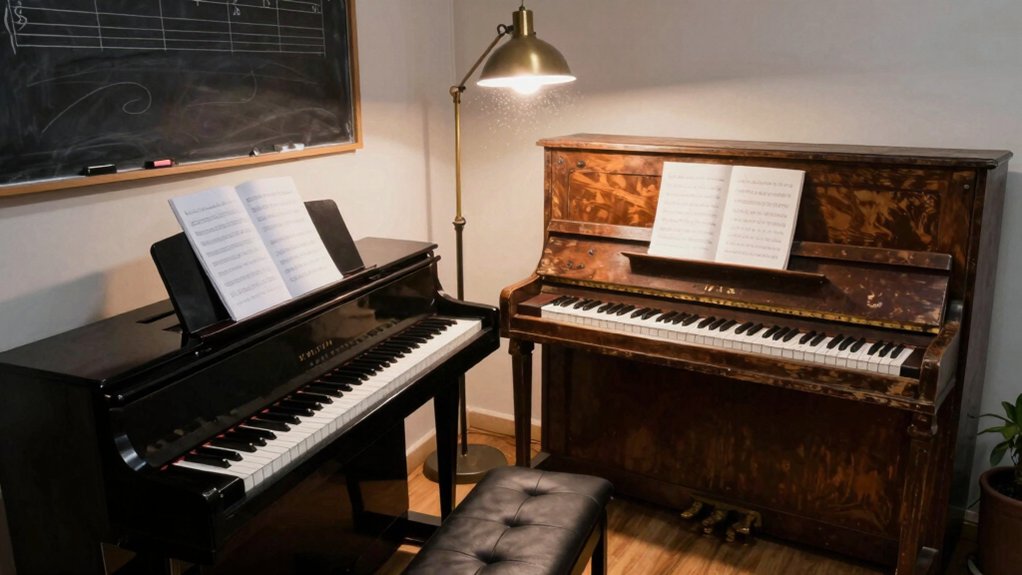
Serious piano study isn’t about hours logged alone; it’s about purposeful, structured practice that targets specific musical goals. You map a sequence of tasks, calibrating difficulty to match skill growth, and you measure progress through concrete metrics rather than sheer time.
This approach blends technical drills, repertoire commitment, and self-review, yielding repeatable improvement. Historical context shows peak study cultures—whether in castle conservatories or modern studios—relied on deliberate routines, disciplined feedback, and instrument stewardship.
Technical precision demands accurate touch, even tone, and consistent tempo, reinforced by focused listening. You also consider instrument maintenance as part of study quality; digital piano maintenance and acoustic piano tuning become integrated tasks, ensuring reliable touch and pitch stability.
How Do Digital Pianos Feel and Respond Versus Acoustics?
You’ll notice a tangible difference in weighted action feel between digital pianos and acoustics, where mechanical let-off and hammer resistance on real pianos deliver variable, nuanced weight across the keybed.
Digital models replicate this through graded hammer action and touch-sensing matrices, yet the response can differ in consistency and sustain due to sensor latency and sample design.
Considering historical design goals, you should evaluate how touch sensitivity settings, key material, and action calibration affect your technique and expressive potential.
Weighted Action Feel
When you compare weighted action, digital pianos aim to mimic the feel of an acoustic action through graded hammer or synthetic-weight keyboards, yet the result isn’t identical. You assess key feel by tracing development from early synthesized springs to modern weighted keyboards, noting how hammer models influence resistance, let-off, and aftertouch feel.
Action response hinges on sampling, sensor latency, and mechanical topology, where digital systems endeavor for consistent repetition yet may diverge from the subtle inertia of real strings. Historically, standards evolved from console pianos to stage models, refining escapement and touch curves.
Technically, weighting distribution and key bushing quality shape dynamic range and repeatability. In practice, you evaluate whether the instrument preserves expressive latitude for repertoire, balancing realism with the advantages of digital consistency and maintenance.


Touch Sensitivity Differences
Digital pianos translate key velocity into MIDI or internal signals that trigger samples or modeled responses, while acoustic pianos respond through real string vibrations and hammer dynamics that vary with touch.
You assess touch sensitivity by comparing how velocity maps to loudness and timbre, noticing that digital models encode dynamics with thresholds, layers, or progressive sampling.
In contrast, acoustic action translates subtle finger pressure into string resonance and hammer irregularities.
Key touch responsiveness matters for phrasing, whereas action weighting defines leverage and feel across the keyboard, historically evolving from wooden actions to modern synthetic/wood blends.
You measure consistency, repeatability, and expressiveness across genres, acknowledging the trade-offs of replication versus physical complexity.
- Key touch responsiveness comparison
- Action weighting influence on dynamics
- Velocity-to-sound mappings
- Historical evolution of feel and construction
Can You Learn Repertoire and Technique on a Digital Instrument?
For all but the most pedal-steeped virtuosi, digital pianos deliver a workable proxy for repertoire and technique because their weighted keys and responsive keys can approximate touch and dynamics closely enough to study phrasing, articulation, and tempo in context.
You assess repertoire transfer by isolating passages, notations, and pedaling instinctually, then compare with historical editions and performance practices. Digital sound offers clarity in attack, sustain, and release spectra, enabling precise tempo alignment and rhythmic clarity during practice cycles.
Key responsiveness, coupled with progressive layering and built-in metronome aids, supports iterative refinement without immediate courtly risk to a piano’s physical action.
Yet you must recognize limitations in tonal projection, color shading, and long-term expressive control when shaping character and architectural form across a full work.
How Digital Practice Shapes Ear Training, Dynamics, and Nuance

A digital practice routine reshapes ear training by isolating tonal building blocks—attack, decay, and spectral balance—so you can listen for precise deviations in pitch, timbre, and dynamic contour with faster cycle times.
This method trains ear training and dynamic control by exposing subtleties often submerged in live performance, enabling analytic comparison across presets, meters, and pedals.
Historically, practitioners calibrated tonal perception through iterative listening to mechanical pianos; digital tools accelerate this by repeatable, measurable feedback.
You develop a catalog of reference curves, enabling rigorous tempo and phrasing analysis.
The result is a disciplined acuity that translates to informed interpretation, stylistic nuance, and dependable intonation.
- Focused pitch audits with immediate a/b comparisons
- Timbral profiling across dynamic layers
- Repeated trials to stabilize rhythmic and dynamic responses
- Contextualization within historical performance norms
Practical Considerations for Space, Budget, and Setup
When evaluating space, budget, and setup, you should balance performance goals with practical constraints, prioritizing components that deliver measurable benefits without excessive footprint or cost.
In objective terms, assess room dimensions, acoustic treatment needs, and future reuse—pianos evolve, but space rarely expands.
Digital sound quality matters, yet it depends on driver wiring, amplification, and sample depth; verify headroom and reverberation accuracy in your listening area.
Portability concerns influence today’s choices: compact controllers with weighted keys can approach acoustic touch but must maintain stability and pedal polarity.
Budgetwise, price-to-performance curves flatten beyond mid-range models, so set criteria for durability, warranty, and firmware updates.
Setup considerations include latency, USB/MIDI compatibility, and speaker placement to avoid phase issues and buzz.
Recording, Amplification, and Multimedia Practice With Digital Pianos
Digital pianos offer recording, amplification, and multimedia potential that blends studio discipline with live practicality. You’ll leverage built‑in metronomes, split–hit detection, and USB audio to analyze performance data, align tempo, and archive practice sessions.
Historically, this evolved from simple MIDI traps to full, engineered pipelines, enabling precise study workflows. Technically, you’ll consider input latency, controller response, and digital re-creation of timbre when pairing with headphones or speakers.
For repertoire, piano tunings and sheet music compatibility shape interpretation, especially across practice software and transcriptions. Use these features to compare touch profiles with collaborators or instructors, and to document progress over time.
This fusion supports disciplined, reproducible study without sacrificing expressive nuance.
- Recording workflow and metadata
- Amplification choices and room acoustics
- Multimedia integration and annotation
- Historical context and tuning relevance
When Does an Acoustic Piano Become Essential for Study?
Acoustic pianos become essential for study when tactile fidelity, tonal complexity, and expressive nuance materially influence technique development and interpretive decisions that digital instruments struggle to replicate.
You assess how hammer action, key resistance, and voicing shape touch control, dynamic shaping, and pedaling grain a performer’s phrasing, sustaining line, and touch consistency with historical repertoire.
In this framing, historical significance matters: eras define touch expectations, timbral shifts, and repertoire-specific response, guiding scholarly practice and performance decision making.
The aesthetic appeal of a well-regulated instrument reinforces engagement, focus, and long-term study commitment, creating a feedback loop between craft and interpretation.
This threshold is reached not merely by sound, but by calibrated perception, repeatable response, and the instrument’s capacity to reveal expressive intent.

How to Choose a Digital Piano for Serious Study
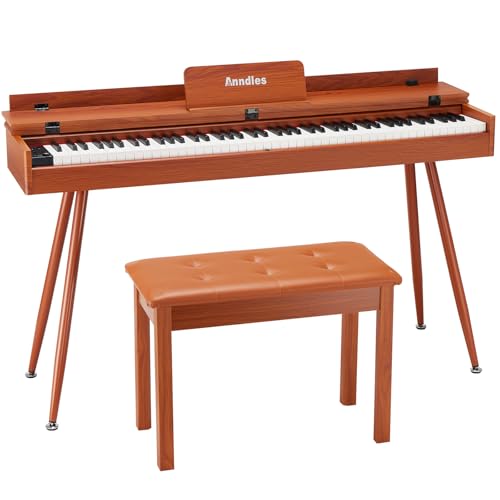
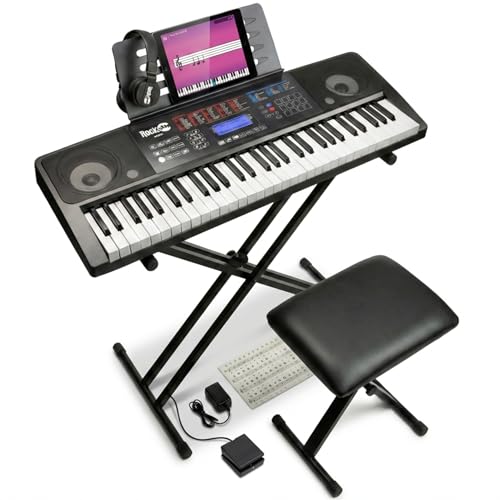
A serious study of digital pianos starts with evaluating how faithfully a board reproduces touch, timbre, and dynamic response under repeated practice. You should compare aftertouch, key weight, and graded hammer action, then assess consistency across velocity layers and polyphony in sustained passages.
Historical context helps: earlier keyboard design often sacrificed realism for portability; modern models converge physics-based sampling with advanced DSP to better mimic acoustic nuance.
Focus on digital sound fidelity, pedal respondivity, and interface data for disciplined practice. Precision matters for pedagogy and technique transfer, so verify calibration via standardized scales and reference recordings.
Your selection should balance tactile realism, reliability, and long-term firmware support.
- Define touch realism and hammer action credibility
- Compare digital sound across dynamic ranges
- Inspect keyboard design and control layout
- Check polyphony, pedals, and firmware updates
Transition Plan: Moving Between Digital Practice and Acoustic Growth
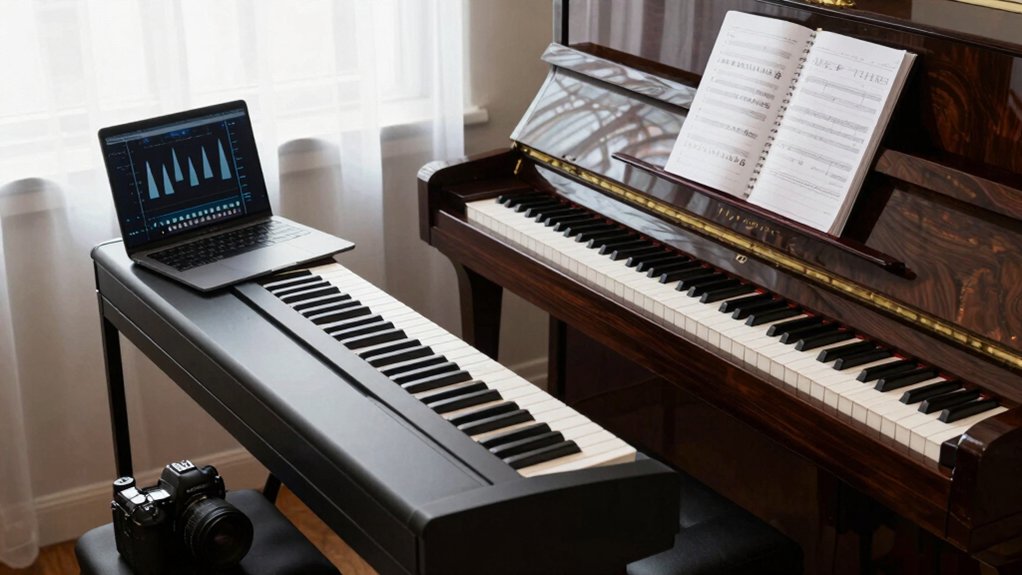
You’ll map shift techniques between pianists by aligning digital practice routines with acoustic performance goals, ensuring tempo, dynamics, and touch translate across contexts.
Historically, players moved from practice rooms to stages by calibrating response curves on both instruments, preserving articulation while adapting to varied timbres.
Practically, you’ll implement a progression plan that ties practice-to-performance milestones to measurable technical benchmarks.
Transition Techniques Between Pianists
Switching between digital practice and acoustic growth requires a deliberate plan that integrates sensorimot cues, timbral awareness, and physical habit changes. You’ll contrast touch models, pedal responses, and keyboard geometry to map skill transfer, ensuring consistency across instruments. This analysis traces historical methods of cross-training, from early tape-recorded experiments to modern hybrid studios, emphasizing measurable progress and repeatable routines.
Technical precision governs your approach: isolate variables, calibrate touch, and document results.
- Establish common pedal techniques benchmarks and compare acoustic feedback to digital latency.
- Build finger independence drills across registral ranges, then translate gains to acoustic touch.
- Synchronize timing cues with a metronome, recording deviations for artifact-free transfer.
- Phase practice between instruments to preserve tonal intention and dynamic contour.
Practice-To-Performance Progression
Practice-to-performance progression requires a deliberate, objective mapping from practice metrics to stage-ready execution. You track timing, dynamics, and articulation with reproducible benchmarks, then translate gains into repertoire-ready decisions.
Historically, pianists shifted from isolated drills to integrated practice regimes, aligning metronome discipline with expressive intent.
Digitally, you leverage granular data from digital pedagogy platforms to quantify consistency, accuracy, and touch response, applying findings to acoustic contexts.
Your evolution plan favors phased exposure: daily digital work, scheduled virtual lessons for corrective feedback, then controlled performance trials on an acoustic instrument.
You calibrate keyboard action, pedal nuancedness, and sight-reading fluency through iterative cycles, ensuring skill transfer.
This approach preserves historical rigor while exploiting technology, enabling transparent measurement, objective progression, and reliable confidence when moving between digital practice and acoustic growth.
Conclusion
You’re not choosing a replacement so much as a bridge. A digital piano can sharpen technique, refine rhythm, and guide nuance with precision, like a metronome that sings. Yet its fibers don’t mirror a concert grand’s heartbeat, its touch isn’t identical, and its tonal palette isn’t infinite. Use it for study, but let an acoustic instrument remain your ultimate reference. Build your practice around a deliberate progression plan, balancing constraints with aspiration, until mastery feels inevitable.