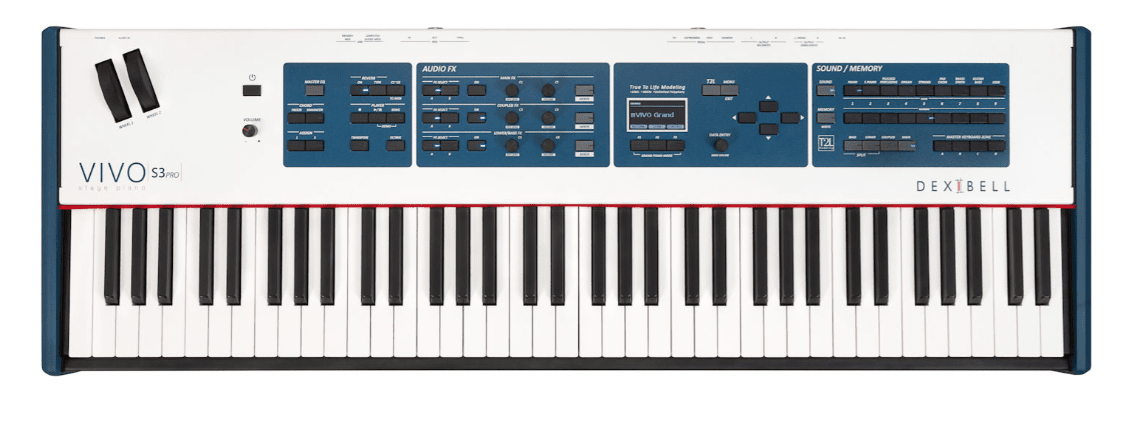
The Dexibell Vivo S3 Pro sits at the pinnacle of the Italian manufacturer’s stage piano lineup, offering professional musicians an instrument that refuses to compromise on sound quality, build construction, or performance features.
What distinguishes the Dexibell Vivo S3 Pro from its siblings and competitors alike is the combination of enhanced connectivity options, expanded sound memory, and refined ergonomics that address the real-world demands of touring keyboardists who need reliability and sonic excellence night after night in challenging stage environments.
What’s the Big Deal About the Dexibell Vivo S3 PRO?
You’re soundchecking before your late-night gig and need a piano that won’t choke when you go big, enter the VIVO S3 PRO. It’s packing T2L sampling-and-modelling magic with Unlimited Notes Polyphony, true 24 bit/48 kHz fidelity and seamless transition on patch changes, plus a 73-key hammer-action feel and 1.5 GB wave memory loaded with 113 pro sounds. Lightweight too – only 11,8 Kg – so you can actually move it. What’s not to like?
Let’s Talk Specs
The VIVO S3 PRO ships with 113 onboard sounds and unlimited notes polyphony, so you rarely run out of texture or power when you play. You get T2L tech with 24 bit / 48 kHz sampling and XXL waves for deep low-note sustain – it’s studio-grade yet stage-friendly, and yes, you can tote it around though weight: 11.8 Kg means you might want a hand. Want pro tonal purity? This is it, no fluff.
Keyboard that Feels Right
The TP-100 LR 73-key hammer action – triple contact gives you the real mechanical feel under your fingers. You’ll notice responsiveness fast – 7 touch curves plus fixed, and the action handles dynamics like a champ, so expressive pianists will grin. And those seamless patch changes? They keep the vibe intact when you switch sounds mid-song, so you don’t get awkward cut-offs – nice, right?
What’s Inside: The Tone Generator Magic
T2L combines sampling and modelling with 320 oscillators and internal 32-bit floating DSP, delivering rich, evolving tones and up to 15 seconds of recorded waves on low notes. You get true realism plus flexibility – user loads, smooth effect recalls and a tonal palette that feels alive. If you care about detail, this is where the S3 PRO earns its rep.
Wave Memory: 1.5 GB is fully user-changeable, so you can drop in DEXIBELL PLATINUM sounds or standard SoundFont packs and reshape the instrument to your taste. The DAC runs at 24 bit / 48 kHz with a S/N of 106 dB so what comes out is clean and dynamic, and the recorder captures at 48 kHz, 32-bit float for pro workflow. Just be mindful when lifting it – that 11.8 Kg is solid, so plan your gig setup.
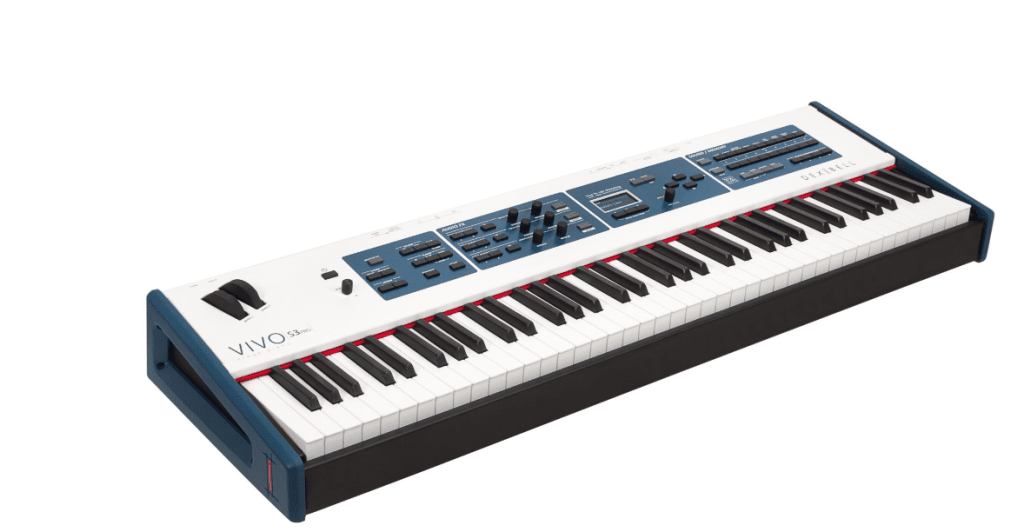
The Sound Experience: Is It Worth the Hype?
Compared to cheap sample libraries, the S3 Pro feels like a living instrument, not a recording you play back, and you’ll notice that right away – lush low end, shimmering highs, and real-space depth. You get DEXIBELL’s T2L tech, 24-bit/48kHz quality and unlimited polyphony, so chords never choke; is that overkill? Maybe, but it’s freeing. The T2L engine changes everything. Just watch your volume – those dynamics can blow your speakers or ears if you go nuts.
Quality Sounds That’ll Blow Your Mind
Compared to run-of-the-mill presets, the S3 Pro’s blend of sampling and modelling lands you sounds that breathe, and yes, some patches will make you grin like an idiot. You get over 113 pro sounds, 15 seconds of 3D wave detail and seamless transitions during patch changes, so your gigs stay smooth. Want realism? You’ll find it. Want weird textures? It’s got those too – plenty to keep you exploring for nights.
How to Make It Your Own with Custom Sounds
Compared to locked-down keyboards, the S3 Pro hands you the keys to the kingdom – you can swap waves, load SoundFonts and toss in DEXIBELL’s PLATINUM tones, so your rig sounds uniquely you. With 1.5 GB wave memory and USB loading you’re not stuck, but be careful when overwriting banks – back up first. You’ll tweak, layer and map until it’s your signature sound, and that’s the fun part.
Compared to fiddling with tiny menus, getting custom sounds onto the S3 Pro is pretty straightforward – grab PLATINUM packs or SoundFonts, copy them to a USB and use the USB TO DEVICE import, or hook up via USB TO HOST for studio transfers. Do a backup before you change the internal waves. Use the phone app and you’ll dial-in multis fast – the workflow’s made for you to experiment without breaking stuff.


Is It Easy to Use? My Experience with the Interface
It’s shockingly straightforward for a pro board. You get fast access to the VIVO S3 PRO’s depth without hunting through menus – the graphic OLED and clear encoders make edits feel tactile and immediate. The T2L engine and Unlimited Notes Polyphony mean you don’t have to compromise sound while you tweak, and the layout keeps performance controls under your hands so you stay in the moment.
Control at Your Fingertips
Every control feels like it was put there for live use. The knobs and wheels are solid, responses are snappy, and you can split, layer or dial in effects on the fly – perfect when you need to react mid-song. Major controls:
- Part Level / FX encoder x 6
- Data Entry / Song Level Encoder
- Master Volume Knob
- Wheel 1 & Wheel 2
- Button Assign (2)
Thou can make instant changes without breaking your flow, which is huge on stage.
Connect and Play: All About the Connectors
The S3 PRO is built to plug into anything and not fumble. You’ve got Balanced XLR OUTPUTs, stereo 1/4-inch outs, dual PHONES, full USB TO HOST (MIDI & DIGITAL AUDIO IN/OUT) and USB TO DEVICE for memory and MIDI – plus MIDI IN/OUT/THRU and Bluetooth streaming. That means you can jump between studio, stage and rehearsal without adapters or awkward workarounds.
In practice the connectors cover every scenario. On stage you use the XLRs for noise-free feeds, at home the PHONES and AUX IN keep things private, and in the studio the USB audio at 48 kHz gives clean, direct recording – note the locking DC-IN is great for steady power on gigs but keep an eye on headphone levels since high volume can harm hearing.
Final Thoughts: Should You Get One?
Compared to many stage pianos, the VIVO S3 PRO punches way above its weight – literally and sonically – and if you want studio-grade tones on a giggable frame, you should take it seriously. You get the True 2 Life (T2L) engine, Unlimited Polyphony and a 73-key TP-100 LR hammer action that feels pro. So yes, if you value tonal purity, flexible sound loading and portability at ~11,8 Kg, this is a top pick for your rig.
The Pros That Won Me Over
Compared to cheap sample players, this thing breathes – the hybrid sampling-plus-modelling gives you dynamic, living piano tones that actually respond, and there are over 113 sounds to play with. It’s got 24-bit/48 kHz waves, 1.5 GB Wave Memory and seamless patch changes so your swells don’t cut out mid-phrase. It simply sounds gorgeous.
You’ll love the expressive feel, the configurable zones and the pro I/O when you plug into a PA.
A Couple of Things to Keep in Mind
Compared to an 88-key stage piano, the S3 PRO’s 73 keys might bug purists and the menu-deep editing can be a chore – so yeah, there’s a bit of a steep learning curve if you want to unlock everything. You’ll also want to watch monitor volume – the outputs are potent, so ear safety matters when you crank it hard.
Compared to a simple plug-and-play board, you’ll spend time customizing sounds, loading SoundFonts and fiddling with the T2L parameters – but that’s where the magic lives. User-replaceable wave memory (1.5 GB) and USB audio/MIDI are amazing, but they demand patience, some tech savvy and a little setup time if you want the full payoff.
Explore the full range of Dexibell digital pianos and keyboards, known for their superb sound and authentic feel.
Click Here To See More Dexibell Keyboards
(Link opens in a new window)
FAQ
Q: What makes the True 2 Life (T2L) engine on the Dexibell Vivo S3 Pro so different – and will I actually notice it when I play?
A: Surprising as it sounds, the S3 Pro isn’t just replaying samples – it mashes sampling and modelling together so smoothly you’ll forget where the recorded sound ends and the modelling begins. It’s not a gimmick, it’s how they get that huge, alive piano sound that breathes and reacts when you dig in or sit back and float a chord. The unlimited polyphony with 320 oscillators plus XXL wave sizes (up to 15 seconds on low piano notes) means no notes get chopped off during big left-hand runs or layered pads – ever.
And since everything’s handled at 24 bit / 48 kHz with internal 32-bit floating DSP, the dynamics and tone stay pristine whether you’re in a quiet room or blasting through a PA. Seamless patch and effect switching is real – so you can change sounds mid-song without the annoying cutoffs lots of keyboards have. It feels like an acoustic instrument on stage.
Q: Can I add my own sounds or use SoundFonts with the Vivo S3 Pro, and how flexible is the memory?
A: The wild bit is you can completely reconfigure the S3 Pro’s wave bank – not just tweak presets but swap in new instruments, including standard SoundFont files. Yup, you can drop in PLATINUM sounds or grab freebies online and load them up. It ships with a 1.5 GB wave memory and 81 internal user slots, but you can load unlimited user sounds from USB – that means your custom library can grow as big as your USB drive.
Use the USB TO DEVICE port to load files, and the unit accepts .sf formats from the Dexibell library and standard SoundFonts, so compatibility is excellent. Want to keep versions for gigs and backups? Just carry a USB stick, plug in, and you’re set. You’ll make this thing sound exactly how you want.
Q: Is the Vivo S3 Pro truly gig-friendly and portable, what about I/O for stage and studio?
A: Most people assume pro-grade equals heavy – except the S3 Pro weighs only 11,8 Kg so you can actually carry it without calling in reinforcements. That lightness doesn’t mean it skimps on pro features though – far from it.
You get balanced XLR outputs, unbalanced jacks, two headphone outputs, MIDI IN/OUT/THRU, USB HOST and DEVICE (for MIDI and 48 kHz digital audio), Bluetooth streaming audio in, AUX in, multiple assignable foot pedals and an OLED graphic display. And the rig includes progressive damper simulation and seamless effect changes so patch swaps on stage sound natural. Packed for the road, built for the studio.