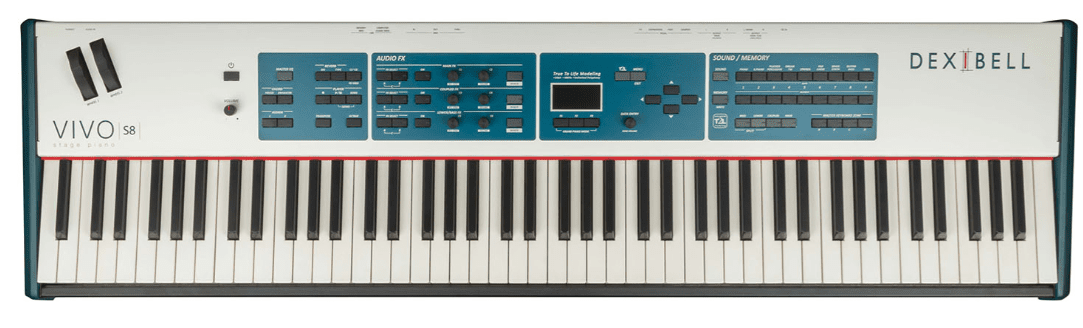
The Dexibell Vivo S8 enters the competitive stage piano arena with Italian design philosophy and proprietary sound technology that challenges established players from Japan and Scandinavia. What distinguishes the Dexibell Vivo S8 from its competitors is the company’s commitment to T2L (Tone 2 Life) modelling rather than traditional sampling, combined with a premium Fatar keybed and extensive connectivity options that target professional keyboardists who need authentic acoustic piano response alongside modern synthesis capabilities for contemporary gigging demands.
With the Vivo S8 you get Dexibell’s Advanced T2L engine, unlimited 24-bit/48 kHz polyphony and a 88-note hammer-action, ivory-feel keyboard so your stage sound is remarkably realistic, plus Bluetooth MIDI/audio and 3.2 GB wave memory. Expect professional routing, 180 sounds and organ presets – but note the steep learning curve and dense feature set that can overwhelm newcomers.
Explore the full range of Dexibell digital pianos and keyboards, known for their superb sound and authentic feel.
Click Here To See More Dexibell Keyboards
(Link opens in a new window)
Key Features
You get a stage-ready instrument with an 88-note Hammer Action, Advanced T2L tone engine, unlimited 24-bit/48 kHz polyphony, 3.2 GB wave memory and built-in Bluetooth MIDI/audio; the quad-core processor drives 180 sounds and 100+ organ presets for live use. Assume that the package includes the continuous pedal DX CP1 and pro-grade balanced outputs.
- 88-note Hammer Action – triple contact, ebony/ivory feel
- Advanced T2L – sampling + modeling engine
- 3.2 GB user-changeable wave memory
- 180 sounds + 100+ organ presets
- Unlimited polyphony with 320 oscillators
- 12 independent DSP effects, seamless recall
- Bluetooth for MIDI & audio streaming
- USB audio/MIDI and balanced XLR outputs
Advanced T2L Technology
You benefit from Advanced T2L, which blends high-resolution sampling and modeling so your touch yields nuanced dynamics and authentic acoustic behavior; internal 24-bit/48 kHz processing and a 24-bit DAC (S/N 106 dB) deliver clear, low-noise output and true-to-life timbre.
- XXL wave size – up to 15s on low piano notes
- Sampling + Modeling hybrid for expressive realism
- Unlimited polyphony with 320 oscillator voices
- Seamless effect changes across layers
Advanced T2L Breakdown
| Feature | Detail |
|---|---|
| Engine | Advanced T2L (sampling + modelling) |
| Wave Size | XXL, up to 15 seconds |
| Processing | 24-bit/48 kHz internal, 32-bit floating DSP |
| DAC | 24-bit/48 kHz, S/N 106 dB |
| Polyphony | Unlimited (320 Oscillator) |
Sound Selection and Memory
You can load and layer 180 factory sounds plus over 100 organ presets, store setups in 81 internal slots and expand via USB for unlimited user memory; the interface and Bluetooth make recall and editing fast on stage.
For deeper control you’ll use 3.2 GB of editable wave memory supporting DEXIBELL and SoundFont formats, play multitimbral setups (MAIN, LOWER, COUPLED, PEDAL) across 4 MIDI zones, record or play back .wav/.aiff/.mp3 files via USB, and stream backing tracks or MIDI wirelessly with the XMURE and VIVO Editor apps for flexible live performance workflows.
Keyboard Specifications
You get the VIVO S8’s Advanced T2L engine, an 88-note Hammer Action graded keyboard with triple contact keys and 3.2 GB wave memory, plus 180 sounds, over 100 organ presets, unlimited polyphony, Bluetooth MIDI/audio and a continuous damper pedal included; note the weight 17.9 Kg when planning transport.
Keyboard Action and Feel
You’ll feel the TP-40 graded response: hammer action with triple-contact sensing and an Ebony/Ivory finish that delivers an acoustic-like bite and release; the progressive damper pedal simulates sympathetic resonance so your dynamics and pedal work feel natural on stage.
Touch Sensitivity and Features
You can choose from 7 touch types + Fixed to tailor response to your technique, map pedals and wheels to controls, use two assignable foot switches and expression input, and connect wirelessly via Bluetooth MIDI for mobile control-ideal for adapting touch on the fly.
Beyond curves, you can split and layer across 4 Parts (MAIN, LOWER, COUPLED, PEDAL) + 4 MIDI zones, store personalized touch presets to internal memory or USB, and exploit 12 independent DSP effects with seamless changes to preserve feel while switching tones mid-performance.
Sound and Effects
You get Dexibell’s Advanced T2L engine, a quad‑core CPU with 3.2 GB wave memory, 180+ sounds and 100+ organ presets; audio runs at 24‑bit/48 kHz with unlimited polyphony. The S8 offers 12 independent DSPs and individually programmable outputs for flexible routing, but complex routings can overwhelm live setups if you don’t plan your mixes.
Sound Engine and Polyphony
The Advanced T2L sampling and modelling combines XXL waves (up to 15s on low notes) with 32‑bit floating internal processing so your dynamics stay detailed; the S8’s unlimited polyphony and 320 oscillators prevent note‑stealing in dense patches, and you can load SoundFonts to tailor the piano to your taste.
DSP Effects and Sound Processing
The S8 provides 12 independent DSP engines with multiple effect types, organ‑centric processors (rotary, overdrive, vibrato/chorus), a 3‑band master EQ and seamless changes to avoid audible glitches. If you stack many DSPs across parts without gain staging, you risk cluttered mixes or unintended clipping, so plan your outputs and levels.
You can route each part to its own output, program effects per MAIN/COUPLED/LOWER/PEDAL and control parameters with six FX encoders or foot controllers; the quad‑core CPU and high S/N DAC (106 dB) handle heavy processing, but for live setlists you must map presets and outputs in advance to avoid onstage surprises.
Connectivity and Control
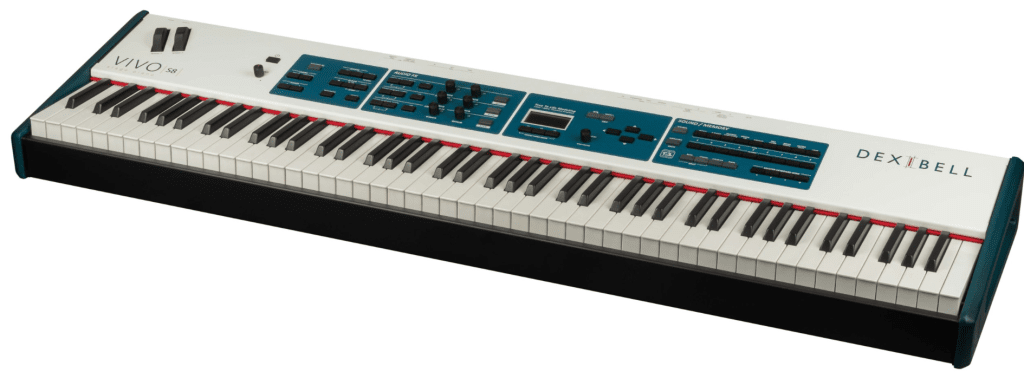
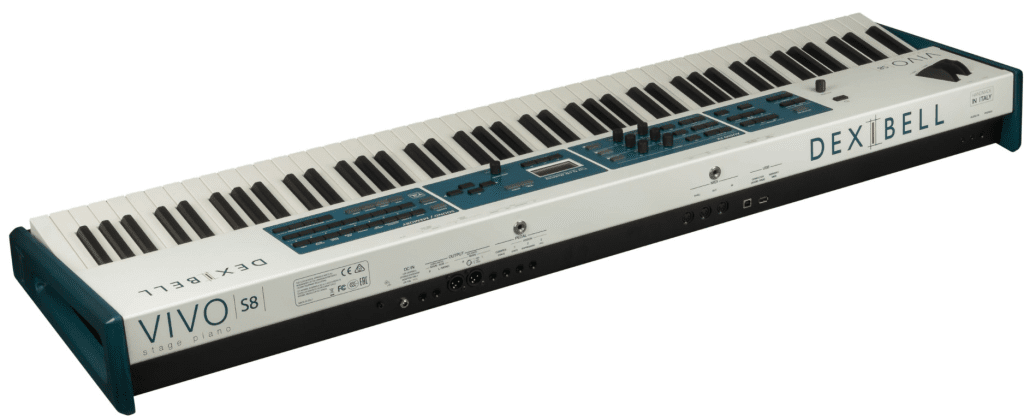
Your Vivo S8 puts extensive routing and control at your fingertips: Bluetooth MIDI & audio, USB Host/Device with digital audio, balanced XLR main outputs, MIDI IN/OUT/THRU and four assignable foot jacks, all selectable for separate parts. You can split or route layers to different outputs and control effects in real time, but be aware that driving outputs at extreme levels can damage speakers.
MIDI and Bluetooth Functions
You can use Bluetooth MIDI (BLE 4.2) and audio streaming to wirelessly control programs with the VIVO Editor and play along via XMURE; USB TO HOST also offers low-latency MIDI and digital audio transfer for DAWs. Wireless convenience is powerful, yet wireless connections may introduce latency compared with direct USB/MIDI wiring.
Output and Input Options
Your S8 offers MAIN Balanced XLR outputs, MAIN/SUB 1/4″ jacks, AUX IN stereo mini-jack, MIDI IN/OUT/THRU, USB TO HOST (MIDI & digital audio) and USB TO DEVICE, plus four foot/expressions jacks. These give you stage-ready connectivity and flexible monitoring, while unbalanced lines can be more prone to noise or ground-loop issues in complex rigs.
The S8 supports independently programmable outputs so you can route MAIN, LOWER, COUPLED and PEDAL parts to separate outs and apply different DSP chains; you can also record or playback .wav files via USB (48 kHz, 32-bit float). Use proper cables and level matching to avoid clipping or equipment damage when assigning parts to multiple outputs.
Design and Build
You’ll find the VIVO S8 built for stage use, with an 88-note Hammer Action graded keyboard (triple contact, ebony/ivory feel), a rigid chassis and high-contrast OLED for fast navigation. The control layout, multiple connectors and included damper pedal make it practical for live work; the Advanced T2L engine and quad-core processor are integrated into a sleek case, though its 17.9 kg weight means you should handle transport carefully.
Dimensions and Weight
You’ll get a compact stage profile at 1270 mm (50″) wide, 354 mm (13.9″) deep and 128 mm (5.0″) high, which fits standard stands and transport cases. The unit’s 17.9 kg (39.4 lb) is relatively light for an 88-key hammer-action instrument but still demands safe lifting practices when you move your rig.
Power Consumption and Efficiency
For live and studio use you’ll appreciate the S8’s efficiency: standby <0.2 W, maximum 18 W, and certification to ErP LEVEL VI, meaning low idle draw and modest power under load. Bluetooth and USB audio/MIDI keep flexibility without large power penalties, so your power strips and battery-based setups stay conservative.
When you push its Advanced T2L engine and unlimited polyphony, the quad-core processor and DSP work hard but remain within the 18 W max envelope; typical gig use with onboard routing will rarely hit peak. The <0.2 W standby lowers venue energy use and ensures compliance with strict efficiency standards, while USB audio and Bluetooth streaming add only minimal extra draw.
To wrap up
Ultimately, the Dexibell VIVO S8 puts professional stage performance in your hands: Advanced T2L sampling and modeling, 88-note triple-contact hammer action, quad-core engine with 3.2 GB wave memory, 180 sounds, unlimited 24-bit/48 kHz polyphony, onboard DSP and Bluetooth MIDI/audio for seamless integration with the VIVO Editor and XMURE apps-plus the included DX CP1 continuous pedal-so you get the sound and control to meet demanding live and studio needs.
FAQ
Q: What is Advanced T2L technology on the Dexibell VIVO S8 and how does it affect tone and realism?
A: Advanced T2L (an evolution of Dexibell’s True to Life approach) combines large-scale sampling with physical modeling to recreate acoustic and electric piano behaviors with high detail. The S8 uses XXL wave files (up to 15 seconds on low notes) stored in a 3.2 GB user-changeable wave memory and processes audio at 24-bit/48 kHz with 32-bit floating DSP; DAC output is 24-bit/48 kHz with 106 dB S/N.
The engine provides unlimited polyphony (implemented across 320 oscillators) so complex layering, heavy pedal use and multitimbral splits stay free of note-stealing. Modeling adds sympathetic resonance, dynamic string/hammer interactions and realistic decay behavior, while sampling preserves the nuance and timbral body of the source instruments-resulting in highly expressive pianos and detailed electric/organic sounds suitable for studio and stage.
Q: Is the VIVO S8 ready for professional live use and how flexible is its signal routing and control?
A: Yes. The S8 is built for stage workflow: an 88-note TP-40 graded hammer-action keyboard with triple-contact (ebony/ivory feel) provides responsive playability; front-panel controls include 6 FX encoders, data/song encoder, master volume, two wheels and two assignable buttons for quick parameter access. Audio-wise, balanced MAIN outputs on XLR plus unbalanced SUB outputs (1/4″) and independently programmable outputs let you route parts (Main, Lower, Coupled, Pedal) separately to FOH/monitor, in-ear or front-of-house submixes.
Twelve independent DSP effect slots (with 17 effect types and organ-specific Rotary/Overdrive/Vibrato/Chorus) and a 3-band master EQ use “seamless changes” so patches switch without audible artifacts. Foot connectivity includes a progressive damper pedal with sympathetic resonance simulation (DX CP1 included), three additional assignable foot jacks for expression/function/FX, and USB/Bluetooth audio and MIDI for modern rigs. At 17.9 kg and 1270 × 354 × 128 mm it’s stage-portable while delivering professional connectivity and low standby power consumption.
Q: What options exist for expanding sounds, editing, and integrating apps or external devices?
A: The S8 supports extensive expansion and remote control. Wave memory (3.2 GB) is fully user-changeable with Dexibell and SoundFont formats via USB TO DEVICE; the instrument can load unlimited user presets from USB. Over 180 onboard sounds plus 100+ organ presets (TW1/TW2/FARF/VX/PIPE and two User banks downloadable from the website) are available, with 9 virtual draw faders for tone-wheel control.
Connectivity includes USB TO HOST (MIDI & digital audio in/out), Bluetooth BLE 4.2 for MIDI and audio streaming, MIDI IN/OUT/THRU, AUX IN and multitrack playback via the XMURE app (accompaniment styles). The free VIVO Editor iOS app lets you wirelessly edit programs/parameters; recording is supported to USB as .wav (48 kHz, 32-bit floating), and the onboard player handles .wav, .aiff and .mp3. Global features like master tuning, 9 temperaments (3 user), and downloadable content make the S8 highly configurable for studio, rehearsal and live setups.