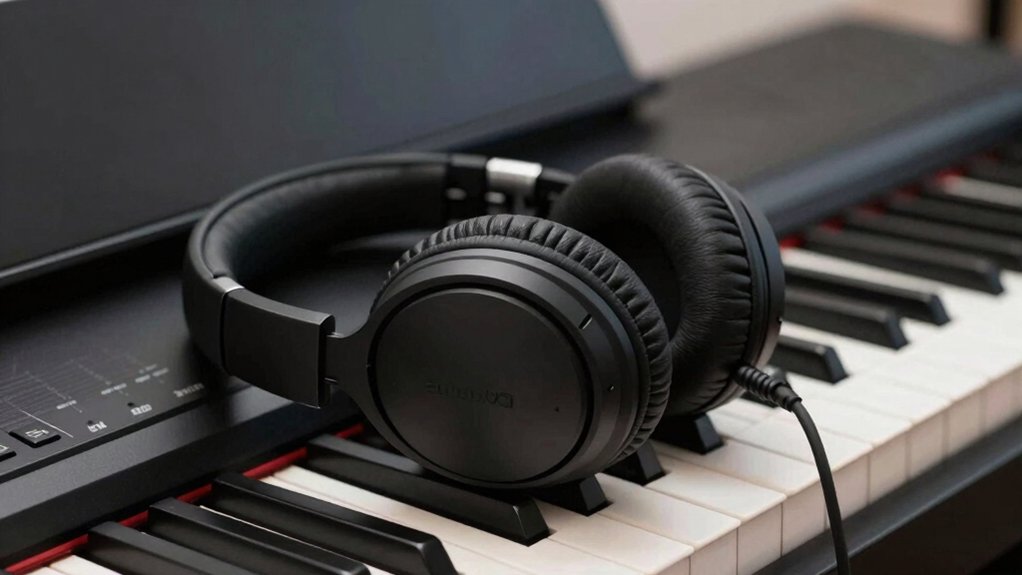
Choosing the right headphones for digital pianos dramatically affects your practice experience, sound quality perception, and long-term comfort during extended playing sessions—yet many players settle for whatever came bundled with their instrument or grab generic headphones that distort piano tones and cause ear fatigue. The specific requirements for piano practice differ significantly from casual music listening or studio production work, demanding accurate frequency response for bass notes, comfortable designs that don’t create pressure during hour-long sessions, and impedance matching that works efficiently with digital piano headphone outputs.
This comprehensive guide reveals which headphone characteristics matter most for digital piano practice, which models deliver superior comfort and sound quality across various price points, and exactly what specifications to prioritize when choosing headphones that enhance rather than compromise your playing experience.
You press the piano keys and hear a hollow echo that reveals more about your gear than your fingers. Not all headphones can translate digital piano detail—impedance, driver placement, and isolation matter as much as volume. If you ignore these, you’ll chase latency, muddiness, or a disconnected soundstage. You deserve precision, comfort, and compatibility shaped for piano nuance. So you’ll want to inspect how a pair matches your piano’s outputs and your practice needs before you commit.
How to Choose Headphones for a Digital Piano: A Practical Decision Framework
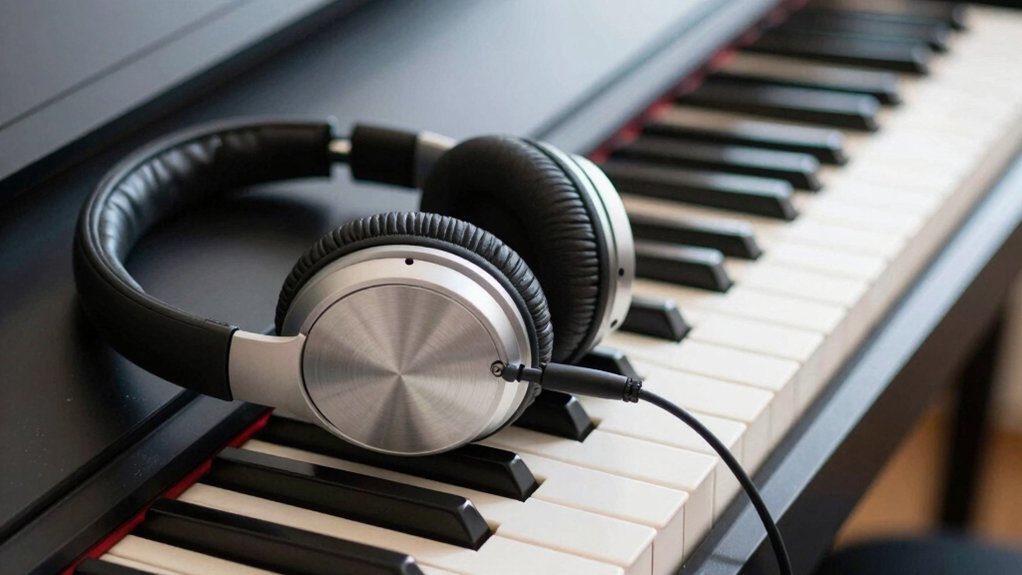
Choosing headphones for a digital piano isn’t about chasing the fanciest spec sheet; it’s about matching sound quality, latency, comfort, and practicality to how you actually play. You’ll assess core factors methodically: sound stage, frequency response, and your room’s noise environment.
Prioritize low latency to keep timing precise with keys and pedals, avoiding perceptible delay that sabotages practice. Noise isolation matters when you’re late-night practicing or working around others, but beware over-attenuation that muffles dynamic cues. Wireless connectivity can simplify movement yet often adds latency or compression; verify codecs and stability before committing.
Comfort matters for long sessions, so test clamp pressure and ear pad materials. Finally, compatibility with your device ecosystem and necessary adapters seals the decision, ensuring you won’t swap midway through a learning sprint.
Matching Impedance and Amplification for Your Piano Setup
Impedance and amplification aren’t afterthoughts—they’re gatekeepers for clean signal transfer and responsive play. If you mismatch, you pay in hiss, latency, or dull dynamics. You’ll want an impedance matching approach: confirm your digital piano’s output impedance and ensure your headphones or monitor amp presents a compatible load.
Without this alignment, louder isn’t better—it’s brittle, uneven, or clipped. Consider amplification compatibility as you select gear: some headphones demand more current, others less; some portable amps regulate impedance, preserving transients, while others color the frequency response.
Your goal isn’t maximum volume but consistent headroom and tonal fidelity across playing styles. In practice, document the piano’s outputs, test with a known-good reference load, and avoid ad-hoc adapters that bypass proper impedance matching.
What Soundstage and Detail Mean for Expressive Piano Playing
Soundstage affects how you place piano voices in space, shaping how you perceive depth, width, and tonal separation during expressive play.
Microdetail accuracy matters because tiny eclipsed cues—hammer dynamics, pedal nuance, and timbre shifts—inform phrasing and articulation with realism.
Together, these factors test whether your headphones reveal expressive depth or blur musical intention into flatness.


Soundstage Dimensions
Soundstage dimensions define how wide, tall, and deep your piano sound feels, and they directly influence expressive nuance. When you evaluate headphones for digital pianos, you’re not just chasing loudness; you’re balancing spatial imaging with tonal fidelity to preserve nuance.
A generous width can articulate wide arpeggios, while depth helps convey stage positioning and dynamic layering. Too narrow a stage collapses the melody line, reducing the sense of musical conversation you expect from a real instrument. The challenge is preserving a coherent, immersive experience without creating artificial separation that sounds fake.
Critical listening reveals how the headset’s dispersion and driver speed affect transient accuracy, which in turn shapes phrasing and articulation. Prioritize headphones that maintain consistent imaging across registers, enabling precise expressive control rather than mere loudness.
Microdetail Accuracy
Microdetail accuracy matters because it’s the hinge between micro-expressions and overall musical honesty. You judge nuance by how precisely a headphone reveals rapid instrument textures, not just broad tonal balance.
In digital-piano playing, tiny tremolos, hammer noise, and subtle pedal reactions carry expressive meaning; if your cans smooth over those cues, you drift toward abstraction. The best options deliver stable phase timing and minimal smearing, so you hear the pianist’s intention rather than a generic shimmer.
Yet microdetail isn’t free; it interacts with headphone ergonomics, where comfort and seal shape listening confidence during long sessions. A refined pair sustains detail without fatigue, avoiding forced brightness that misrepresents dynamics.
Choose with critical tests that reflect real practice material, not showroom hype.
Expressive Depth Insight
Expressive depth hinges on how well headphones convey the perceived space and tonal nuance surrounding the piano. You evaluate soundstage not as a buzz of bandwidth, but as a believable room, where instrument placement and reverberation shape musical expression.
If imaging is shallow, your touch sounds isolated; if it’s precise, the listening space mirrors the hall or studio you expect, enabling you to react to echoes, dampers, and pedalwork.
Detail must extend beyond texture to dynamic texture: legato line, staccato snap, and the pianist’s intention all ride on microsecond timing. The best headphones preserve emotional nuance without flattening it into a sterile snapshot.
In short, expressive depth is earned when headphones translate intent, not just frequency.
Closed-Back vs Open-Back: Which Suits Piano Practice and Why
Closed-back headphones generally deliver better isolation and tighter bass, which can help you focus on piano practice without external distractions, but they can also color the sound in a way that makes transient details harder to hear.
Open-back models, by contrast, reveal more natural room ambience and a broader soundstage, which improves ear-training for tonal balance but offers less ambient noise rejection.
For practice, your priority is audio isolation to maintain consistent dynamics; yet you must avoid masking subtle pedal and hammer nuances.
Consider the trade-off: closed-back for controlled sessions, open-back for critical listening and touchscreen feedback.
In short, neither design is universally better—choose based on whether you value ambient noise awareness or isolation, and test with your piano’s timbre and your technique.
Headphones by Use Case: Practice, Recording, and Live Play
For practice, you’ll weigh the need for quiet zones against your own timing and focus, since isolation affects your ability to build consistent touch without leaks.
For recording, you’ll need accurate monitoring that reveals mic placement, room ambience, and latency so you don’t chase a phantom tempo.
For live play, you’ll balance latency, feedback risk, and stage monitoring to keep you synchronized with others and the audience.


Practice Quiet Zones
When practicing on a digital piano, headphones create a protected quiet zone that keeps the sound contained and your neighbors unbothered, but not all models deliver the same reality. You’ll notice that many sets mask leakage poorly, inviting neighbor complaints or situational hiss.
Critical factors matter: headphone ergonomics influence comfort during long sessions, while clamp pressure can distort ionized audio isolation if misadjusted. Wireless connectivity sounds convenient, yet it introduces latency and occasional dropouts that disrupt timing precision you rely on for practice zones.
Some models overcompensate with aggressive noise cancellation, which can strip natural attack and harm your sense of touch. Seek a balanced profile: reliable cable options, stable wireless pairing, and a design that stays comfortable without tunneling your ears.
Precision in selection preserves quiet zones and musical clarity.
Recording Monitoring Needs
Recording monitoring demands demand headphones that deliver faithful reproduction without coloring the mix, since any extraneous bass boom, shrill peak, or latency can derail your take. You evaluate monitors by how faithfully they translate piano timbre, room ambience, and subtle dynamics during recording sessions.
A headphone with exaggerated low end or harsh highs can bias performances and complicate edits, especially when tracking dense musical genre arrangements. Prioritize flat or near-neutral response, low distortion, and accurate transient behavior to preserve attack and decay.
Comfort matters for long sessions, but it shouldn’t compromise monitoring accuracy. Consider isolation to prevent bleed into the mic, yet avoid excessive claustrophobia. Know your audience preference for end results, and test with reference tracks to ensure the headphones align with your recording goals.
Live-Play Latency Factors
Latency is the bottleneck you’ll feel most acutely in live-play scenarios, where any delay between your keystroke and the sound reaching your ears can throw off timing, phrasing, and feel. In practice, you need headphones that minimize latency without sacrificing clarity.
Wireless options often introduce Bluetooth connectivity quirks that add perceptible lag, compounding rhythm mistakes in fast passages. Even when measured latency seems low, inconsistency across devices or apps creates unpredictable delays you can’t ride out.
For live performance, wired monitors still win for reliability, but if you must go wireless, choose low-latency codecs and hardware with stable sync. Noise isolation helps you hear your timing distinctly, yet it can isolate you from stage cues, so balance is critical.
Prioritize predictable, transparent sound to preserve your timing integrity.
Balancing Treble, Mids, and Bass for Authentic Keyboard Timbre
Achieving authentic keyboard timbre hinges on getting treble, mids, and bass in the right proportion, since each band shapes attack, detail, and body differently. You’ll notice that slight treble boosts can sharpen articulation but risk brightness rivalry with cymbal clang; too much bass muds the percussion and buries decay.
The goal is harmonic balance: treble preserves crisp note boundaries, mids convey body and piano-like texture, and bass anchors weight without overpowering upper harmonics. When you audition headphones, prioritize a tuning that preserves natural envelope and sustain rather than marketing gloss.
Beware depowered mids that flatten tonal complexity, which dulls timbre enhancement efforts. Prefer monitors with flat or gently lifted mids and controlled highs, so timbre remains faithful under dynamic playing. Precision in EQ, not hype, defines authentic keyboard timbre.
Comfort and Durability for Long Piano Sessions
Comfort and durability matter as much as sound when you’re spending long sessions with a digital piano. You’ll notice that lightweight builds often trade comfort for portability, but that’s a false economy when sessions stretch past an hour.
Look for firms with solid hinge hardware, reinforced headbands, and reliable cable attachments, since looseness and wear multiply with use. Cushion padding should feel responsive without flattening; excessive clamping pressure can cause fatigue and skew your posture.
Ear cup materials matter too: breathable cushions reduce heat buildup, while synthetic leathers can irritate over time. Prioritize models designed for extended wear, with replaceable pads and documented stress testing.
In the end, true durability equals consistent fit and predictable acoustics, cornerstones for accurate practice and long-term health.
Driver Size, Cables, and Compatibility You Should Check
When evaluating headphones for digital pianos, driver size, cable design, and overall compatibility matter as much as any other spec. You should scrutinize driver size because it influences perceived immediacy and transient detail; a bigger driver isn’t always better if it muddies nuance or leaks sound.
Cable length matters too, especially if you perform near your instrument—too short can constrain movement, too long invites tangles and signal loss. Examine connector types and impedance, ensuring your headphone amp or MIDI/audio interface matches, to avoid muffled highs or recessed mids.
Be wary of built-in DACs claiming universal compatibility; they often color timbre. Prioritize a balanced, low-impedance load and a predictable frequency response, so you won’t misread your piano’s articulation or dynamics.
Practical Headphone Testing With Your Digital Piano: Step-By-Step
To properly test headphones with your digital piano, start by establishing a controlled listening setup: route the piano’s audio through your usual amplifier or audio interface, then connect the headphones and note the immediate differences in dynamics, timbre, and transient detail.
You’ll compare on- and off-axis responses, listening for consistency across registers and articulation accuracy. Focus on sound isolation, ensuring external cues don’t color judgments, and assess frequency response for flatness versus colored profiles that might mislead you about real piano timbre.
The goal is to map how your headphones reveal or hide subtle piano cues, not to praise or condemn gear.
- Assess isolation against room noise and keyboard chatter in real-time
- Map low, mid, and treble balance across octaves
- Compare touch-responding dynamics with pedal nuances
- Note hiss, impedance, and driver consistency
- Document repeatable listening positions and findings
Troubleshooting Common Piano-Headphone Pairing Issues
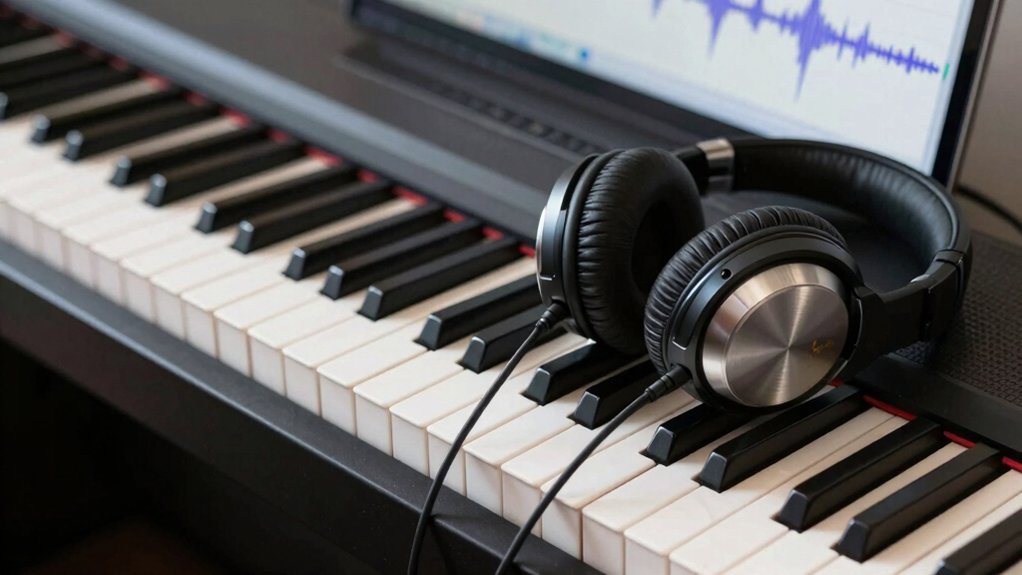
Latency can throw off your rhythm, so you should test for sync issues and identify whether the lag is consistent across sources or just with certain inputs.
Check impedance matching and make certain your headphones and amp stage are compatible, since a mismatch can distort tone or reduce volume more than you expect.
Finally, consider soundstage and comfort as practical limits to long sessions, so you can choose headphones that stay accurate without fatigue.
Latency And Sync Issues
Even when you’ve got the right headphones, latency and sync drift can undermine a piano’s feel: you hear the sound after you press a key, and the timing hops ahead or lags behind. You must diagnose whether the issue stems from wireless connectivity, buffering, or device processing.
In practice, pinpointing the bottleneck lets you avoid chasing phantom delays. Poor noise isolation lets the keyboard’s own noise skew your perception of timing, while subtle jitters from Bluetooth or USB-C adapters compound the problem.
Treat latency as a design flaw, not a user error, and demand transparent specs before you buy.
- Wireless connectivity impact on latency
- Buffering and sample rate effects
- USB/DAC processing delays
- Noise isolation’s perceptual role
- Real-world timing versus spec sheets
Impedance Matching Tips
Are you getting clean, controlled sound from your digital piano’s headphones by matching impedance correctly? Impedance mismatches aren’t just a headline issue; they shift your frequency response and dynamic range, making harsh highs or muddy lows fluctuate with playback volume.
Start with the basics: check your headphones’ impedance rating and ensure your device’s output is designed to drive that load. If you’re using higher-impedance cans, you may need a headphone amp or an impedance-matching adapter to prevent loss of detail. Conversely, very low-impedance buds can overdraw the amp, causing distortion.
Favor a modest, near‑unity match when possible, and test across genres. Also consider wireless connectivity and latency implications, since some wireless paths introduce extra impedance elements and noise cancellation can complicate the signal chain.
Soundstage And Comfort Factors
If you’ve nailed impedance considerations, you’re not done—soundstage and comfort can still sabotage your piano-playing experience. Even great drivers won’t help if the stage feels flat or oddly centralized, muting your spatial imaging and turning listening fatigue into a barrier to practice.
- Identify how driver placement relative to your ears alters perceived width and depth.
- Prefer headphones with a natural, balanced soundstage over exaggerated “surround” effects.
- Consider clamp force and weight; pressure shifts affect endurance and focus.
- Test long sessions to gauge listening fatigue and heat buildup.
- Match padding and seal to minimize ear canal strain and leaks.
Did you notice how comfort shapes clarity? A crowded, tiring soundstage undermines technique and musicality more than any trebly brightness or bass boost.
Conclusion
Choosing headphones for a digital piano isn’t a throwaway decision—you’re shaping your musical reality. You must assess impedance, soundstage, and isolation, then test with your setup to avoid mismatches that mute expressiveness. Don’t assume “any pair” works; that assumption stalls progress. Think of pairing like tuning a piano with the right mouthpiece: wrong fit, off-key results. With careful selection, you’ll hear truer tones and tighter timing—your practice room becomes a precise, revealing instrument.