What’s the Buzz About the KORG i3 Arranger?
Because it lets you turn a half-baked tune into a full-on song in minutes, the Korg i3 matters if you want instant inspiration and less fiddling, and it’s shockingly simple to use. Want real accompaniment, great sounds and on-the-go battery power? You get 270 styles, 800+ sounds, easy set lists and quick effects, so your ideas actually sound like songs – not demos. It’s portable, playful and smart; you’ll grab it and just play.
Let’s Dive In: What’s the KORG i3 All About?
The KORG i3 turns your ideas into full songs in seconds. You get instant accompaniment, 800+ sounds, 270 styles and easy chord suggestions so your demos sound huge right away. Want portability? It’ll run on batteries, weighs under 9 lbs and fits studio or stage. It’s simple, but deep when you need it, and you can record or export tracks fast – so you’re in the zone, not buried in menus. Instant, intuitive, inspiring.
Why This Thing Packs a Punch in Sound
Ever wondered how a compact keyboard can fill a room like a full rig? The Korg i3 packs a high-fidelity PCM engine, about 790 sounds, 200 Sound Sets and two stereo effects processors into a tiny, lightweight body, letting you layer up to four parts and shape them with onboard EQ and effects. You get lush polyphony, instant Grand Piano recall and motion-rich tones that sit in a mix, so when you play your ideas already sound like a finished track – no extra gear, just you and that big sound.
So Many Awesome Sounds to Explore
Want a sonic buffet you can actually navigate? You’ve got roughly 790 sounds, 59 drum kits and a full GM2 set, plus 200 curated Sound Sets that let you stack three upper layers and a split lower for instant depth. And those color-changing buttons and presets make hunting for tones stupidly fast, so you spend less time digging and more time playing – it’s playful, immediate and surprisingly deep.


Full-On Music Styles – What’s Included?
Curious how the i3 turns your chords into full productions? It ships with 270 Styles, each offering four variations, intros, fills, breaks and two endings, and up to eight accompaniment parts that follow your chord changes so your performance sounds arranged and alive. So you hit a chord and the whole band reacts – bass, drums, percussion, pads – instant song structure without hours of setup.
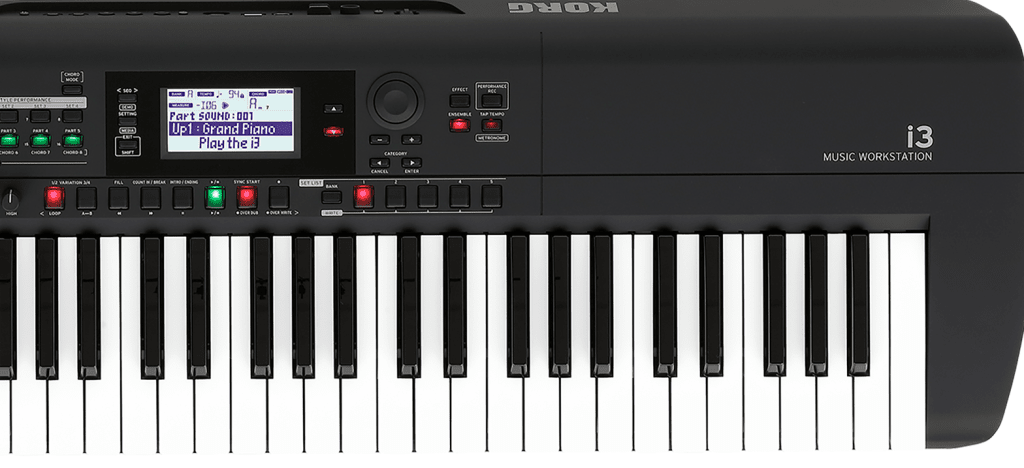
How deep do those Styles go? They’re basically mini-arrangement engines: each Style bundles drum, bass, percussion and backing parts into Performance Sets you can mix, mute or replace on the fly using the illuminated controls, and active parts follow whatever chords you play so everything stays musical.
You can mute or swap parts in real time and the band still follows your chords. You can save your combos into Set Lists across banks for instant recall, edit parts or swap sounds to craft a custom backing, then record it with the onboard sequencer when you want to lock it in – great for gigging, composing or sketching ideas fast.
What’s in the Box?
The first time you pry open the Korg i3 box at home or backstage you get that little rush – it’s neat and uncomplicated: the keyboard itself, the AC adapter, and a slim packet of manuals and warranty papers. You can power it up right away, or grab batteries for portable play. No extra clutter, no mystery cables. Want to start jamming fast? This unboxing gets you there.
The Looks and Build Quality
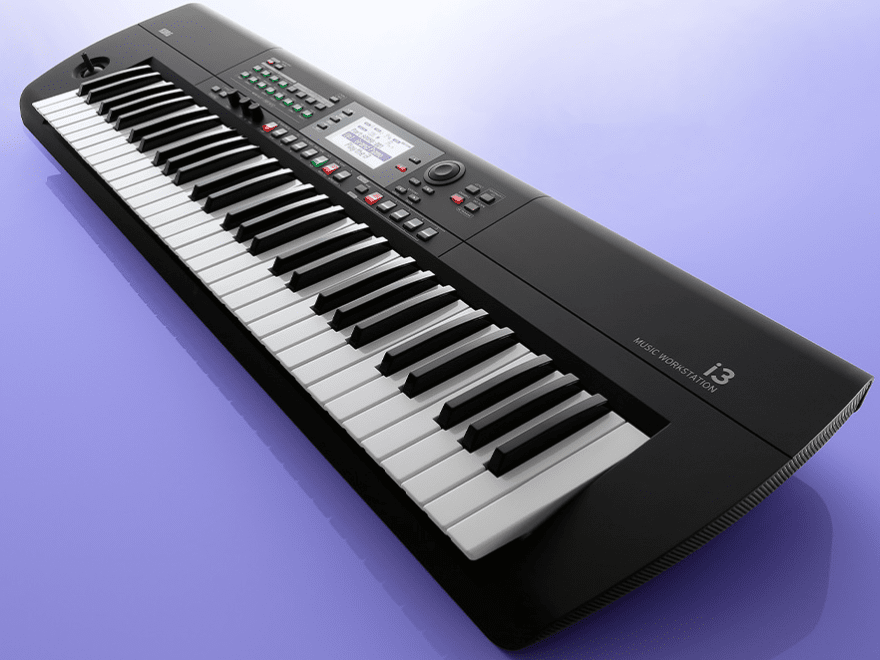
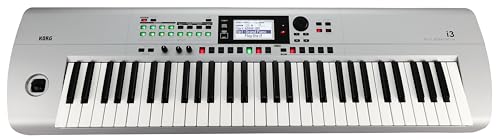
When you set the Korg i3 on your desk you’ll notice it looks sharper than you expected, like a sleek bit of kit that belongs in a studio or a coffee-shop set. The rubberized black or clean silver options, perforated end panels and color-changing buttons give it personality. It’s slim, under 9 pounds, and the 61 full-size keys feel solid enough – not flimsy – the backlit LCD makes navigation easy even in dim light.
What Comes with Your Purchase
Unboxing at home you pull out the keyboard and the AC adapter first – that’s the main included item, plus the paperwork. Batteries for portable use aren’t included, and pedals or foot controllers are sold separately. So if you plan to gig battery-powered or want sustain and expression, you’ll want to add those extras to your buy list.
At a late-night rehearsal you’ll find the Korg i3 runs on six AA batteries for about 8 hours, so buy rechargeables if you’re on the move. The box doesn’t include a sustain pedal, USB host cable, or MIDI/interface cables, and accessories like PS-1, PS-3, DS-1H or EXP-2 are optional. In short: the core package gives you the instrument and power adapter – the rest you pick to suit your setup.
How Portable Is It, Really?
Compared to lugging a full-sized arranger, the Korg i3 feels like a breath of fresh air, light and compact. You can sling it under your arm and hit the road, or drop it on a cafe table and start playing – it even runs on AA batteries for about 8 hours, so power outlets aren’t always a worry. And because it skips built-in speakers it’s slimmer and easier to pack.
Love the Lightweight Feel
Compared to heavy stage pianos you’ll actually enjoy hauling the i3 around, it’s under 9 pounds after all. You feel it the second you pick it up – ergonomic edges, slim profile, easy grip. So if you gig, teach, or just like moving your setup around your place, you’ll appreciate that lightweight freedom; no sweat, no backache, just play.
Why It’s Perfect for on-the-Go Jamming
Compared to lugging a laptop and a bunch of gear, the i3 gets you into a groove in seconds, with 270 styles and instant accompaniment under your fingers. Press a style, strum a chord, and the backing follows you – it’s that simple.
You can start a full band-sounding track in seconds. And with battery power and quick Set List recall, you’re gig-ready anywhere.
Compared with juggling mixers and plugins, the Korg i3 keeps things simple – you get 61 velocity keys, on-board effects, an X/Y joystick for expression and immediate Grand Piano recall so your tone’s ready without fuss. Hook up headphones or outputs, save Set Lists to jump between songs, and use USB for quick transfers. Batteries give you about 8 hours, so if you want a quick street set or studio sketch, it’ll hang with you.
The Sounds You Get – Are They Any Good?
The Korg i3 sounds way better than you’d expect at this price. You get a polished, lively palette that jumps out – piano is warm, strings have motion, synths are usable live. It’s not flawless studio-grade but it’s inspiring and immediate, and you can shape tones with on-board EQ and effects.
The Variety of Instrument Sounds
There’s a huge spread of instruments so you won’t feel boxed in. Over 800 sounds, 200 sound sets and layered patches mean you can stack textures – pads, brass, acoustic, electronic, whatever fits your song. You can play realistic pianos and also throw in quirky synths, and four-sound layering plus splits give real performance depth.
Authenticity of Styles and Rhythms
The Styles actually feel playable and alive, not canned backing tracks. You get 270 Styles with variations, fills, intros and endings so arrangements respond to your playing; the backing follows your chords so it sounds like a band reacting to you. Want a samba or a ballad? You’ll get convincing grooves that mostly sit in the pocket.
Drums and percussion are where the Korg i3 earns its stripes. With 59 drum kits and up to eight backing parts, rhythms have body and movement and the stereo effects add space. Sometimes articulations feel a bit generic if you nitpick, but you can swap parts, tweak EQ and effects, and the result usually sits nicely in a mix. Not perfect, but is it useful? Absolutely.
Got Ideas? Here’s How to Capture ‘Em
You’re sitting in a cafe when a melody pops into your head and you want to grab it before it vanishes; the Korg i3 lets you do that – one-touch recording gets it down instantly. With battery power and easy Style/Sound recall you can sketch full arrangements anywhere, swap sounds fast, and tag a take to tidy later. Why wait? Hit record, play, and carry on – your idea’s safe.
Recording Made Super Easy
You’re juggling a chord idea and a beat – one tap on the i3’s record and you catch both in real time, no fuss. The onboard sequencer handles 16 tracks so you can overdub, edit and replace as you refine, and when you’re happy you export WAV or MIDI straight from the unit. It’s fast, intuitive and actually fun to use… like playing, but with a safety net.
Playing Back Your Masterpieces – No Trouble!
You’re ready to listen back – plug in headphones or route to PA, and the i3 plays WAV or MP3 without drama. It even lets you play along while the song rolls, syncs with Style parts, and saves takes to USB so sharing’s a breeze. Fancy tweaks? Swap parts or mute tracks on the fly and hear the change instantly.
If you want detail – the Korg i3 handles WAV at 44.1 kHz and MP3, and the sequencer will play SMF files too, so your demos travel across platforms. Use the USB-A to save songs, or USB-B to host with a DAW; outputs and headphone jack make monitoring simple. You can also tweak EQ and effects during playback to polish the mix before you export.
How Portable Is It, Really?
Compared to most arrangers, the Korg i3 feels like a travel-sized powerhouse. It’s slim, speaker-less and under 9 pounds so you can shove it in the car, carry it onto a bus, or set it on a tiny cafe table without sweating it; battery power means you can play anywhere and the auto-power off saves juice when you forget. So yeah, it’s actually portable – more than you’d think.
Size and Weight – Perfect for Travel
Unlike 88-key beasts, the 61-key i3 is featherlight and compact, just over a meter wide and only about 4 kg (under 9 lbs), so you won’t need a truck to move it. It slips into a gig bag or sits snugly on your lap, and because it’s slim you won’t battle bulky cases or awkward stage setups. Nice and simple – grab and go.
Is The Korg i3 User-Friendly?
Compared to pro workstations, the Korg i3 is way more approachable, the controls are grouped, the backlit LCD and color buttons make sense fast, and there’s a Grand Piano button when you just wanna play. You get Styles, Set Lists, and chord helpers that actually keep the flow going – no menu diving for ages. Why fight the gear when it should help you write?
Where some keyboards bury functions behind endless screens, the i3 lays things out so you can tweak sounds, switch styles, and record on the fly without breaking your groove. The joystick, touch curves, and simple recording to USB mean you can perform and capture ideas in minutes. You won’t be fighting menus. And if you like tinkering later, there’s enough depth to grow into without scaring you off now.
Am I Plugging In or Not? Let’s Talk Connectivity
Want to gig battery-only and still sound pro? You can run the i3 on six AA batteries for roughly 8 hours or plug in the AC adapter when you need marathon sessions, and it even auto-powers off to save juice if you wander off forgetting to shut it down. And when you’re ready to plug into a PA or monitors there are stereo outputs, a headphone jack and an AUX in for backing tracks – so whether you’re portable or plugged in, the i3 has your back.
All the Jacks You Need – Seriously!
Want simple, no-fuss hookups for stage or studio? You’ve got two 1/4″ outputs (L/Mono, R), a 1/4″ foot controller jack, MIDI OUT, a 1/8″ headphone jack and a 1/8″ audio in for playing along with tracks – that’s basically everything you actually need. Stereo outputs, a headphone jack, MIDI out – they’re all there. So plug speakers, monitor privately, feed external gear, or stomp a pedal and keep playing – it’s quick and obvious.
USB Magic – Connecting to Your Computer Like a Pro
Want to drag tracks into your DAW or save a song without fuss? The i3 gives you two USB ports – a Type A for flash drives and a Type B to hook to your computer, so you can transfer WAVs, back up Sets, or use the keyboard as a USB-MIDI controller. It’s fast, painless and lets you record, arrange, or control virtual instruments from your desktop without faffing about.
How do file transfers actually work when you’re in the studio or on the go? Use the USB Type A port to load or save Sets and audio to a flash drive right on the keyboard, no laptop needed, and use USB Type B to connect to your DAW as a USB-MIDI device or to move files back and forth. You can export audio as WAV (44.1 kHz) or song data as SMF, so whether you’re printing stems, archiving songs, or sending MIDI to virtual instruments, the workflow is straightforward and reliable.
Let’s Talk Features – What Can It Do?
790 sounds, 270 styles and 59 drum kits give the i3 a massive sonic toolbox you can grab in seconds. You get layered Sound Sets, four-part splits, and a high-fidelity PCM engine that make your ideas sound big right away, so you can focus on melody not menu-deep tweaking. It’s inspiring, intuitive, and honestly a lot of fun to just play and compose on the fly.
Easy Recording and Composition
The i3 packs a 16-track sequencer and one-touch recording so your ideas get captured the moment you hit a groove. You can overdub, edit individual tracks and export WAV or MIDI, which means you can sketch, fix, and finish without hunting for extra gear. Want to punch in a better take? You can do that, quick and painless.
Connectivity – Does It Play Nice with Others?
Two USB ports plus MIDI OUT, stereo L/R outputs and an audio input mean you’ll connect to most rigs right away. You can save sets to a flash drive, plug into a computer, or run headphones for quiet practice – which is exactly what you want when you’re gigging or producing. It just slots into your workflow.
The USB TO DEVICE port handles song and data storage on a flash drive, so swapping Set Lists between rehearsals or backing up projects is dead simple. The 1/4″ foot controller jack and MIDI OUT let you add pedals or drive external sound modules, and the 3.5 mm audio in makes playing along with MP3s or backing tracks painless. So whether you’re running a small PA, using studio monitors, or just practicing with headphones, you’ve got the connectors you need.
FAQ
Q: Is the Korg i3 a good choice for live gigs or street busking?
A: You’re on a small cafe stage at sunset, amp on one side, tip jar on the other, and you need something light that still sounds huge and keeps up with whatever you throw at it. The i3 fits that scene-it’s under 9 pounds, runs on six AA batteries for about 8 hours with alkalines, and the backlit buttons and joystick make quick tweaks on the fly easy – even in dim lighting. The arranger engine gives you instant backing with 270 styles and four variations each, plus 200 sound sets so you can stack pads, leads and bass without fuss.
Onboard effects and EQ help you shape tone right there, and the Grand Piano button is a lifesaver when someone asks for a familiar acoustic sound. You will need an amp or PA though, because the Korg i3 is speaker-less. It’s perfect for go-anywhere playing. Use the L/MONO and R outputs to feed the house system, or plug headphones for silent practice; a footswitch can handle sustain or start/stop functions if you want hands-free control.
Consider An Extended Warranty For Your Instrument
Q: I’m not a keyboard pro – can the i3 help me write and record complete songs?
A: Picture this: you’ve got a melody stuck in your head at midnight and you want to capture it before it evaporates. Hit one-touch recording or drop into the 16-track sequencer and you’re rolling-real-time recording, easy overdubs, edit a single track later if you need to fix something. The i3’s Styles give you full arranged backing with drums, bass and percussion so you get a full-sounding bed instantly, and the eight chord buttons plus chord-following backing make harmonic ideas fall into place fast.
Export options are flexible too – bounce your tune out as a WAV (44.1 kHz) or save MIDI data to a USB stick. You can go from a hummed idea to a shareable WAV in minutes. Swap parts from different Style Performance Sets to craft a unique arrangement, layer up to four sounds with each Sound Set, and when you’re ready bring it into your DAW or hand it to a friend.
Q: Can I use the Korg i3 as a MIDI controller or integrate it into my home studio setup?
A: Imagine your compact keyboard sitting on your studio desk, controlling virtual instruments, while also being able to play back WAVs or MP3s and record its own audio-that’s the Korg i3 in a nutshell. It has USB to Host for MIDI to your computer, a MIDI OUT jack, and two USB ports (one for a flash drive) so it plugs into modern setups without drama.
The unit doesn’t have onboard speakers which actually helps if you want a clean desktop controller – just route the Korg i3 outputs into your audio interface, or record the internal WAV exports if you want a direct audio take. It also includes a GM2-compatible sound set, good for sending standard tones to other gear. It makes a killer compact controller for your studio setup. Assign the foot controller jack as an expression or sustain input, use the joystick for pitch and vibrato, and take advantage of the i3’s lightweight design to move between home, rehearsal and live use with no fuss.
My Take on the Korg i3 – Is It Worth Your Money?
You’re grabbing the Korg i3 to toss in a backpack for a last-minute gig or a jam session at a friend’s place, and that portability hits you first – it’s featherlight yet packed. The sounds and arranger tools feel instant and inspiring, so if you want an easy, fun platform to sketch songs or perform without fuss, it’s a smart buy. Worth every penny if you value speed and playability.
Pros That Make It Shine
You’re noodling through hundreds of presets and suddenly a full band is backing you, no sweat – the 270 styles and 200 sound sets do that, fast. And the battery power, Grand Piano button, USB, and simple arranger workflow make it plug-and-play for gigs or studio work, so you get big features in a tiny, affordable package that won’t break the bank.
Any Cons to Watch Out For?
You’re at a coffeehouse without a PA and you realize the Korg i3 has no onboard speakers, so you’ll need an amp or headphones; that’s the big trade-off for the slim design. Also, 61 keys and 64-voice polyphony mean you can hit limits if you layer lots of parts or run heavy styles during dense arrangements.
You’re layering pads, leads, and roomy effects and then a few notes drop off – that’s when the polyphony shows up as a real limitation, especially with stacked sounds. And the keybed is light – good for portability but not for pianists craving weight or half-damper nuance. You’ll want to budget for monitors or an amp, and maybe a pedal upgrade, to get the full-stage experience.
Final Thoughts – Should You Take the Plunge?
You’re setting up in a tiny coffeehouse, batteries in, crowd murmuring, and the Korg i3 fires up full, roomy accompaniment, it’s inspiring, intuitive and instant, you get pro sounds, loads of styles and a light, battery-powered rig that actually lets you gig anywhere. So is it worth it? If you want portability without giving up arranger depth, playback and real-time control, yes, you’ll get a fun, capable instrument that helps songs happen fast and sounds way better than you’d expect.