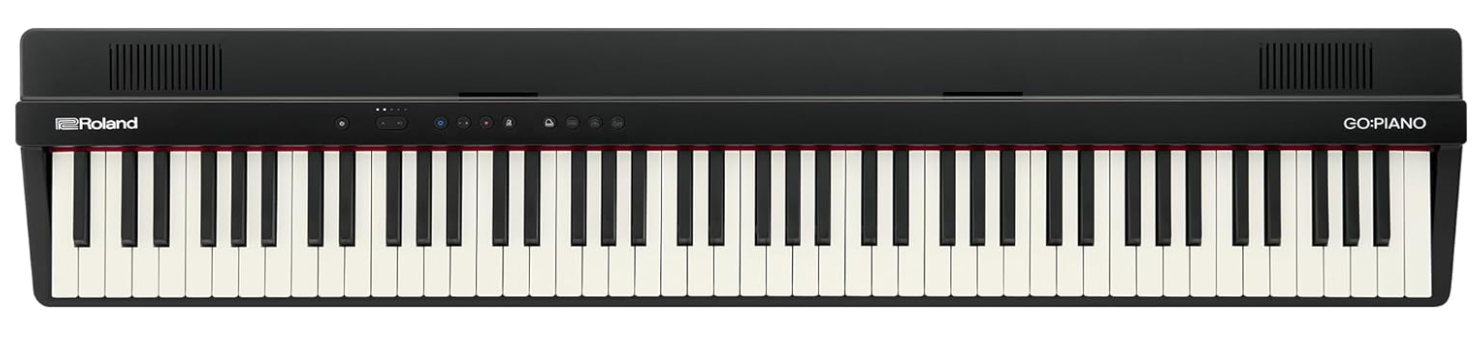
As a digital piano player who has tickled the ivories of countless instruments over the years, I’ve had the pleasure of spending some quality time with the Roland GO:Piano (GO-88P). Here is my Roland go piano 88 review to help you decide if this is the instrument you deserve.
This 88-key digital piano is Roland’s offering in the entry-level, portable keyboard market. Let’s dive into what makes this instrument tick and see how it measures up for players of all levels.
First Impressions and Design
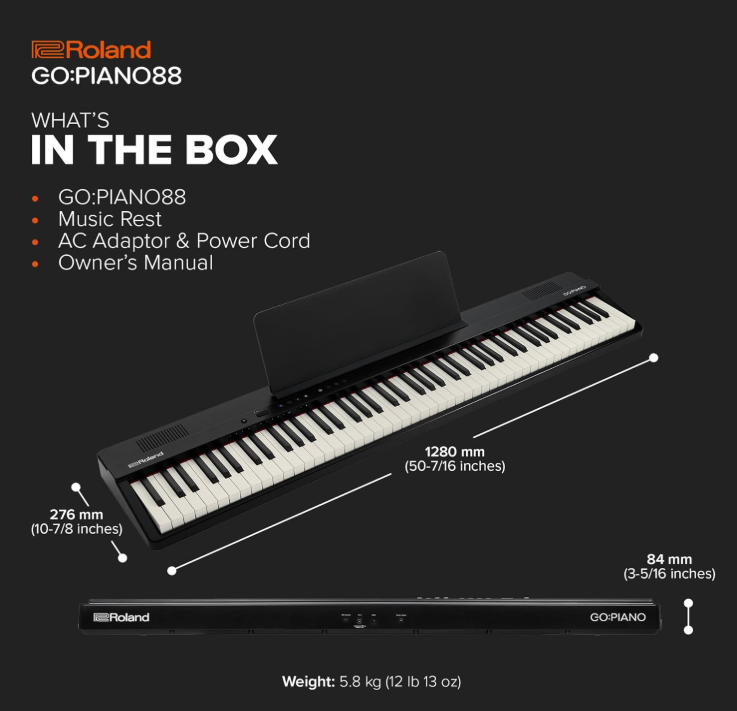
The Roland GO:Piano makes a strong first impression with its sleek, modern design. Measuring 52-3/16″ x 10-1/8″ x 3-1/2″ (W x D x H) and weighing just 15 lbs 7 oz, it’s impressively compact and lightweight for a full 88-key instrument. This portability is a significant selling point, making it an excellent choice for students, travellers, or anyone with limited space.
The build quality feels solid despite its lightweight nature. The matte black finish gives it a professional look that wouldn’t seem out of place in a variety of settings, from a bedroom to a small stage. The control panel is straightforward, with clearly labelled buttons and a simple LED display. While not as extensive as some higher-end models, the interface is intuitive and easy to navigate.


Key Action and Touch Sensitivity
One of the most crucial aspects of any digital piano is its key action, and this is where the GO:Piano shows both its strengths and limitations. The keyboard features Roland’s newly developed key mechanism, which aims to provide a realistic playing experience in a compact form factor.
The keys have a nice weight to them, certainly better than many entry-level keyboards. However, experienced players used to higher-end digital pianos or acoustic instruments might find the action a bit lacking in nuance. The keys are not graded (meaning they don’t get progressively heavier from high to low notes like an acoustic piano), which is a compromise made for portability and cost.
The touch sensitivity is adjustable with five levels (including OFF), allowing players to tailor the keyboard’s response to their playing style. This range of adjustment is impressive for an instrument in this price bracket and helps to compensate somewhat for the simplified key action.
Sound Quality
Roland has equipped the GO:Piano with their proprietary sound engine, which delivers impressive results for an entry-level instrument. The default grand piano sound is rich and expressive, with a good dynamic range that responds well to different playing styles. While it might not fool a concert pianist, it’s more than adequate for practice, learning, and even small performances.
Beyond the acoustic piano sounds, the GO:Piano offers a variety of other instruments, including electric pianos, organs, strings, and more. There are 40 built-in sounds in total. While not all of these tones are of the same quality as the acoustic piano sounds, many are quite good and add versatility to the instrument.
The 128-note polyphony ensures that even complex pieces with sustained notes and pedaling can be played without any dropped notes. This is particularly impressive for an instrument in this price range and makes the GO:Piano suitable for more advanced pieces as well as beginner repertoire.
Speakers and Audio Quality
The GO:Piano is equipped with two 10W speakers, which produce a surprisingly full and clear sound given the compact size of the instrument. The speakers provide enough volume for personal practice and small room performances, with good balance across the frequency spectrum.
For silent practice or to achieve the best possible sound quality, the GO:Piano includes a headphone jack. When using good-quality headphones, the nuances of the sound engine really shine through, revealing the depth and detail of the samples.
Features and Connectivity
Despite its entry-level positioning, Roland has packed a fair number of features into the GO:Piano. Some notable inclusions are:
- Bluetooth connectivity for audio playback and use with music apps
- Dual and Split modes for layering sounds or playing different instruments with each hand
- Metronome with adjustable tempo
- Transpose function
- USB MIDI connectivity for use with computers and music software
- Battery-powered operation option (6 x AA batteries)
The Bluetooth connectivity is a standout feature, allowing wireless connection to smart devices for using music learning apps or playing along with your favourite songs. This opens up a world of possibilities for learning and entertainment.
The USB MIDI port allows for easy integration with Digital Audio Workstations (DAWs) and virtual instrument software, making the GO:Piano a capable MIDI controller for home studio use.
Learning and Practice Tools
For students and teachers, the GO:Piano offers several useful features. The Twin Piano mode splits the keyboard into two identical ranges, perfect for side-by-side lessons. The built-in metronome is helpful for developing timing and rhythm.
Roland’s Piano Partner 2 app extends the instrument’s capabilities, offering additional features like score display, rhythm accompaniment, and Flash Card games for ear training. However, it’s worth noting that some users have reported occasional stability issues with the app.
Portability and Battery Operation
One of the standout features of the GO:Piano is its portability. Not only is it incredibly lightweight and slim, but it also offers the option of battery operation. With 6 AA batteries, you can use the piano for about 4-5 hours without needing a power outlet. This feature, combined with its compact size, makes the GO:Piano an excellent choice for outdoor gigs, busking, or simply moving the instrument around with ease.
Value for Money
Priced in the entry-level range for digital pianos, the Roland GO:Piano offers good value for money. It delivers a respectable key action, good sound quality, and a range of useful features in a remarkably compact and portable package.
When compared to its competitors, the GO:Piano stands out for its brand pedigree (Roland is known for high-quality digital pianos), its full 88-key keyboard (many entry-level models only offer 61 or 76 keys), and its Bluetooth connectivity. While some rivals might offer more sounds or more powerful speakers, few can match the GO:Piano’s combination of portability, features, and sound quality at this price point.
Pros:
- Extremely compact and lightweight design
- Full 88-key keyboard
- Good quality piano sounds
- Bluetooth connectivity for audio and MIDI
- Battery operation option for true portability
- USB MIDI for easy computer connectivity
- Decent key action for an entry-level instrument
- Good value for money
- Dual and Split modes for layering sounds
Grab An Extended Warranty For Peace Of Mind
Cons:
- Key action may not satisfy more advanced players
- Limited sound editing capabilities
- Some non-piano sounds are of lesser quality compared to the piano tones
- No pitch bend or modulation controls
- No line outputs for direct connection to PA systems
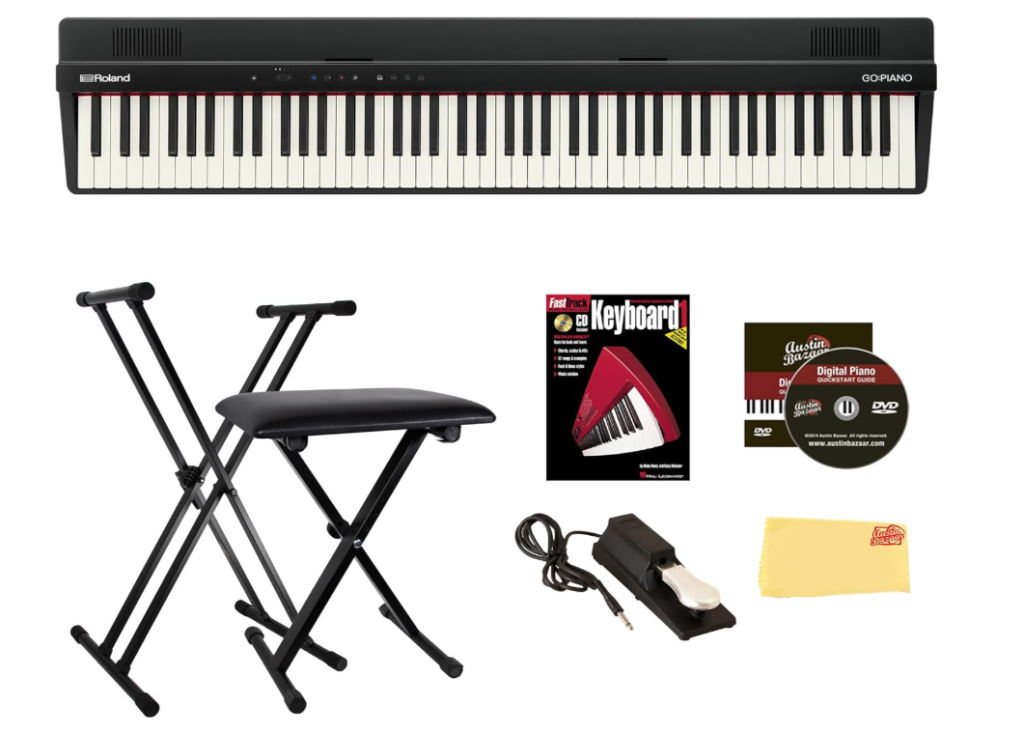
- The included sustain pedal is basic; upgrading to a better pedal unit is recommended for serious players
- No onboard recording function
- Limited polyphony (128 notes) compared to some competitors
- Some users report occasional issues with the companion app
Conclusion
The Roland GO:Piano is a versatile and highly portable digital piano that offers impressive value for money in the entry-level market. Its standout features are undoubtedly its compact design, full 88-key keyboard, and the quality of its primary piano sounds. The ability to operate on batteries further enhances its appeal for musicians on the go.
For beginners, students, or pianists who prioritize portability, the GO:Piano is an excellent choice. Its realistic feel and expressive sound make it suitable for learning and practice, while its portability and battery operation make it ideal for those who need to move their instrument frequently.
However, for more advanced players or those seeking a permanent home instrument, the compromises made for portability (particularly in the key action) may be limiting. The GO:Piano represents a well-balanced compromise between quality, features, and portability in the entry-level market, but it’s not intended to compete with higher-end digital pianos.
Beginners will find the GO:Piano to be an instrument they can grow with, thanks to its full-size keyboard and extensive feature set. Intermediate players will appreciate its portability and connectivity options, though some may outgrow its simplified key action over time.
In conclusion, the Roland GO:Piano (GO-88P) represents an excellent balance of quality, features, portability, and value in the entry-level digital piano market. It’s an instrument that can satisfy a wide range of players, from beginners to intermediate pianists looking for a portable option for practice or small performances. While it may not be the last piano you’ll ever need, it’s a fantastic starting point or secondary instrument that opens up a world of musical possibilities.