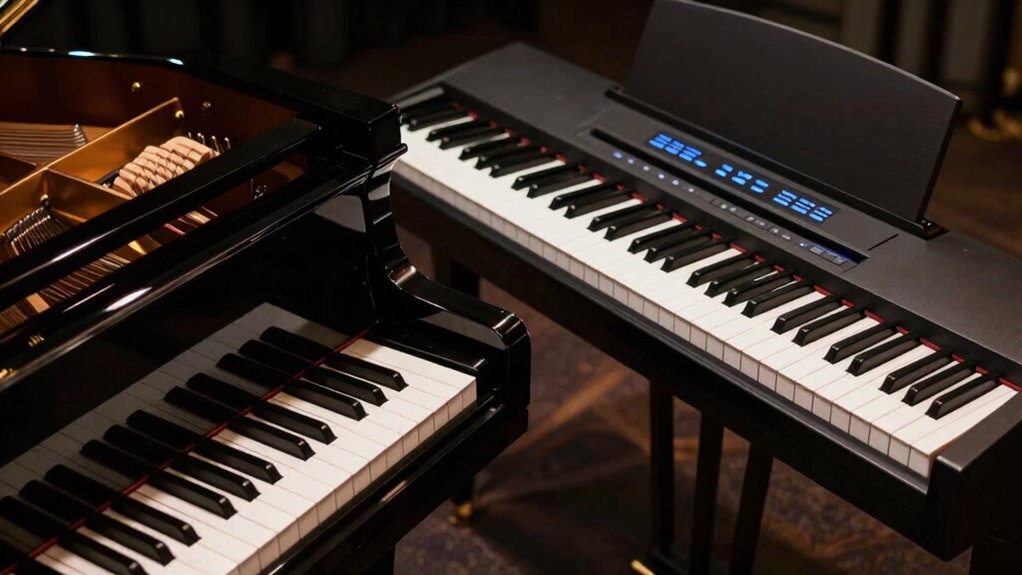
The stage piano vs digital piano decision confuses many buyers because both offer 88 weighted keys and realistic piano sounds, yet they’re designed for fundamentally different purposes with distinct feature sets and price points. Stage pianos prioritize portability, durability, and versatile sound libraries for live performance, while home digital pianos emphasize built-in speakers, furniture-style cabinets, and features that enhance practice and learning. This comprehensive comparison reveals the crucial differences in construction, connectivity, sound engines, and practical functionality that determine which piano type actually matches your performing environment, skill level, and musical goals.
If you’re choosing between a stage piano and a digital piano, you’ll weigh practicality against home-friendly features. Stage pianos prioritize durability, live reliability, and pro connectivity, while digital pianos emphasize authentic touch, built-in learning tools, and aesthetic fit for a living space. Your decision hinges on how you perform and practice: command onstage grit vs comfortable at-home mastery. Consider where you’ll use it most, and what trade-offs you’re willing to tolerate as you compare options. The next detail might tip the balance.
Stage Pianos vs Digital Pianos: Who Should Buy Each?
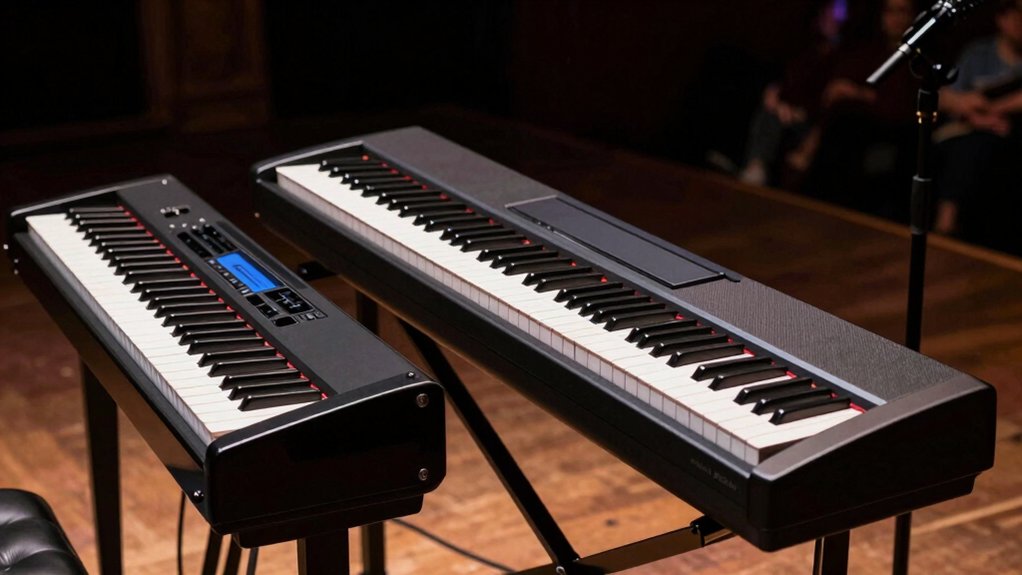
Stage pianos and digital pianos both serve the same function, but they suit different users. You choose a stage piano if you perform live and need reliable tone at volume, fast preset access, and rugged construction. Stage pianos prioritize performance portability, letting you transport a compact rig to gigs without sacrificing sound quality.
You’ll value hardware-centric controls, robust MIDI I/O, and stable drivers for stage laptops. Digital pianos suit learners and home players who prioritize a realistic touch and a broad feature set, including built-in lessons or recording without external gear.
Keyboard customization matters here: you can tailor action feel and response, but it’s often more limited than a true stage model. If you need portability and performance-ready tones, pick the stage piano; if learning and integrated features drive you, choose the digital.
How Action, Touch, and Response Differ
Action feel and response shape how you perceive key resistance, trigger speed, and aftertouch across stage and digital models. You’ll notice calibration affects playability, from hammer-like weight to linear or graded resistance, which in turn influences precision and response consistency.
This is the starting point to compare how Action, Touch, and Response differ, and why it matters for your technique and repertoire.


Action Feel And Response
On a piano’s action, feel, and response, the key mechanism determines how lightly or firmly you press and how quickly the note springs back. In this comparison, you’ll notice that stage pianos often prioritize a consistent, heavier action, delivering stable keyboard responsiveness across a performance.
Digital pianos, by contrast, tend to simulate weighted keys with varied synthetic heft, aiming for a responsive, expressive touch. The result is a tangible difference in action feel: stage models emphasize predictability for live playing, while digital models chase nuance via graded or adjustable weights.
Response timing matters, too—recovery speed and key return influence your phrasing and dynamics. Choose based on whether you value steadfast action feel or configurable, expressive feedback aligned with your technique and repertoire.
Touch Calibration And Playability
Touch calibration and playability hinge on how the keyboard translates your touch into sound. You’ll notice differences in how softly or firmly you press a key triggers dynamics, and how consistently that response scales across the keyboard.
Touch sensitivity matters: on some boards, a light touch yields subtle dynamics, while others require more effort before you hear discernible change.
Key weighting also shapes your feel and accuracy; heavier actions can slow fast passages yet reduce unintended notes, while lighter actions increase agility but may encourage jittery phrasing.
Calibration refinements let you tailor velocity curves and response zones to your style, eliminating surprises during performances.
For stage use, stable, repeatable touch calibration minimizes adaptation time, ensuring you perform with confidence regardless of instrument.
Sound Quality: Stage vs Digital Pianos in Real Use
Sound quality in real use hinges on how stage pianos and digital pianos reproduce tone under performance conditions. In practice, stage pianos deliver more natural dynamics, broader frequency response, and expressive touch, especially with weighted actions and high-fidelity samples.
Digital pianos often punch up clarity for studio-like gigs, but may compress dynamics under loud monitoring, limiting nuance. Your perception hinges on how consistently the instrument handles velocity layers, pedal behavior, and timbre across room acoustics.
Consider how keyboard ergonomics affects control during songs, because a comfortable layout preserves expressive intent. Aesthetic design matters less for tone, but it can influence your onstage confidence and engagement.
In real use, pick the model that preserves your musical intent without forcing compensations due to latency or harsh character.
Connectivity, Durability, and Onstage Reliability
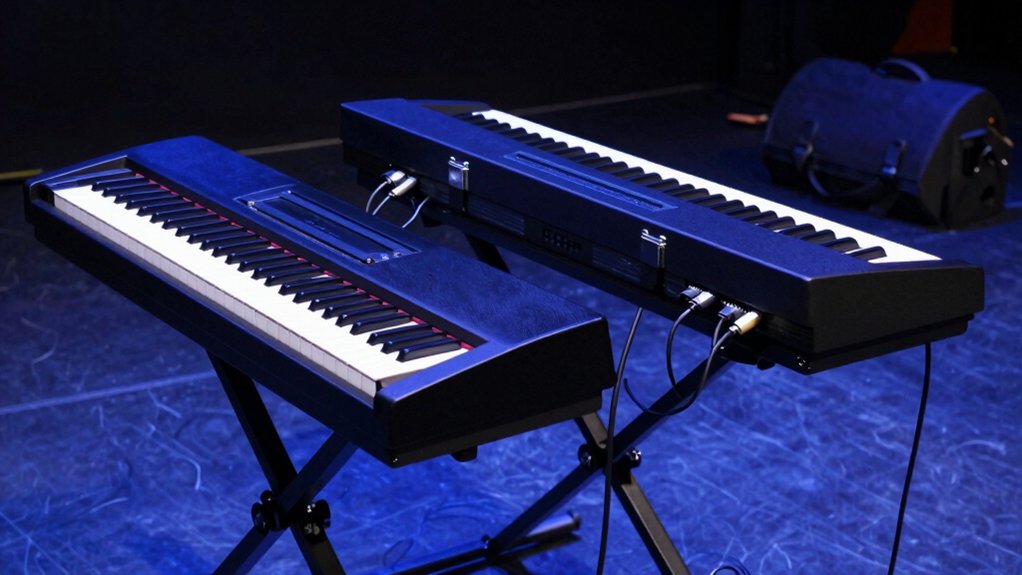
You’ll want gear that stays reliable under pressure, so consider how connectivity is designed and tested for onstage use.
Durability isn’t just counting knobs; it’s how the piano withstands vibrations, drops, and repeated transport.

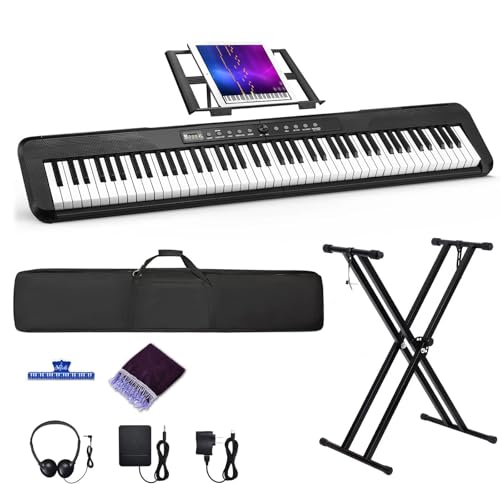

Onstage Durability Matters
Onstage durability matters because connectivity, build quality, and reliability directly affect performance. When you pick a stage piano or a digital piano, you’re not just choosing features—you’re selecting a tool you must trust under pressure.
Performance durability matters most in how a unit handles quick setup, repeated transport, and sudden tempo changes in a live room. You’ll want robust housings, secure lid latches, and reinforced keypad and I/O guards that resist impact.
Transportation challenges test your gear beyond specs, so consider weight distribution, balance, and shock resistance. Reliable chassis design reduces fretful adjustments mid-show and sustains consistent touch response.
In short, durable construction and stable connectivity guard your performance against interruptions and ensure you finish with the same tone you started.
Reliable Connectivity Design
Reliable connectivity design is the backbone of onstage reliability, tying together input/output stability, protection against interference, and quick recovery from technical hiccups. You’ll prioritize robust paths, shielded cables, and locked connectors to minimize dropouts.
Wireless connectivity should offer low latency, stable pairing, and clear RF management to prevent dropouts mid-song.
Built in effects stay out of the way of core signals, reducing chain complexity and potential noise. Plan for quick fault isolation so you can keep playing while fixes happen.
- Choose interfaces with locking housings and proven EMI resistance
- Test wireless links under stage conditions and document tolerances
- Verify that built in effects don’t consume essential bandwidth or introduce latency
Price, Value, and Long-Term Investment Considerations
Price, value, and long-term investment in stage piano vs. digital piano hinge on upfront cost, durability, and resale potential. You’ll see stage pianos often demand higher initial prices but offer rugged build and better long-term resale, improving total cost of ownership if you compensate with heavier use.
Digital pianos typically cost less upfront, yet can incur higher maintenance or faster feature obsolescence; however, their lighter frames and firmware-based upgrades can preserve value if you prioritize supported models.
When evaluating price comparison, consider how you plan to use the instrument: touring needs durability and reliable reliability, studio work may favor long-term value from updates and software compatibility.
Balance upfront expense with anticipated usage, lifecycles, and resale prospects to determine the smarter investment.
Decision Framework: Which Piano Fits Your Use Case?
When choosing between a stage piano and a digital piano, start with your use case and work backward from required features. Your framework should prioritize real-world needs over brand hype, guiding you to a clear choice.
- Assess where you perform: stage gigs, home practice, or studio work, and map features to each scenario.
- Evaluate key capabilities: keyboard amplification, realistic feel, and onboard sounds that match your repertoire.
- Balance portability with durability: digital piano portability matters if you commute or travel light, while stage rigs demand reliability.
Conclusion
Looking at the differences, you’ll see stage pianos prioritize rugged build, reliable onstage performance, and flexible connectivity, while digital pianos focus on authentic touch, home-friendly features, and learning aids. You’ll evaluate action feel, sound realism, and maintenance costs, plus durability and portability. Consider your venue, power and cable needs, and whether you’ll value built-in features or future upgrades. So, which path fits your gigs and practice life best: rugged reliability or lifelike practice at home?