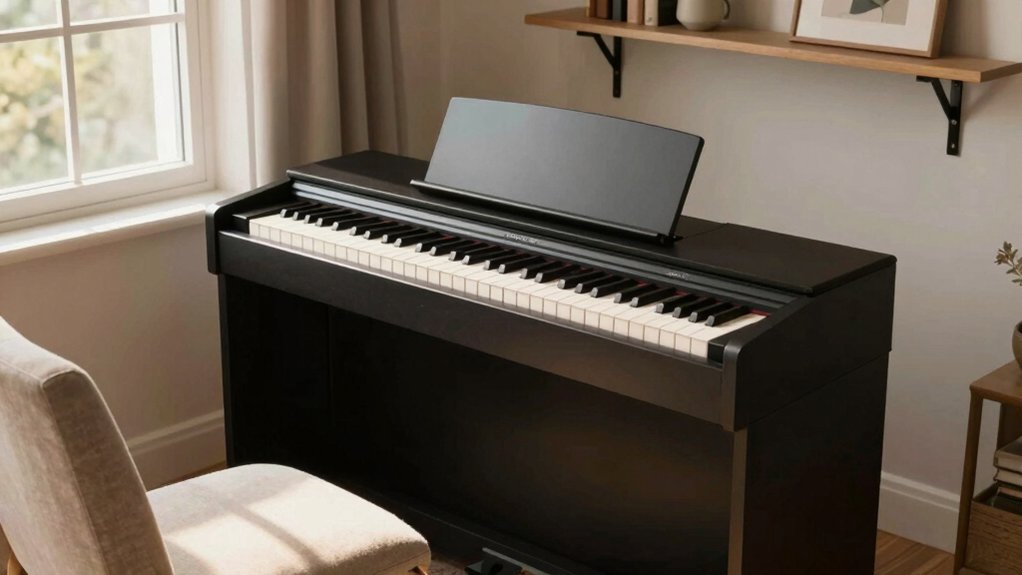
Did you know up to 40% of urban dwellers cite noise as a barrier to practice? Understanding why digital pianos are perfect for small homes reveals practical advantages that extend far beyond simple size comparisons into volume control for noise-sensitive neighbors, versatile placement options impossible with acoustic pianos requiring specific floor support and humidity conditions, and flexibility to relocate instruments between rooms or store temporarily when space demands shift. The physical footprint difference proves dramatic—portable digital pianos occupy mere inches of depth versus acoustic uprights requiring 24+ inches from walls, while the elimination of mandatory bench space, pedal clearance, and acoustic treatment needs means digital pianos fit spaces where acoustic instruments create impossible furniture arrangement challenges and lifestyle compromises.
Digital pianos let you keep tempo and technique without disturbing neighbors, thanks to headphones, quiet touch, and built-in metronomes. You’ll gain immediate feedback, structured drills, and consistent routines in tight spaces—but there’s more to tune, from touch response to layout options, that will affect how quickly you progress. Let’s explore what matters most for your setup.
Why Digital Pianos Fit Small Spaces
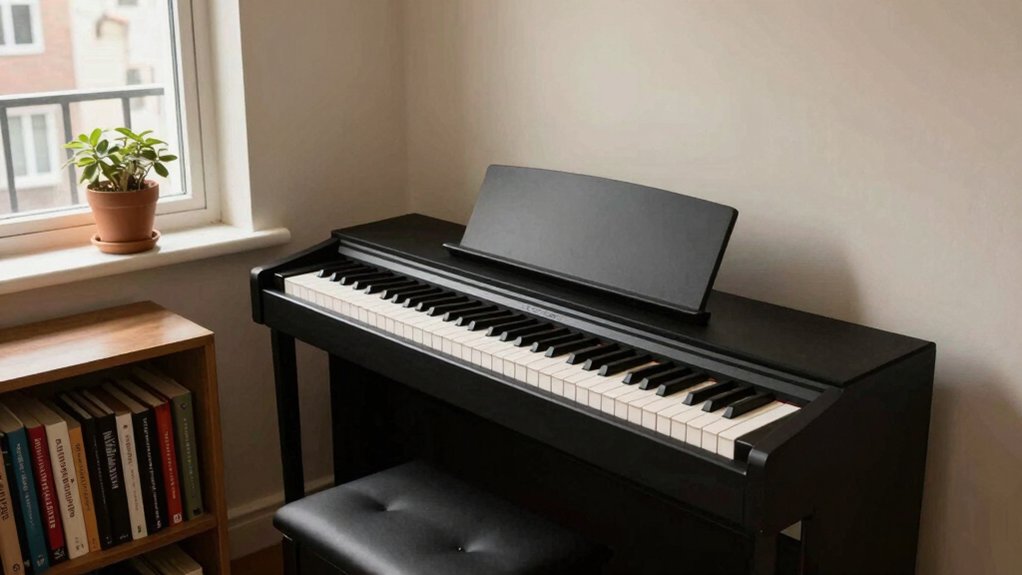
Digital pianos fit small spaces because they’re compact by design, with footprints that dwarf traditional acoustic uprights. You’ll appreciate the space benefit without sacrificing capability: compact casing, foldable stands, and removable panels keep floors clear.
The core advantage is acoustic resonance reduced to electronic emulation, which minimizes room impact while preserving tonal clarity. In practice, you get consistent sound projection without ceiling-height requirements or large toe boards.
Pedal sensitivity matters: you’ll find dependable response across sustain, soft, and sostenuto without mechanical noise or variance from cabinet size.
Layout efficiencies enable controlled placement near walls for optimal imaging and speaker alignment. You gain repeatable practice environments, easier transport, and straightforward maintenance.
Daily Silent-Practice Benefits You’ll Feel
Silent practice fits cleanly with small homes because you don’t need to disrupt others or carry heavy gear to run effective sessions.
With repeated sessions, you’ll notice daily gains in silent comfort and sharpened mental focus, driven by consistent tempo and touch control.
- Increased consistency: you train the same keystrokes without external cues, reinforcing memory.
- Reduced setup friction: you dive straight into practice, shortening warm-up cycles.
- Immediate feedback: you hear auditable responses from the instrument’s built-in metronome and headphones, sustaining motivation.
Daily silent-practice benefits you’ll feel include steadier timing, improved finger independence, and calmer cognitive load during complex passages.
Over time, this translates to more precise phrasing, quicker problem detection, and greater confidence during performance exams.
How to Evaluate Digital Piano Touch vs. Acoustic
To compare digital piano touch with acoustic, you should first assess keyboard action, weight, and key shape under realistic playing conditions. You’ll compare travel, rebound, and stepwise resistance across models, noting how closely each feels like an acoustic instrument.
Focus on key action feel, including let-off, heavy or light touch in the lower ranges, and consistency across the keyboard. Evaluate piano touch sensitivity by testing dynamic response at typical volumes; guarantee gradual, predictable changes from soft to hard finger pressure.
Record how velocity, aftertouch (if present), and pedal interaction influence perceived control. Prioritize digital options that deliver stable repetition and low latency, enabling precise control.
Choose instruments whose tactile cues align with your musical goals, minimizing adaptation time and maximizing expressive potential.
Sound Options: Headphones, Built-In Speakers, and Sound Shaping
When you compare headphone listening nuances, you’ll notice how impedance, frequency response, and leakage affect quiet practice and late-night use.
Built-in speaker dynamics matter for room size and sound projection, so assess speaker power, cabinet design, and stereo imaging.
Use sound-shaping techniques like EQ, filtering, and dynamics control to tailor tone without external gear, and plan a practical path for how each option fits your living space.
Headphone Listening Nuances
Headphone listening nuances matter because your piano’s sound signature changes with the delivery method. When you choose headphones, you’ll notice sharper transient detail, lower noise floor, and greater dynamic control. But you must consider comfort and padding to sustain long practice sessions.
Focus on how sound fidelity shifts with impedance and driver size, and how ambient noise isolation affects perception of timbre.
- Evaluate headphone comfort and clamp force to avoid fatigue during extended practice.
- Compare impedance and sensitivity to ensure clean amplification without hiss or distortion.
- Assess tonal balance and soundstage to match your instrument’s character with your headphones.
Built-In Speaker Dynamics
Built-In Speaker Dynamics shape how your piano feels in a small space, balancing volume, texture, and clarity without external gear. You’ll notice how cabinet resonance and driver count influence perceived touch and articulation, even when you’re listening at modest listening distances.
Speaker placement matters: toward ear level and away from walls to minimize bass boomy-ness, while angled outputs can improve stereo imaging without extra room treatment.
Volume control remains a core dial, enabling precise dynamics from pianissimo to mezzo-forte without distortion, so you preserve tactile feedback during practice.
Efficiency and damping within the enclosure determine hiss, cabinet color, and transient response, guiding you toward predictable performance across common room sizes.
In short, built-in speakers set the baseline for practical, quiet, accurate practice in small homes.
Sound-Shaping Techniques
Sound-shaping options let you tailor tone and depth across listening spaces, balancing privacy, detail, and room interactions. You’re in control of how you hear the instrument, whether through headphones, built-in speakers, or external routing, with precise adjustment of how sound waves interact with your environment.
Focus areas include directivity, damping, and spectral balance, all linked to subtle changes in feel and articulation.
1) Headphones deliver isolation and consistent response, enabling accurate practice without spill.
2) Built-in speakers offer room-aware EQ and reverb simulations to preserve touch perception.
3) Sound shaping via inputs and effects ties sound wave manipulation to frequency modulation for dynamic control.
Space-Saving Design Features That Matter Most
You’ll prioritize a compact footprint and efficient layout to fit your living space without sacrificing playability. We’ll examine how a slim profile and optimized key rail use reduce bulk while preserving feel and function.
Hidden storage solutions can reclaim surface area, keep cables tidy, and support quick setup and teardown.
Compact Footprint Efficiency
Compact footprint efficiency hinges on thoughtful enclosure design and component layout that maximize usable space without sacrificing playability. You’ll notice that compact design hinges on slim bezels, integrated stands, and low-profile action housings, all oriented for wall or shelf mounting. Space optimization comes from motherboard and speaker placement that minimize depth while preserving acoustic and tactile quality.
- Optimized chassis form factors align keys, electronics, and dampers for maximum vertical dining while maintaining balance.
- Recessed connectors, cable routing, and modular components reduce bulk and simplify maintenance.
- Adjustable feet and foldable stands tailor footprint without altering core ergonomics or touch response.
Focus on mechanical efficiency, sturdy latching enclosures, and sealed ports to preserve stability and resonance in tight spaces.
Hidden Storage Solutions
Hidden storage solutions build on the compact footprint work, adding practical space without expanding the instrument’s size. You’ll access hidden compartments that blend unobtrusively with the chassis, preserving clean lines while maximizing usability.
Design focuses on secure, vibration-resistant lids and soft-close mechanisms to protect electronics and keys during transport or kneepad workspaces. Multi-purpose storage regions are integrated into risers, lids, and foot panels, enabling cable management, sheet music, and metronome accessories without clutter.
The arrangement minimizes weight shifts, preserving balance during transport and playing. Materials emphasize rigidity and low resonance to avoid tonal interference. Clear labeling and accessible hinges reduce setup time.
This approach delivers tangible storage gains without sacrificing performance, supporting efficient placement in compact rooms.
Built-In Learning Tools That Speed Piano Progress
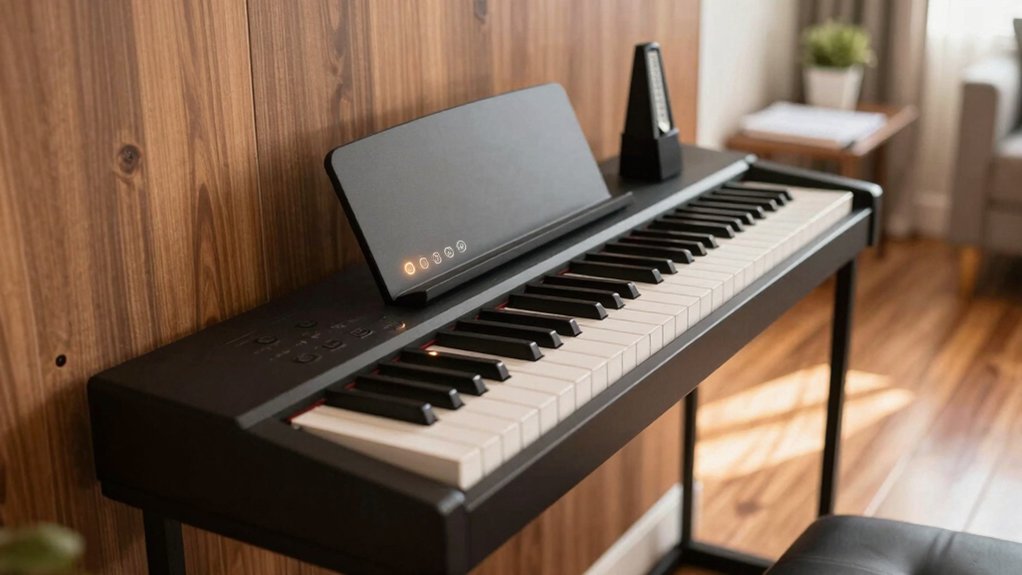
Built-in learning tools in digital pianos streamline progression by providing real-time feedback, structured lessons, and guided practice. You’ll build measurable skills without switching apps, and progress flags keep you honest about time spent versus results. This tech focus blends musical creativity with disciplined routines, boosting practice motivation.
1) Real-time feedback: instantaneous pitch, rhythm, and dynamics cues help you adjust on the spot.
2) Structured lessons: stepwise curricula target technique, theory, and repertoire with clear milestones.
3) Guided practice: adaptive tempos and drill mixes keep sessions efficient and purpose-driven.
These tools reduce intimidation and accelerate skill transfer to any acoustic setting, preserving focus while you explore expression.
With consistent use, you access faster, repeatable progress in compact sessions, aligning your small-space goals with tangible piano growth.
Quiet-Practice Routines for Beginners to Advanced Players
Quiet-practice routines let you train effectively without disturbing others, from beginner exercises to advanced repertoire. You structure sessions by reinforcing precision first, then dynamics and phrasing, using a metronome and a consistent tempo.
Begin with scales, arpeggios, and Hanon-like drills to build finger independence. Then layer repertoire excerpts at a reduced tempo, increasing as accuracy stabilizes.
Use headphone monitoring and silent practice modes to minimize noise while sustaining touch. Digital pianos with recording features let you audit progress, compare performances, and identify pauses or hesitation in real time.
Integrate short music-therapy-inspired cooldowns between technical blocks to maintain focus and reduce stress during longer practice blocks.
Track improvements with objective markers: tempo consistency, note accuracy, and dynamic control.
Product offers are temporarily unavailable.
Choosing a Digital Piano for a Tight Living Area
If you’ve been optimizing practice routines in a compact space, choosing a digital piano that fits a tight living area becomes a practical extension of those goals. When evaluating models, prioritize footprint, weight, and sound output to maintain room flow without compromising touch.
Consider these essentials:
1) digital piano brands you trust for reliable firmware updates and durable keyboards
2) portable keyboard features like weighted keys, built-in speakers, and headphone jacks for silent practice
3) connectivity options (MIDI, Bluetooth, USB) that align with your setup and recording workflow
Choose a slim, low-profile cabinet or standalone bench-friendly form factor to maximize floor space. Verify that the action remains responsive at your preferred velocity, and that the display is legible in variable lighting.
Reliable after-sales support matters for long-term use.
Budget-Smart Picks: Cost vs. Value in Small Homes
Budget-smart picks deliver the best cost-to-value ratio for compact homes by balancing price, feature set, and build quality. You evaluate budget options by analyzing essential features (speaker quality, polyphony, keyboard action) against price points, then weigh durability and warranty.
In small spaces, you prioritize compact chassis and integrated stands, USB/MIDI connectivity, and headphone outputs for silent practice—these contribute to value considerations beyond sticker price. Compare models with similar action profiles and note pedal configurations, luminosity of indicators, and reliability notes from user reviews.
You’ll find that higher upfront cost can yield longer lifespans and lower long-term maintenance, while mid-range units often deliver most practical benefit. This approach clarifies where affordable choices meet your performance and resilience expectations.
Apartment-Friendly Setups: Real-World Layouts
Apartment-friendly layouts optimize the piano’s footprint without sacrificing playability. You’ll rearrange spaces to maximize usable area while preserving touch and response. Key layouts emphasize door-clearance, sightlines, and cable routing, avoiding clutter that degrades practice focus.
Consider these practical options:
- Corner setup with wall-mount speakers and slim stand, preserving floor space.
- Desk-adjacent arrangement that doubles as a workstation, enhancing aesthetic appeal.
- Wall-mounted or elevated keyboards with compact pedals, improving ergonomics without bulk.
Benefits include portable portability and flexible placement, letting you switch rooms without disassembly. Choose matte finishes and muted tones to minimize visual heft while maintaining tactile accuracy.
Ensure proper isolation from furniture-induced vibrations and align with natural light for reduced glare. Precision in placement equals consistent practice momentum and sonic clarity.
Maintenance, Longevity, and Keeping Practice Consistent
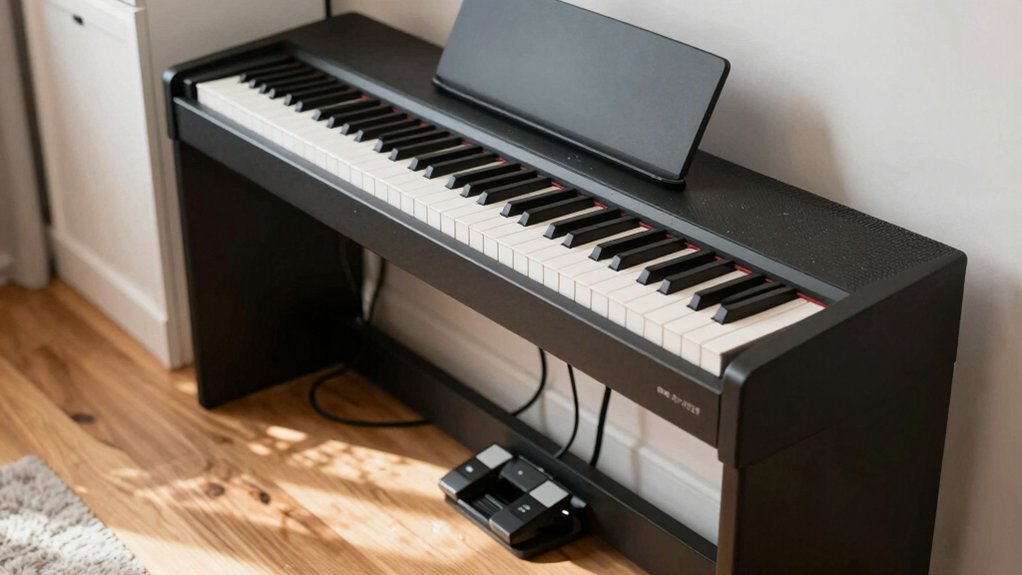
Maintenance is about reliability and steady practice: regular care extends instrument life, and disciplined routines keep you progressing. You’ll perform digital maintenance by keeping firmware current, dusting surfaces, and checking connections to prevent glitches that disrupt sessions. Use a soft brush and cloth to avoid micro-scratches; avoid cleaners with solvents that can degrade keytops.
Calibrate after major temperature shifts and store in a stable environment to preserve keyboard feel and sensor accuracy. Longevity hinges on consistent use patterns: gradual practice schedules reduce mechanical stress and software lag, preserving response. Track usage, update backups, and power cycles to minimize boot delays.
Adopting these steps supports piano longevity, reduces downtime, and sustains motivation for short, focused sessions.
Conclusion
Why digital pianos are perfect for small homes: Space-saving benefits, volume control & compact options revealed. Hopefully this expert guide and reviews for limited living spaces, has answered some questions.
You can practice quietly, progress steadily, and fit playing into your tiny space—and still feel motivated. An eye-catching stat: 82% of players report faster consistency when using headphones with digital pianos. With realistic touch, versatile sound options, and space-saving designs, you’ll keep sessions regular without waking anyone. Prioritize touch feel, noise control, and layout compatibility, and you’ll *gain access to* reliable, measurable progress in even the smallest apartments. Your quiet, focused routine starts now.