
The Alesis Recital line is a practical starter choice for home practice, offering authentic hammer-action feel options, built-in speakers, and flexible learning features like lesson mode and bundled subscriptions. You’ll get 88 keys with graded or semi-weighted action, multiple voices, and USB-MIDI for software integration, plus dual headphone outputs for private practice. Its sturdy stand, pedal bundle, and portability suit beginners seeking stability at home. If you want more, you’ll find deeper setup and performance tips ahead.
Alesis Recital 88-Key Digital Piano with Stand
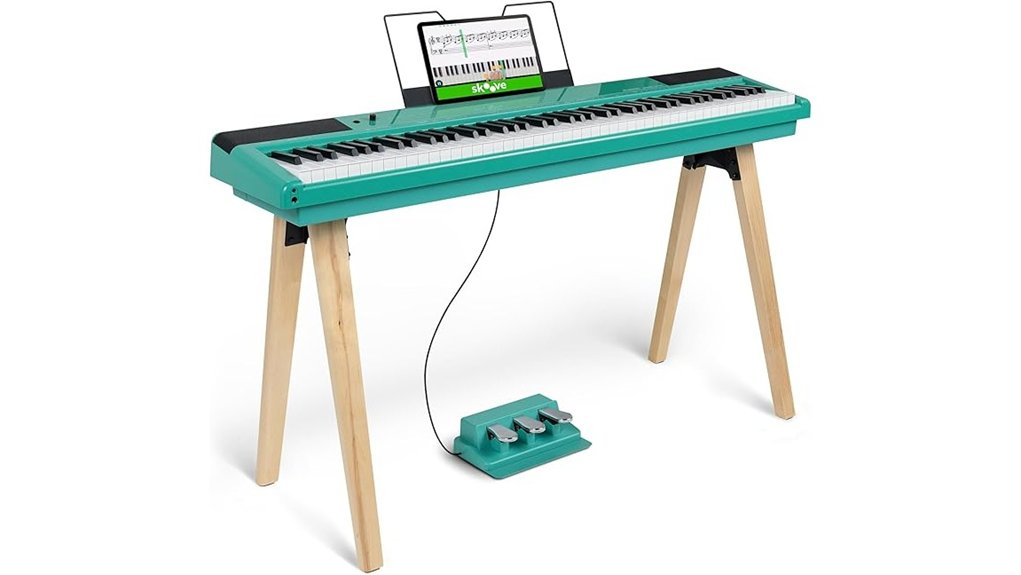
If you’re seeking an 88-key digital piano that blends classroom-ready features with home-friendly design, the Alesis Recital 88-Key Digital Piano with Stand stands out. You get full-sized graded hammer-action weighted keys and adjustable touch sensitivity for authentic response. The sturdy four-leg wooden stand saves space while delivering solid support, and the three-pedal unit adds soft, sostenuto, and damper functions for realism. With 25 built-in sounds, layering and splitting, plus 20W speakers, you’ll fill rooms with clear, rich tone. Lesson mode, dual-zone practice, USB/MIDI, and Melodics/Skoove access drive effective learning in a compact, stylish package.
Best For: This 88-key digital piano is best for beginners to intermediate players who want an authentic feel with classroom-ready features and a sturdy home setup.
Pros:
- Authentic graded hammer-action weighted keys with adjustable touch sensitivity for responsive play.
- Sturdy four-leg wooden stand, three-pedal unit, and 20W speakers deliver solid, room-filling sound.
- Lesson mode with dual-zone practice and access to Melodics and Skoove for structured learning.
Cons:
- Heavier unit (around 41.8 pounds) may be cumbersome to move and reposition.
- Built-in sounds are versatile but may not satisfy advanced players seeking a broader, pro-grade piano library.
- Integrated speakers, while adequate for practice rooms, may require external amplification for larger spaces or performances.
Alesis Recital 88-Key Digital Piano with Speakers
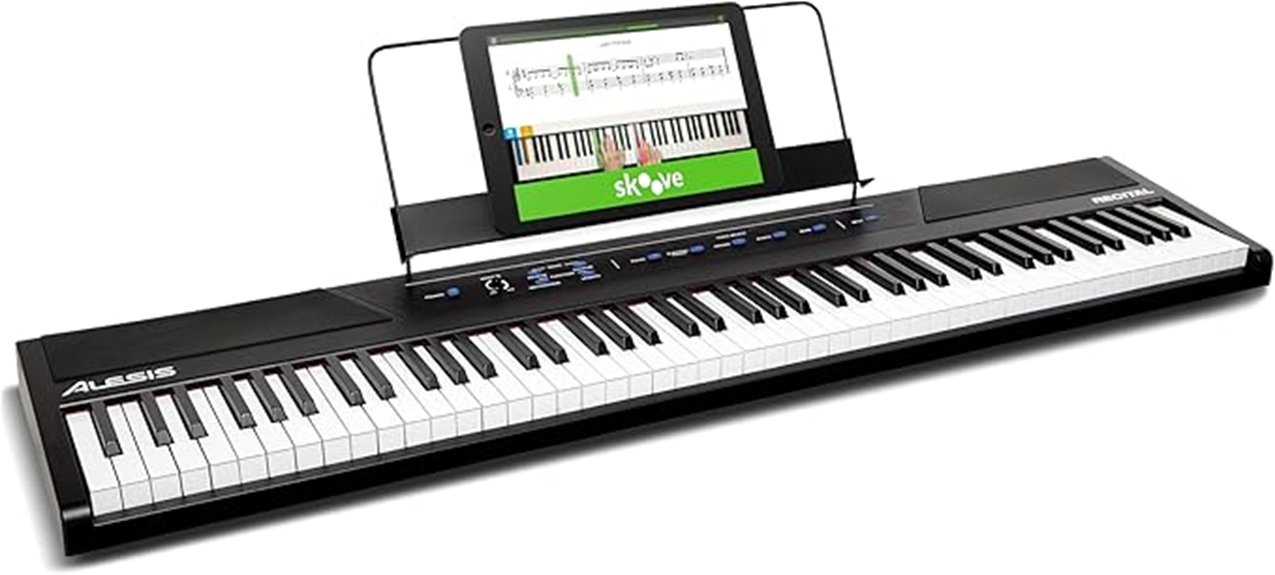
The Alesis Recital 88-Key Digital Piano with Speakers is best suited for learners and educators who need a portable, all-in-one practice solution with built-in amplification. You get 88 full-sized semi-weighted keys with adjustable touch, a lacquered finish, and a portable 15.65-pound frame. Connectivity covers USB, sustain pedal, stereo headphones, and RCA outputs for versatile setups. Two 20W speakers deliver room-filling sound, with five voices, plus Chorus and Reverb. Layer and Split modes support advanced practice, while Lesson Mode enables two-zone play for student and instructor. Includes Skoove Premium and Melodics subscriptions, plus battery or adapter power options for flexible use.
Best For: Learners and educators seeking a portable, all-in-one practice solution with built-in amplification and classroom-ready features.
Pros:
- 88 full-sized semi-weighted keys with adjustable touch for expressive playing
- Built-in 20W x 2 speakers provide room-filling sound without external amps
- Lesson Mode + bundled Skoove Premium and Melodics subscriptions for guided learning
Cons:
- Heavier than some compact keyboards (approx. 15.65 pounds) may still be cumbersome for very limited spaces
- Limited to 128-note polyphony, which can constrain complex passages with many layers
- Battery operation requires six D-cell batteries, which may be less convenient than all-plug power in some setups
Alesis Recital 88-Weighted Action Digital Piano Set
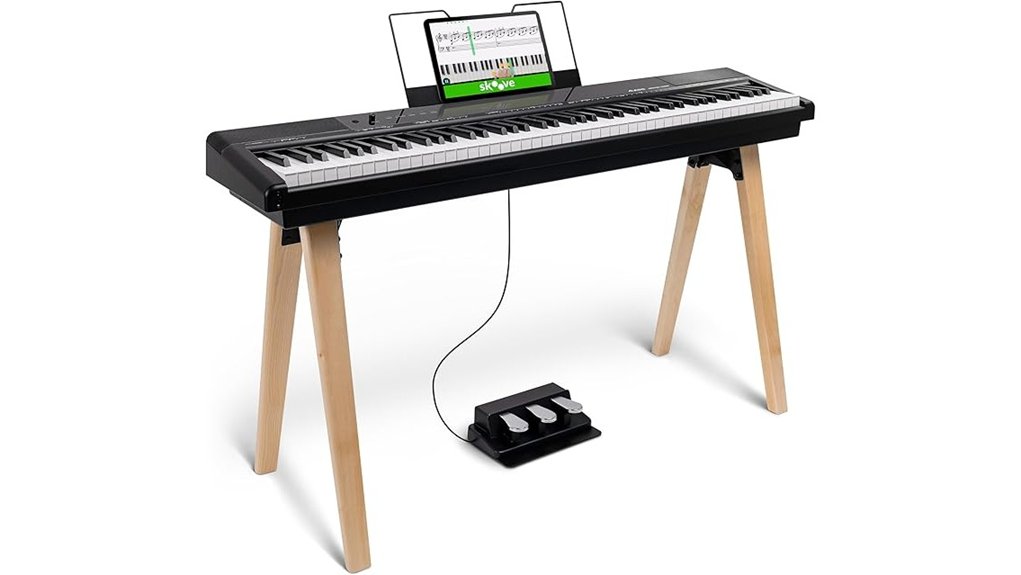
The Alesis Recital 88-Weighted Action Digital Piano Set is ideal for players seeking an authentic piano feel without sacrificing versatility. You’ll notice the full-sized 88 graded hammer-action weighted keys that respond like an acoustic piano, paired with a sleek design that suits homes and performance spaces. Its 25 built-in tones span acoustic, electric pianos, organs, and strings, with layering, splitting, and adjustable reverb for flexible performances. The lesson mode splits the keyboard for teacher-student interaction. Included accessories—stand, sheet music/tablet stand, pedal unit, and power—plus USB MIDI, stereo out, aux input, and dual headphone outputs optimize practice and integration.
Best For: Musicians seeking an authentic weighted-key feel with versatile playback options and included practice tools for home use or small performances.
Pros:
- 88 graded hammer-action weighted keys provide an authentic piano feel.
- 25 built-in tones with layering, splitting, and adjustable reverb for versatile performances.
- Includes complete accessory bundle (stand, pedal unit, power) plus USB MIDI, stereo out, AUX input, and dual headphone outputs for easy practice and integration.
Cons:
- Built-in lesson features rely on bundled software/subscriptions, which may require additional ongoing commitments.
- Heavier, more desk/tabletop-oriented setup could require dedicated space for the stand and pedal unit.
- Limited sound library compared to higher-end digital pianos, which may matter for advanced performers seeking more tonal variety.
Alesis Recital 88-Key Digital Piano Keyboard
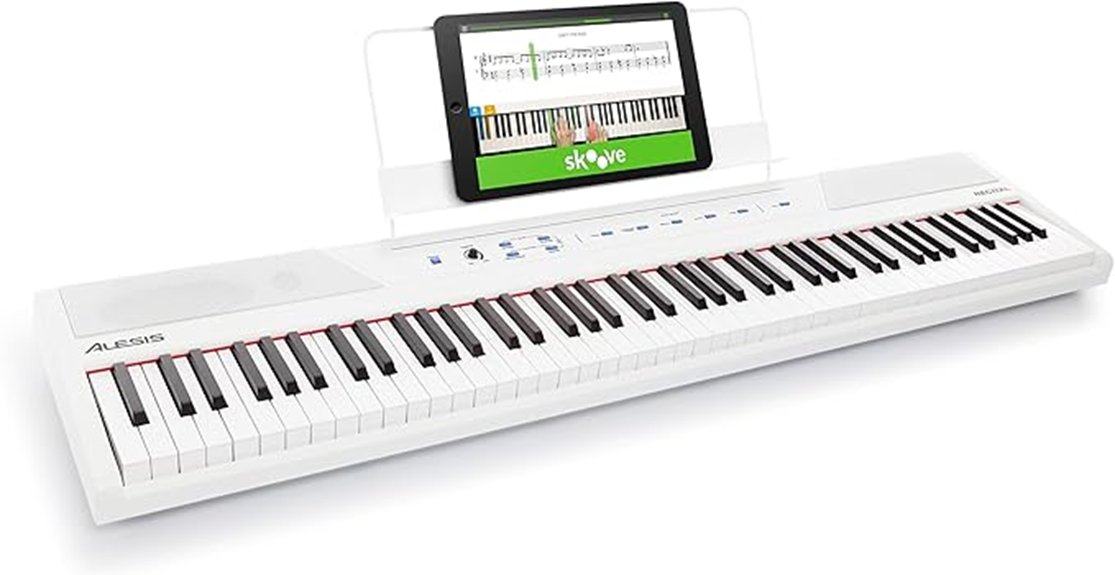
Alesis Recital 88-Key Digital Piano Keyboard stands out for beginners and early intermediates who want a realistic, full-size piano feel without breaking the bank. You get 88 semi-weighted keys with adjustable touch response for nuanced dynamics, plus 5 built-in voices—Acoustic Piano, Electric Piano, Organ, Synth, and Bass—with customizable Reverb and Chorus effects. Dual 20W speakers deliver room-filling sound, while 1/4-inch sustain input, stereo headphone, RCA outputs, and USB enable flexible setups. Practice-friendly features include Lesson Mode, split/layer, 128-note polyphony, and playlist-friendly Skoove/Melodics subscriptions, all in a portable, battery-powered package.
Best For: Beginners and early intermediates seeking a realistic, full-size 88-key experience with portable, affordable practice options.
Pros:
- 88 semi-weighted keys with adjustable touch response for nuanced playing
- 5 built-in voices and customizable Reverb/Chorus effects for versatile tones
- Dual 20W speakers and multiple connectivity options (sustain pedal input, headphones, RCA, USB)
Cons:
- Does not include a sustain pedal
- Heavier touch may still feel different from an acoustic piano to some players
- Battery-powered operation reduces speaker performance compared to plugged-in use (battery mode is portable but noisier)
Alesis Melody 61 MK4 Keyboard with Essentials Bundle
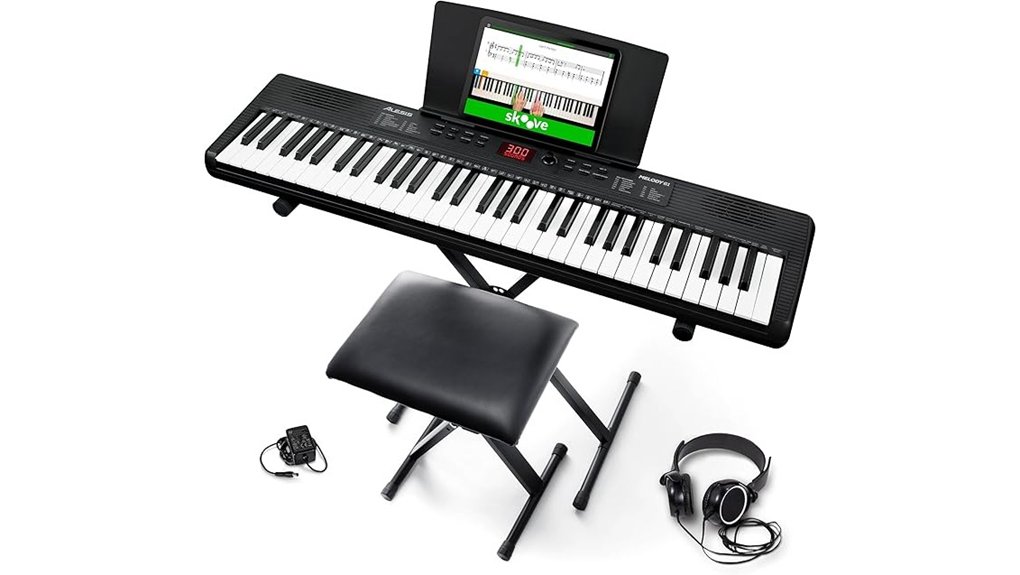
Whether you’re starting out or teaching a beginner, the Alesis Melody 61 MK4 Keyboard with Essentials Bundle stands out for portability and a complete practice setup, including 61 compact keys, built-in speakers, and a full accessories bundle that lets you get up and playing without extra purchases. This beginner-focused unit delivers 300 sounds, layering/splitting, 30 demos, 300 accompaniment rhythms, metronome, and USB-MIDI for computer integration. The bundle adds a height-adjustable stand, bench, tablet/sheet stand, headphones, and power adapter, with a lightweight 6.6 lb frame. It supports Mac/Windows via USB, plus external pedal, aux input, and headphone outputs for flexible practice.
Best For: Beginners seeking an all-in-one, portable keyboard bundle with built-in sounds, learning features, and a complete practice setup.
Pros:
- Comprehensive bundle includes stand, bench, tablet/sheet stand, headphones, and power adapter for immediate use.
- 300 built-in sounds, 300 accompaniment rhythms, 30 demo songs, and USB-MIDI for easy computer integration.
- Lightweight design (6.6 lb) with portable 61-key keyboard and built-in speakers.
Cons:
- Lacks premium features found on higher-end keyboards (e.g., weighted keys).
- Battery option requires six AA batteries (not included), which may be less convenient for frequent on-the-go use.
- Some users may outgrow the bundled learning tools and explore more advanced gear for progression.
Factors to Consider When Choosing Alesis Recital Home Digital Piano
When you choose the Alesis Recital, you’ll assess keyboard action quality, ensuring it matches your touch sensitivity and playing style. Consider the built-in sound system power and voice range to verify enough headroom for practice rooms or small venues, plus how the lesson mode supports structured sessions. Finally, review connectivity options to pair with external devices and software, aligning the instrument’s capabilities with your preferred learning and recording workflow.
Keyboard Action Quality
The keyboard action on the Recital matters more than just feel; it shapes your technique by translating touch into dynamic response. You’re working with full-sized 88 keys featuring graded hammer-action, delivering an authentic grand piano feel that supports nuanced dynamics. The weighted keys respond to touch sensitivity adjustments, enabling expressive control from mellow to forceful passages. Semi-weighted options mimic acoustic resistance, adding realism when you’re exploring faster passages and subtle dynamics.
This action design supports a range of performance techniques, ensuring you can execute quick scales, arpeggios, and nuanced phrasing without sacrificing response. Holistically, keyboard action quality influences technique development, finger independence, and accuracy, making weighted keys essential for serious practice. In practice, action quality defines how faithfully your touch translates into musical intent.
Sound System Power
Sound System Power is a critical factor because built-in speakers directly shape volume, clarity, and dynamic range for the Recital in real-world rooms. You’ll notice that the typical setup uses 20W per speaker, which influences overall loudness and tonal definition. Higher wattage translates to louder output with improved dynamic range, making the instrument suitable for larger spaces or casual performances.
The power output also governs the fullness and richness of the piano tone, essential for an authentic experience. Many models employ multiple speakers arranged to project sound evenly, enhancing the listening experience across the room. Balance is key: align speaker power with the instrument’s size and intended use to achieve adequate volume without distortion.
Built-In Voices Range
Built-in voices define how versatile your Alesis Recital can be across genres and performance contexts. The number and variety of onboard sounds shape your potential palettes, enabling authentic acoustic pianos alongside electric pianos, organs, strings, and synths. With more voices, you gain richer layering and sound-splitting options for complex performances, so you can tailor textures without external gear.
Acoustic piano voices aim to reproduce the tonal character and dynamic response of grand and upright instruments, providing real-time expressive control. The overall sound palette expands with quality, realism, and versatility, directly influencing your playing experience and musical expressiveness. In short, a broader voice range enhances versatility, depth, and your ability to adapt to diverse repertoire.
Lesson Mode Utility
Lesson mode on the Alesis Recital can transform practice by dividing the keyboard into two responsive zones, letting student and teacher play simultaneously without stepping on each other’s parts. This dual-play environment enhances interactive learning by enabling real-time duet practice, a key driver of engagement and progression. As you explore, you’ll notice how beginners develop proper hand positioning and coordination through shared, guided tasks.
The feature supports teaching techniques like call-and-response and structured prompts, enriching the instructional toolkit without overwhelming you. Setup is straightforward, and switching between lesson and performance modes adds versatility to practice sessions. In short, Lesson Mode Utility consolidates pedagogy and play, fostering immediate feedback, smoother transitions between tasks, and a scalable approach to mastering fundamentals on the Recital.
Connectivity Options
Are you optimizing your setup for flexible practice and seamless integration? The Alesis Recital offers a robust array of connectivity options that matter for beginners refining workflows. USB handles MIDI and audio transfer, so you can connect to a computer for recording, playback, and guided learning without extra adapters. Stereo outputs and a three-pedal unit enable direct links to external amplifiers or a full sound system, boosting your tonal depth.
Headphone jacks with dual outputs support private practice or teacher-student sessions without disturbing others. Aux in and sustain pedal compatibility broaden device pairing, while the ability to connect mobile devices and recording gear adds versatility for varied practice scenarios. Overall, these options support integrated, multi-device setups.
Portability And Weight
Choosing a balance between stability and portability matters, and the Alesis Recital Home delivers a solid middle ground: at about 41.8 pounds with a detachable stand, it’s heavy enough to stay put during vigorous play yet lighter than a full studio setup. This combination favors durability without sacrificing practical mobility for home use. The detachable stand simplifies transport and storage, reducing setup friction between sessions and practice.
Compared with lighter 20-pound portable models, the Recital Home trades some weight for stability, yielding a steadier playing surface and reduced wobble during dynamic passages. Size and weight align with typical home layouts, supporting convenient placement while signaling limited appeal for frequent, on-the-go performances. Overall, you gain a stable, moderately portable instrument suitable for committed practice without demanding specialized travel.
Educational Subscriptions Value
Education value hinges on accessible, structured lessons that justify the instrument’s cost. You gain a 30-day premium Melodics subscription, giving you over 100 interactive lessons across genres to build core skills quickly. A three-month Skoove Premium trial adds structured courses and virtual lessons, supporting your learning level as you progress.
The built-in lesson mode lets you and a teacher play simultaneously, boosting real-time feedback without interference. USB MIDI/audio connectivity integrates with popular learning software and digital audio workstations, expanding your educational ecosystem. These subscriptions complement the Recital’s features by delivering guided, interactive practice and genre diversity, helping you track improvement. In short, the value rests on accessible, layered instruction that enhances your growth beyond standalone keyboard functions.
Consider An Extended Warranty For Your Instrument
Stand And Pedal Bundle
A solid stand and pedal bundle is essential for stable play and authentic expression with the Alesis Recital. You’ll get a sturdy wooden stand that supports the digital piano securely, reducing wobble during lively passages. The included three-pedal unit mirrors soft, sostenuto, and damper functions, delivering a familiar tonal palette and nuanced control.
An adjustable or foldable stand accommodates different playing heights and helps you optimize posture, saving precious space when not in use. Pedals connect via a standard 1/4-inch or dedicated port, ensuring straightforward compatibility with the Recital’s input. A reliable stand-pedal setup boosts stability, promotes proper alignment, and enables expressive dynamics across genres. Prioritize build quality, adjustability, and connector compatibility to maximize performance potential and long-term satisfaction.
Conclusion
In your living room, the Alesis Recital becomes a doorway—a gateway to practice, progress, and presence. Its keys symbolize choice: light for beginner steps, weighted feel for growing technique, built‑in speakers for immediate immersion, a stand for upright resolve. Each setting is a lighthouse, guiding you away from excuses toward steady discipline. You don’t just own a keyboard; you own a signal that you’re choosing to practice, to improve, and to express your evolving musical self.