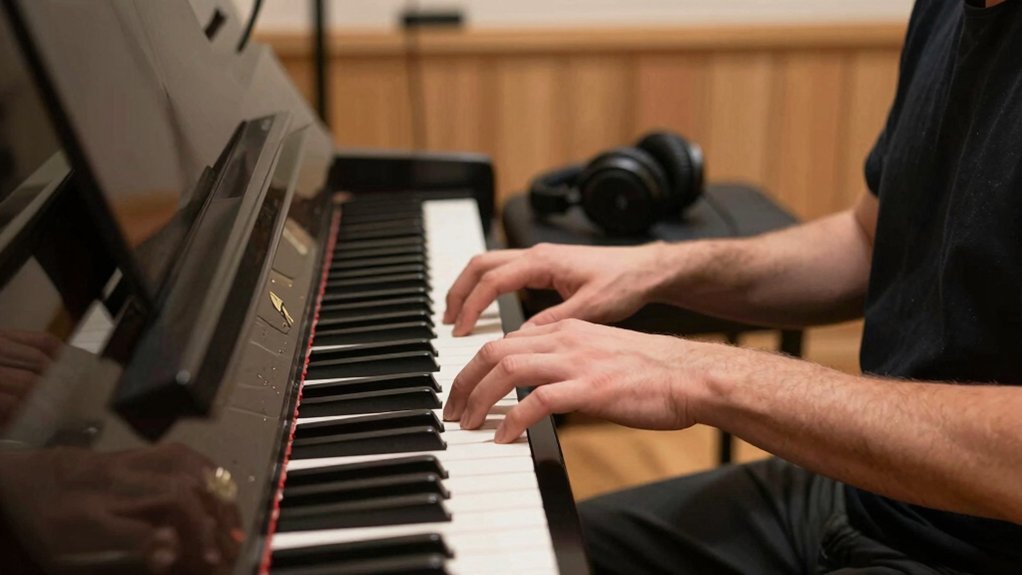
Discovering the best headphones for digital piano practice transforms silent sessions from compromised necessity into genuinely satisfying musical experiences that reveal tonal nuances, dynamic subtleties, and bass depth your piano’s built-in speakers cannot reproduce regardless of quality or wattage. The specific requirements for extended piano practice differ dramatically from casual music listening or studio production work, demanding accurate frequency response across the full piano range (27.5Hz-4186Hz), exceptional comfort that prevents pressure headaches during hour-long sessions, and impedance matching (32-80 ohms) that works efficiently with digital piano headphone outputs without requiring external amplification.
You’re balancing closed-back, low leakage, and a flat response with comfort for long sessions, plus practical setup tips to dampen vibrations. The path isn’t just about sound quality; it’s about how well your gear limits spill and fits your routine. Keep going to see how to choose the right quiet piano rig.
Digital Piano Headphones: Key Criteria for Choosing
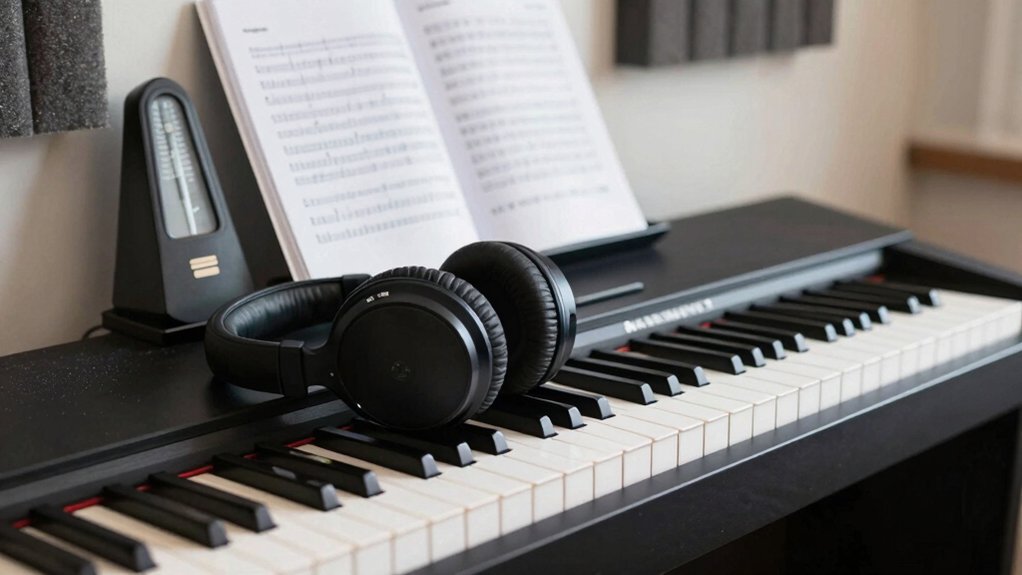
When choosing digital piano headphones, prioritize sound quality, comfort, and compatibility with your instrument’s outputs. You’ll assess frequency response, impedance, and driver size to predict real-world performance with your piano’s line or headphone jack.
Look for flat or near-linear response to avoid coloration that masks key articulation and pedal nuances.
Comfort matters for extended practice sessions, so evaluate clamp pressure and padding against the ears.
Wireless connectivity should be considered only if latency is negligible and pairing stable with your device; if you use a pedal sustain, ensure low-latency performance.
Battery life is critical for practice efficiency; verify real-world endurance and quick recharge.
Confirm impedance compatibility and required adapters before purchase to prevent impedance mismatch or signal loss.


Closed-Back or Open-Back: Which Keeps Neighbors Quiet?
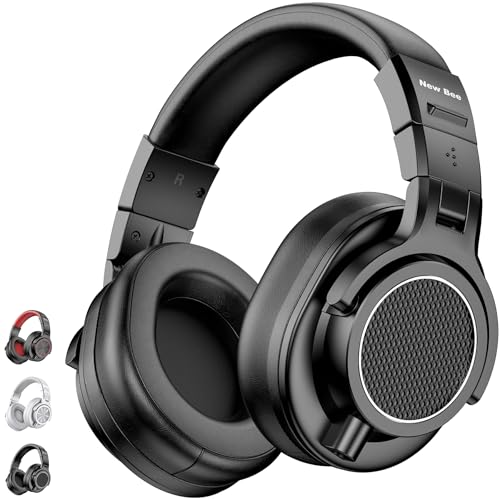
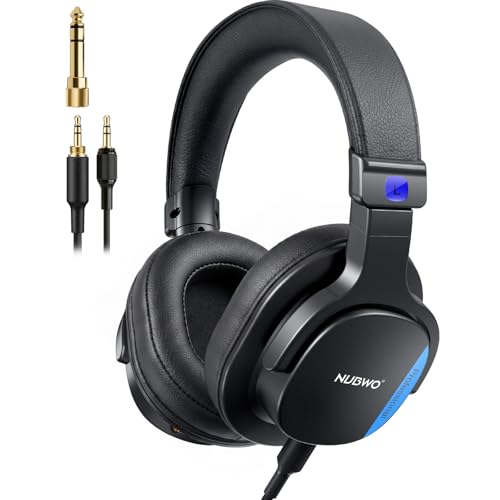
Closed-back headphones generally keep more sound inside the cup, which reduces spill into nearby spaces, while open-back designs leak more ambient sound.
Your goal is neighbor-friendly practice, so compare their profiles quantitatively: sound leakage reflects how much acoustic energy escapes at typical piano frequencies. Closed-back models exhibit markedly lower leakage at 125–250 Hz, often under 20 dB relative to in-cup level, cutting neighbor disturbance in small rooms.
Open-back headphones show higher leakage across mid and high bands, usually exceeding 25–30 dB in audible ranges, increasing neighbor disturbance potential.
Consider enclosure seal, cup impedance, and driver efficiency to predict real-world outcomes. If quiet is priority, prefer sealed designs with verified leakage measurements and room-specific listening levels, then test for comfort and long-session reliability.
In practice, choose closed-back for strict neighbor considerations.
How to Minimize Vibration From Your Desk and Floor
Isolating vibration is the next practical step after choosing quiet headphones. Even well-sealed cups won’t fully prevent desk and floor transmission if impact paths remain unmanaged. You’ll reduce upset by controlling contact points and mass distribution, not just isolating the headphone driver.
Implement the following:
1) Place a solid, damped platform under the desk and speaker surfaces to decouple desk vibrations from the floor.
2) Use compliant feet, pads, or isolated risers to damp floor noise, especially on hard surfaces.
3) Add under-desk isolation mats at both the chair and pedal zones to minimize contact-coupled transmission.
These measures directly address desk vibrations and floor noise, improving practice consistency without altering headphone acoustics.
A Piano-Friendly Sonic Profile: Why Linear Helps
A piano-friendly sonic profile benefits from a linear, low-contrast response because it preserves the instrument’s natural dynamics without imposing aggressive coloration. You’ll hear accurate transient detail from each keystroke, with minimal emphasis on any single frequency range.
This linearity supports consistent control over dynamics, enabling you to differentiate soft passages from fortes without masking nuance. In practice, aim for headphones that reproduce flat low end and uncolored mids, preserving harmonic content essential to timbre.
Sonic clarity emerges when the device avoids peakiness or compression artifacts that blur attack and release. Sound fidelity improves as phase coherence remains intact across the audio band, reducing temporal smearing.
Your monitoring remains trustworthy for expression, articulation, and intonation across diverse digital pianos.
Comfort First: Long-Session Fit and Support
You’ll prioritize comfort-oriented padding, ensuring even pressure distribution to minimize fatigue over long practice sessions.
Secure headband support maintains consistent alignment and reduces micro-movements as you play, boosting stability without added pinch.
Extended-wi t h ergonomics—note the design intent for lighter weight, breathable materials, and neutral contact points to sustain comfort through extended durations.
Comfort-Oriented Padding
Comfort-oriented padding guarantees long sessions stay comfortable without compromising fit or control. You prioritize sustained listening, so padding materials must balance softness and stiffness to minimize pressure points. Effective padding reduces heat buildup and transfer from your ears, while preserving seal and isolation.
Material choices include memory foam with breathable cover, open-cell foams for airflow, and hypoallergenic fabrics to prevent irritation. Durability matters; choose padding that resists compression over time to maintain consistency.
The result is a stable fit during dynamic playing, with no common hot spots or slips.
- Memory foam with breathable cover for comfort and airflow
- Open-cell foam blends to reduce heat and maintain padding integrity
- Hypoallergenic, durable fabrics to prevent irritation and wear
headphone comfort and padding materials.
Secure Headband Support
Secure headband support is essential for maintaining consistent contact pressure during extended practice sessions. Your selection should emphasize headband stability, minimizing micro-movements that disrupt instrument synchronization. A fixed clamp or low-friction interface reduces slip during rapid tempo changes, preserving steady acoustic isolation and comfortable wear.
Look for adjustable support that distributes weight evenly across the crown, preventing hotspot formation after long durations. Tests show that materials with slight compliance absorb minor vibrations without increasing fit fatigue.
Prioritize designs offering simple, repeatable adjustments—click-in positions or graduated sliders—so you can reestablish ideal pressure quickly. Avoid overly rigid frameworks that create pressure points.
In practice, choose a model where the headband’s contact area aligns with your head geometry, ensuring secure, repeatable fit across sessions.
Extended-Witn Ergonomics
Extended-Witn Ergonomics focuses on long-session comfort without compromising stability. You measure fit by pressure distribution, weight, and clamp force, ensuring stable headphone alignment during expert piano sequences.
For sustained use, select models with breathable padding, memory-foam cushions, and a lightweight frame to minimize fatigue. You’ll evaluate earcup geometry, headband tension, and contact points to prevent hotspots that degrade focus over time.
Music therapy considerations guide design choices that reduce tachycardia or discomfort from prolonged listening, while preserving accurate audio cues. Use these principles for customization:
- Adjust headband height and earcup angle for even seal and minimal ear pressure
- Swap to silicone or velour pads to tailor texture and temperature
- Calibrate impedance matching for consistent volume without strain
Headphone customization informs every adjustment.
Budget Benchmarks: Best-Value Options by Price
You’ll compare budget-friendly headphones on sound quality, ensuring you don’t sacrifice essential tonal neutrality for price.
You’ll assess noise-isolating performance to maintain focus during practice, especially in shared spaces.
You’ll evaluate value per pairwise cost to identify options that maximize both performance and affordability.
Budget-Friendly Sound Quality
When evaluating budget-friendly headphones for digital piano practice, value centers on clear tonal reproduction, low distortion, and reliable comfort within a minimal price. You’ll prioritize measured frequency response, reproducible dynamics, and sustained wearability, with attention to practical latency and wireless implications.
- Clear tonal reproduction: guarantee the midrange remains intelligible for instrument cues, with minimal sibilance and balanced highs.
- Low distortion at practice levels: verify rise in THD remains negligible near peak outputs to preserve piano articulation.
- Comfort and durability: light clamping force, breathable pads, and sturdy joints reduce fatigue across sessions.
These factors define budget sound quality, where audio latency and wireless connectivity considerations shape perceived immediacy and reliability during performance and practice.
Noise-Isolating Performance
Noise isolation matters for practice because it directly affects perceived latency and tonal clarity in a quiet room. You’ll measure performance by isolation rate, leakage, and how enclosure design reduces external re-entry.
In budget benchmarks, passive damping and seal quality dominate, with closed-back models typically outperforming open-back when aimed at digital piano latency perception. You should expect consistent attenuation of ambient noise around 15–25 dB for midrange pressures, rising with fit precision.
Wireless connectivity introduces minimal latency in modern codecs, but you must verify actual round-trip delay with your piano via Bluetooth or USB-DAC chains.
Headphone amplification matters: ensure your headset drive meets impedance and sensitivity targets to avoid hiss or clipping at higher levels.
Prioritize stable seals and predictable tonal neutrality across typical piano timbres.
Value Per Pairwise Cost
Value per pairwise cost captures how much performance you gain per dollar when selecting headphones for digital piano practice. You’ll compare two metrics: sound fidelity versus build reliability, prioritizing consistent output and long-term use.
The best-value options balance headphone durability with practical features like wireless connectivity, avoiding frequent replacements. By price tier, you can quantify savings while preserving essential performance.
1) Under $50: base durability suffices for casual practice, with stable wireless connectivity and minimal latency.
2) $50–$150: improved drivers, clearer mids, and firmer construction; wireless links show reduced dropouts.
3) $150–$300: optimal blend of low distortion, robust build, and reliable wireless performance; durability supports daily sessions.
You measure value by sustained volume accuracy and resilience, not just upfront cost.
Wired vs. Wireless for Piano Practice: Reliability and Latency
There’s no single answer to wired versus wireless for piano practice, because reliability and latency depend on hardware quality, protocol, and environment. You’ll measure practical impact by testing worst‑case and average values across typical sessions.
Wireless setups introduce inherent collision risk and RF interference, which can elevate wireless latency under load. In contrast, wired connections generally offer consistent transfer timing and minimal jitter, provided you use quality cables and well‑made connectors.
Key metrics to track are end‑to‑end latency, jitter, and dropouts, then compare against your acceptable threshold for feel and timing. Wired reliability tends to exceed wireless in demanding practice, while modern wireless codecs reduce latency to playable levels for casual play.
Choose based on tolerance for occasional pauses versus mobility and setup simplicity.
Desk-Friendly Design: Portability and Footprint for Compact Spaces
Desk-friendly design prioritizes portability and a compact footprint without sacrificing function. You’ll assess devices by how little space they occupy while preserving control and accessibility, enabling quick setup between practice sessions. Focus on three core adaptations:
1) Foldable or retractable elements that reduce width without compromising pedal or keypad access.
2) Stable, low-profile bases and cable routing that minimize desk clutter and prevent tipping during use.
3) Ergonomic adjustments that align screen height, chair position, and arm reach with minimal compensation, improving comfort over long sessions.
In practice, prioritize units with solid construction, detachable components, and simple reconfiguration.
Ambient noise control benefits from a compact form factor that allows closer microphone placement or headphone isolation tests without overwhelming the desk.
Isolation Accessories That Actually Help Piano Practice
Isolation accessories can meaningfully improve piano practice by reducing external noise and shaping the piano’s acoustic footprint. You evaluate passive isolation methods by measured attenuation and coupling efficiency. Ear cushions, isolation cups, and closed-back housings offer specific decibel reductions, with tradeoffs in comfort and heat buildup.
For practice rooms, attachable acoustic panels complement headgear by dampening reflected sound, not just ambient noise. When you select accessories, consider headphone cable routing and weight distribution; a lightweight cable minimizes tug on the headset and preserves seal, while thicker jackets can trap heat.
Headphone weight matters: sub-200-gram models typically maintain seal longer during longer sessions, preserving silence without fatigue. Combine hardware with room treatment to achieve reproducible, low-noise piano monitoring outcomes.
Daily-Use Durability: Care, Tips, and Longevity
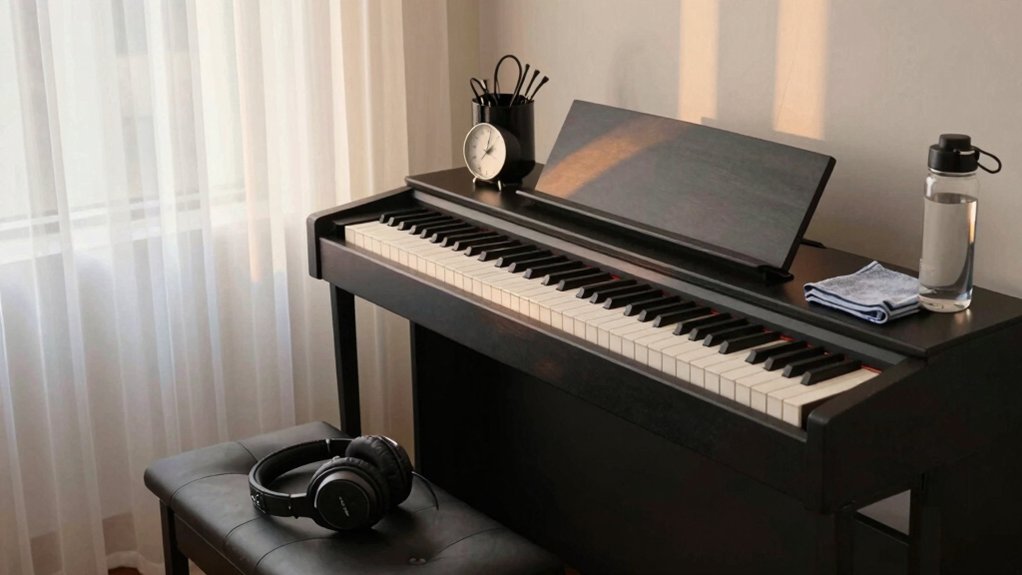
To maximize daily reliability, you should practice with headphones that tolerate routine handling and cable movement, and inspect connectors for wear after each session.
Regular cleaning, proper storage, and mindful cable routing prevent performance degradation and tangling that can affect longevity.
Use guidelines for expected wear and documented care to extend both the headset’s life and consistent sound quality.
Careful Daily Use
Careful daily use extends the life of headphones for digital piano practice by reducing wear from handling, movement, and intermittent power. You’ll minimize stress points by managing cable routing, avoiding tight bends, and using a non-slip surface.
Regularly inspect connectors and earpads for micro-tears that precede failure, and clean dust from grills to sustain audio fidelity. Track usage patterns across music genres to detect load spikes that precede fatigue.
Follow these practices:
- Store headphones in a rigid case when not in use.
- Detach cables gently and avoid yanking during power on/off.
- Clean cushions and housings with a mild, non-abrasive solution.
This approach supports headphone maintenance, aligns with empirical wear patterns, and preserves performance across practice sessions.
Longevity Tips For Use
Longevity tips for daily use focus on practical, repeatable steps that extend a headphone’s lifespan during piano practice. You should clean earpads and grills weekly with a mild, label-safe cleaner, avoid moisture, and air-dry fully before use.
Inspect cables for nicks, twists, or loose jacks; replace damaged sections promptly to prevent intermittent audio and connector failure. Keep volumes modest and avoid sustained peaks that stress diaphragms.
Use a protective case or sleeve when transporting to gigs or lessons, and store in a cool, dry environment away from direct sunlight to preserve material integrity.
Regularly rotate headphones to distribute wear evenly, noting your music genre patterns and color preferences to balance usage. This disciplined approach reduces stress on drivers and extends lifespan without sacrificing sound fidelity.
Quick Setup for Quiet Practice: Create Your Practice-Ready Space
Creating a quiet, ready-to-practice space starts with a focused layout: place your digital piano on a stable surface away from high-traffic areas, and set up a dedicated, sound-dampening zone with room for headphones, a small desk, and a chair at the proper height.
Effective setup reduces external noise intrusion and stabilizes monitoring. Implement a concise plan:
1) Arrange cabinet or stand isolation to minimize desk vibrations and reflectivity, optimizing room acoustics.
2) Position the headphone listener and cable path to avoid foot traffic and glare, ensuring tidy headphone cable management.
3) Define a minimal, distraction-free workflow area with acoustic panels or soft furnishings to damp reflections and maintain consistent tone.
How to Pick the Right Piano Headphone Setup for Your Goals
Choosing the right piano headphone setup starts with aligning your gear to your practice goals. First, define your primary objective: silent practice, detailed monitor mixing, or late-night jazz cues.
Then evaluate headphone types by impedance, sensitivity, and frequency response, since these factors determine sound quality and loudness with your amp or interface. Prioritize low-latency drivers for pedal and timing precision in practice modes, and consider isolation if you share walls.
Compatibility matters: verify that your digital piano’s audio outputs align with your headphone amp or DAC, and confirm phantom power needs if using active headphones.
Finally, test with your instrument’s pedalboard and touch response to ensure consistent dynamics across gear. Document results to refine future gear choices.
Conclusion
You’ve got the framework: closed-back, low leakage, flat response, and breathable padding, paired with vibration damping for neighbors’ peace. Stay empirical: verify leakage under 20 dB, test latency for wireless models, and prioritize comfort for long sessions. A linear sonic profile keeps piano timbre accurate, while isolation accessories close the gap between room and headphone. Remember: practical setup matters as much as gear. In short, your quiet practice is a well-engineered equation—achieve balance, minimize spill, maximize consistency.