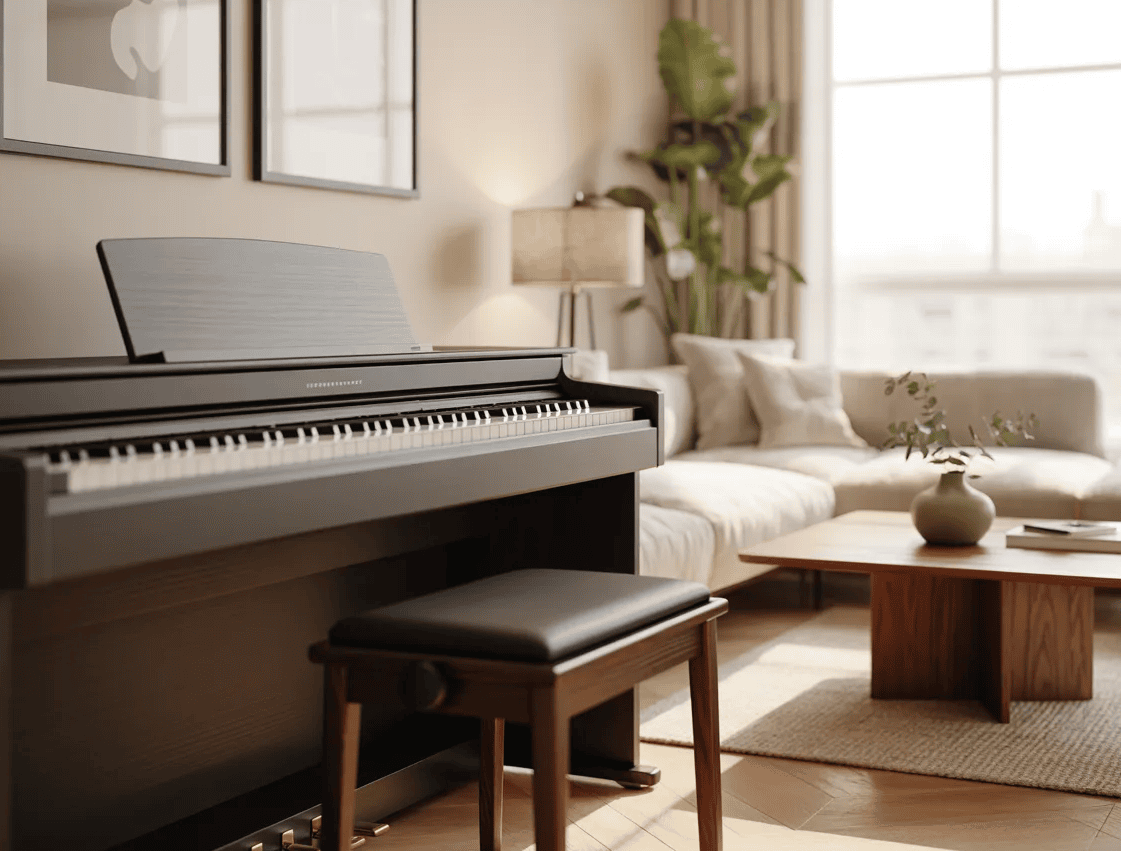
Can you learn piano properly on a keyboard or will it ruin your technique? Discover the truth about keyboard learning, weighted keys, and transitioning to acoustic pianos.
You can learn piano effectively on a keyboard, especially if it has weighted keys and responsive touch that mimic an acoustic piano. Focus on proper hand posture, consistent practice, and clear technique goals, and you’ll build the same habits used at the instrument’s core. A well-chosen keyboard supports technique and expression, but you’ll run into nuances you’ll want to address soon. There’s more to evaluate about shifts, routines, and tools that can shape your progress.
Why Practice on a Keyboard Helps Piano Progress
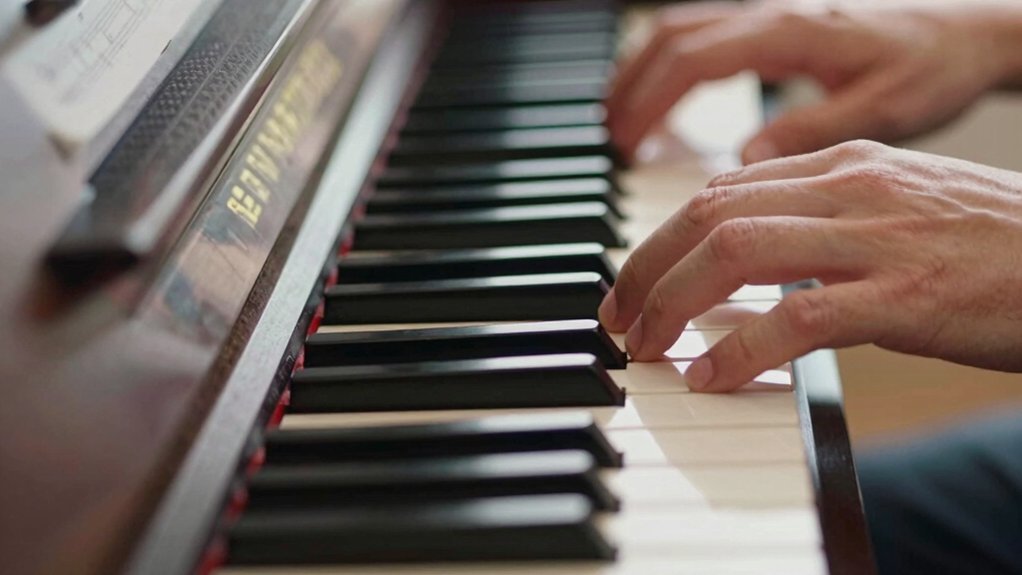
Practicing on a keyboard can accelerate piano progress because it provides immediate feedback and accessibility. You’ll notice errors in tone, timing, and dynamics as you play, enabling rapid correction without waiting for a teacher’s cue. This hands-on loop reinforces neuro-muscular pathways, so you build consistency while exploring phrasing and articulation.
In addition, keyboards offer consistent action and adjustable tempo, helping you lock in accurate fingering patterns before you transfer skills to a weighted or acoustic instrument. Digital amplification allows you to hear subtleties you might miss aloud, sharpening listening skills critical for expressive touch.
Virtual lessons complement practice by guiding technique, offering curricula, and tracking progress remotely. Together, these tools support deliberate practice, measurement, and iterative improvement, forming a solid foundation for forward momentum.
Map Piano Technique to a Non-Weighted Keyboard
If you’re mapping piano technique to a non-weighted keyboard, start by aligning finger independence with the keyboard’s lighter touch. Begin with slow, controlled scales to feel lighter elevations in keystrokes, then gradually increase tempo while maintaining even tone.
Focus on relaxed wrists, steady finger curvature, and precise articulation to prevent clawing or tension. Use cognitive labeling for dynamics—softs and fortes—so you don’t default to heavy-handed attacks.
Adopt a consistent tactile feedback loop: practice, assess, adjust, repeat. This approach supports technique transfer without overburdening wrists, reducing injury risk.
Digitally enhanced practice apps can track accuracy and timing, reinforcing correct habits. The portability advantages mean you can sustain daily micro-sessions, building endurance and muscle memory wherever you play, without compromising technique quality.
Essential Keyboard Features for Piano Work
Your keyboard’s action and touch determine how your fingers respond to each note, so choosing a model with a comfortable, consistent feel matters for building control.
Consider how the weighted or graded keys mimic real piano dynamics, and how responsive the action is to your touch at varying speeds.
Also, explore pedals and the instrument’s dynamic range, as these features shape articulation and expression in practice and performance.
Keyboard Action and Touch
Keyboard action and touch are the core interfaces you use to shape tone, dynamics, and control on a keyboard. Your touch determines phrasing, articulation, and response, while action determines how you physically engage the keys. Good feedback helps you learn precise dynamics and consistent technique, which translates to clear digital sound and expressive nuance.
Be mindful of key sensitivity, which varies across instruments and affects how you hear weight and rebound. With proper setup, you’ll connect intention to result rather than chasing perceived sound. Practice should assess dynamic gradation, touch consistency, and response accuracy.
- Compare weighted versus unweighted feel to gauge suitability.
- Focus on finger independence and even tone across ranges.
- Track dynamic changes to reveal sensitivity and control.
Pedals and Dynamic Range
Do pedals really enrich piano performance, or do they just add ornamentation? The answer lies in how you apply pedal techniques to shape tone, articulation, and phrasing. In evidence-based practice, you’ll learn to use sustain and soft pedals to extend or suppress notes, creating legato lines or diminuendo effects without overpowering the keyboard’s sound.
Focus on timing: change pedals at musical rather than mechanical moments to preserve clarity and avoid blur. Pedaling also supports dynamic control by aligning pedal release with color changes in your phrasing, not simply when notes vanish.
Practice slowly with a metronome, recording each attempt to compare intelligibility and balance. With intentional pedal use, you’ll gain expressive depth while maintaining precision across repertoire.
Build Correct Hand Posture and Finger Independence at Home
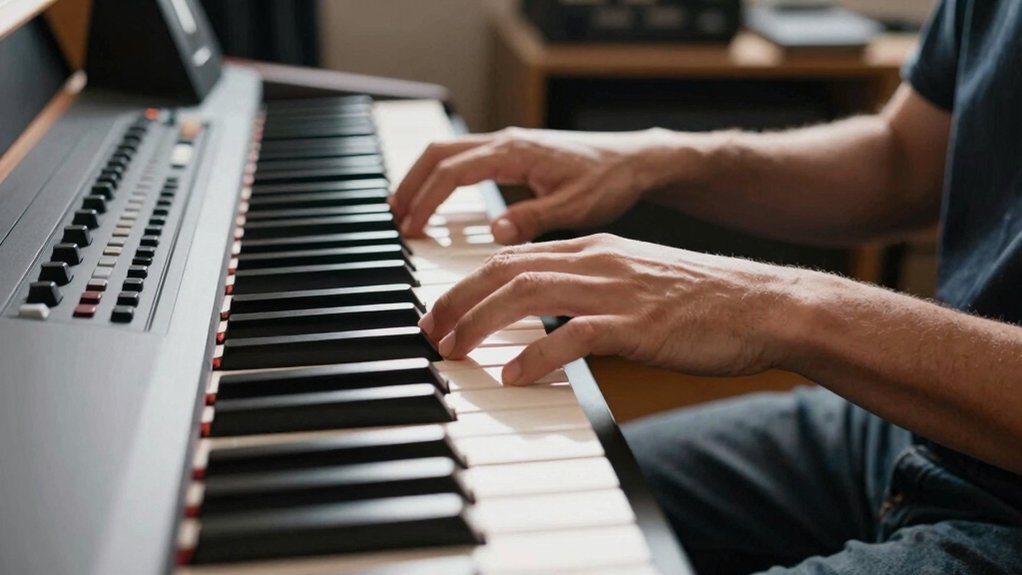
Start by aligning your wrists and fingers so your hands rest light and curved, with fingers poised over the keys. Practice simple finger independence drills—each finger moving cleanly on its own, then in scale patterns—to build control and accuracy.
Keeping a steady, relaxed posture at home supports consistent technique and reduces strain over long practice sessions.
Proper Hand Alignment
Good hand alignment matters from the start: keeping wrists neutral, elbows relaxed, and fingers curved lets you play cleanly and avoid tension.
- Prioritize hand positioning at the keyboard: align forearms with the keys, and keep minimal tension while you hover over the keyboard.
- Develop finger alignment by resting the fingertips on the keys and curving each finger naturally, avoiding flattening or bending too much at the joints.
- Practice light, consistent touch drills that reinforce even weight distribution across all fingers without collapsing the wrists.
This approach supports reliable tone, fluid motion, and reduced strain.
Build awareness of posture before speed, and regularly check for subtle shifts that compromise technique.
Finger Independence Drills
Finger independence drills are essential because they train each finger to move cleanly and independently while you maintain correct hand posture.
You’ll begin with simple five-finger scales and slow arpeggios, focusing on even tone and relaxed wrists. Practice metronome-supported repetitions to reinforce consistent finger timing, then increase tempo gradually as accuracy shines.
Emphasize finger dexterity by isolating movement—lift, press, and return each finger without dragging others. Maintain a neutral hand position, keeping the knuckles over the keys and the thumb aligned to the palm.
This builds hand coordination across both hands, improving coordination during chords and melodies. Short, deliberate sessions yield measurable gains and reduce tension, supporting safer, more precise piano technique at home.
Develop Touch and Dynamics Without an Acoustic Piano
Developing touch and dynamic control on a keyboard, even without an acoustic piano, is doable with intentional practice and appropriate tools. You can train sensitivity to touch by focusing on weight transfer, arm relaxation, and finger articulation during scales and simple melodies. Use feedback from digital tutorials to refine finger velocity and release timing, then compare your progress with virtual lessons to ensure alignment with technique standards.
Build consistency by practicing a consistent dynamic range (pp–f) across passages, not just at loud or soft extremes.
- Practice with varied touch: light, moderate, heavy to map your instrument’s response.
- Record short passages and analyze dynamics against a target performance.
- Integrate gradual tempo changes to control phrasing and articulation.
Pedal Use and Sustain Control on a Keyboard
Using the skills you’ve built in touch and dynamics, you’ll extend control to sustain and pedals on a keyboard. In practice, use the sustain pedal judiciously to shape phrasing, not just to hold notes. Start with small, even depressions and release gradually to avoid abrupt tonal breaks.
Develop a clear pedal plan: half-pedal for legato lines, full pedal for harmonies, and pedal changes on strong phrases rather than every chord. Practice listening for resonance and decay to determine ideal pedal timing.
Sustain pedal techniques should align with tempo and articulation, supporting your musical goals. Remember pedal maintenance tips, like cleaning the contact points and avoiding overuse, to prevent tone wash. With mindful application, pedals enhance expression without overwhelming clarity or control.
Achieving Piano Tone on a Compact Controller
When you’re aiming for piano tone on a compact controller, focus on how touch, dynamics, and control settings interact with the instrument’s tonal potential. Your goal is to produce authentic digital sound by aligning key sensitivity with your playing style and the device’s response curves. Controlled velocity, aftertouch (if available), and proper touch calibration help you approximate hammer-on behavior and note decay.
- Tweak key sensitivity to match your touch, preserving natural dynamic range.
- Calibrate velocity curves so soft and loud notes translate to proportional digital sound.
- Use envelope settings (attack, decay, sustain, release) to shape legato and articulation.
Practice sessions should track how small adjustments affect tone, ensuring consistent results across registers.
Repertoire That Translates to a Keyboard Setup
You’ll want repertoire that translates well to a keyboard setup, focusing on pieces with clear finger patterns and manageable hand positions. Start with translatable pieces that emphasize touch, phrasing, and tempo control so your practice transfers to a full-size instrument.
This approach is evidence-based: build skills incrementally on the keyboard and monitor how your technique shapes tone and rhythm.
Repertoire for Keyboard Setup
Repertoire for Keyboard Setup: choose pieces that translate well to a keyboard arrangement, emphasizing works with clear, evenly spaced chords and melody lines that stay within a practical hand span.
You should select repertoire that supports a solid sense of digital sound, yet keeps the keyboard layout intuitive, reducing finger-crossing early on.
Favor pieces where harmony guides left-hand motion and melody remains accessible in the right hand, aiding reliable rhythm and articulation.
- Simple, well-structured classical pieces that spotlight clear rhythm and balanced voicing
- Arrangements of folk tunes or chorales with straightforward chord progressions
- Short transcriptions of well-known melodies that preserve essential phrasing without excessive leaps
Translatable Pieces for Practice
To practice effectively on a keyboard setup, choose translatable pieces that emphasize clear melodies, steady rhythms, and chordal support for the left hand. You’ll translate repertoire from other contexts by prioritizing bass stability and predictable phrases, which aids transfer of musical ideas to the keyboard layout.
Favor works with explicit right-hand melodies—movements with simple contour and repeated patterns—to support efficient sight reading and rehearsal speed. Integrate basic music theory concepts, such as scale degrees, chord progressions, and voice leading, to scaffold learning.
As you practice, regularly test transfer: play by ear, then annotate fingering and rhythm changes, reinforcing cognitive maps. This approach strengthens sight reading and reinforces transferable skills across genres, improving overall fluency on a keyboard setup.
Structured Practice Plans for Keyboard-Based Progress
Structured practice is essential when progress is rooted in a keyboard-based setup. You’ll progress faster by pairing clear goals with deliberate, focused sessions. Build routines around manageable durations, varied tempos, and deliberate repetition to reinforce motor patterns and musical understanding.
Evidence suggests deliberate practice with specific targets yields durable skill gains, even on non-graded keyboards, when you track your accuracy and pace over time.
- Define daily targets (technique, repertoire, and sight-reading) and log results.
- Alternate focused drills with short, expressive pieces to develop control and musicality.
- Incorporate technology like digital amplification and MIDI connectivity to monitor timing, dynamics, and articulation.
Structured plans reduce guesswork, keep you accountable, and adapt as you improve.
Common Technique Pitfalls and Fixes on Non-Weighted Keyboards
Non-weighted keyboards present unique technique challenges, but you can overcome them with targeted fixes that build strength, precision, and control. You’ll likely encounter inconsistent response, delayed articulation, and jittery finger movements.
To address this, practice light, deliberate scales and arpeggios at a slow tempo, focusing on even tone and clean progressions. Emphasize finger independence by maintaining relaxed wrists and steady arm support. Prioritize accuracy over speed to reduce bad habits that the keyboard’s key sensitivity can amplify.
Use a metronome to reinforce steady pulse, gradually increasing tempo while preserving clarity. When you hear uneven digital sound, adjust touch, aiming for consistent attack and release. Record yourself periodically to monitor progress and adjust technique before bad habits take root.
When to Transition to a Real Piano or Weighted Keyboard
Choosing the right moment to shift from a non-weighted keyboard to a real piano or a weighted keyboard depends on consistency and technique, not just age or prior hours of practice.
You should transition when your fingers show controlled tone, reliable dynamics, and comfortable hand position across scales, arpeggios, and chords. If you rely heavily on touchless feel or produce inconsistent tones, wait a bit longer.
A digital pianos or MIDI controllers can ease validation of progress before committing to a weighted keyboard.
- Assess technique weekly with a metronome and record tone quality, dynamically varied passages, and repeats.
- Move to weighted feel once you maintain clean articulation across dynamic levels.
- Prefer real piano or weighted keyboard if you intend to perform publicly or study repertoire that demands authentic hammer resistance.
Tools and Accessories to Accelerate Keyboard Learning
Tools and accessories can considerably speed up keyboard learning by providing immediate feedback, consistent resistance, and guided practice. Using a digital metronome helps you internalize tempo, subdivide beats, and reduce rushing or dragging between notes. Start with a comfortable, steady tempo and increase only after clean execution.
A keyboard stand improves posture by elevating the instrument to a playable height, which reduces strain and encourages longer practice sessions. Together, these tools support deliberate, evidence-based practice: warm up with a metronome, then play scales and simple pieces at a controlled tempo before progressing.
Pair a stable setup with deliberate repetition, focused feedback, and gradual complexity. Invest in reliable accessories, commit to consistent scheduling, and monitor progress through regular performance checks.
Conclusion
Piano teachers and online forums are filled with heated debates about whether you can learn piano properly on a keyboard, or if starting without weighted keys will permanently damage your technique and muscle memory. The answer to can you learn piano properly on a keyboard is more nuanced than a simple yes or no, because whilst millions of successful pianists have begun their journey on basic keyboards, the type of keyboard you choose and how long you use it before upgrading can significantly impact your technical development and ability to play acoustic instruments.
You can progress on a keyboard, yes, with disciplined, deliberate practice. Start steady, shaping strong technique, structuring careful scales, and simulating soulful dynamics. Stay selective with suited repertoire, setting schedules, tracking progress, and tweaking touch to echo expressive intent. Build balanced, relaxed posture, finger independence, and mindful wrist motion, then steadily push precision. Pair patience with persistent effort, pursue gradual growth, and periodically assess readiness for real-piano transition. Practical, proven practices propel performance, and persistence produces lasting, piano-ready prowess.