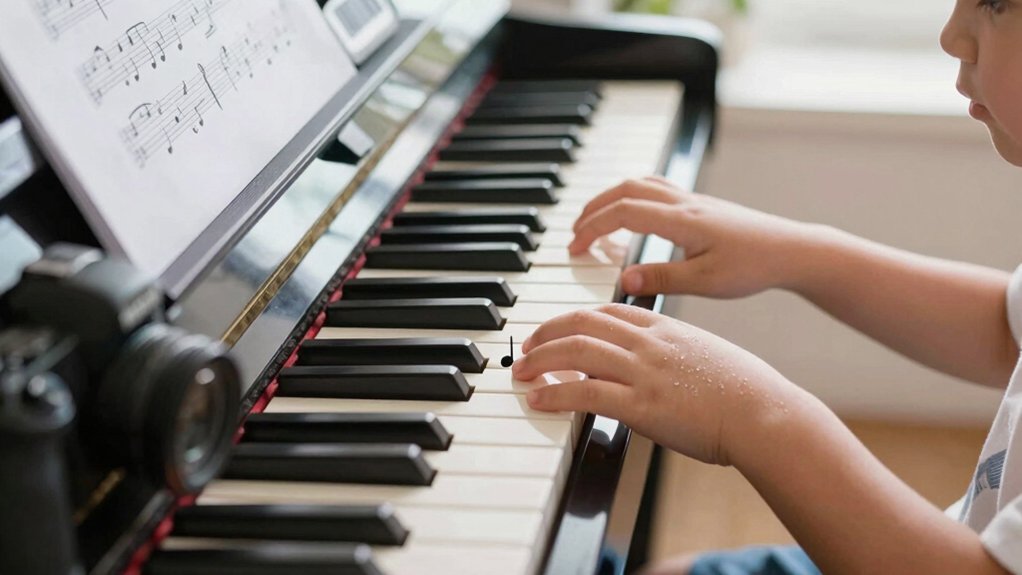
Starting as a total beginner, you can’t skip the basics and still expect a full song to fall into place. You’ll use a piano keyboard simulator to see notes in real time, one hand at a time, building confidence as you go. With clear, practical steps—readable cues, simple fingerings, slow tempos—you’ll notice progress, even on day one. Keep going to see how a tiny daily drill becomes real-muscle memory and a complete tune you can play.
Pick a Beginner-Friendly First Song to Start With
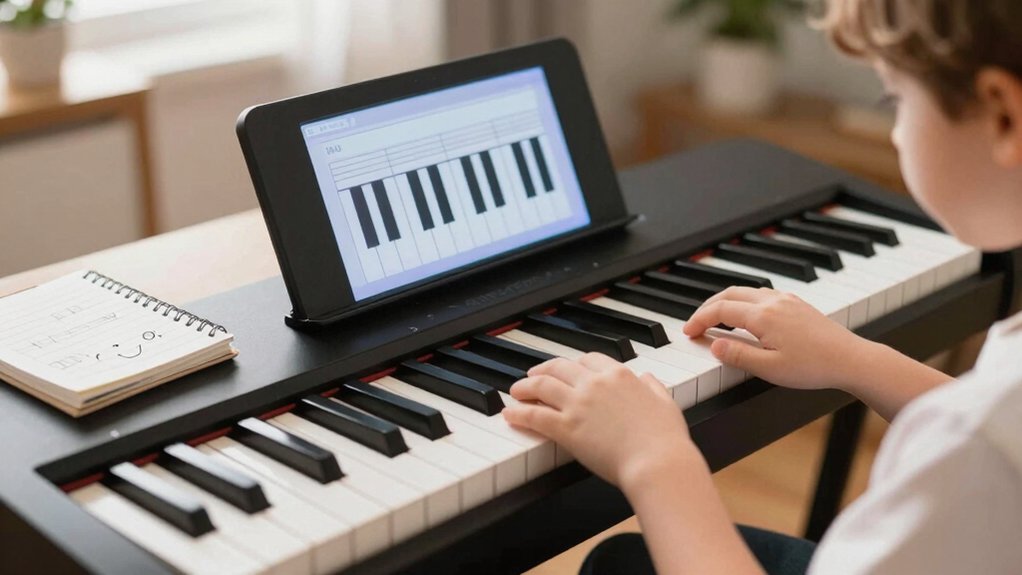
Choosing a beginner-friendly first song helps you build confidence quickly. Start with a simple, well-known tune that uses a limited range and easy rhythms. Look for a melody you recognize, so you stay motivated as you practice.
Check the sheet music for the key, tempo, and note patterns, then map them to what you’ll press on your keyboard. Keep your focus on a single hand at first, then add the other hand once you’re steady.
Relate the notes to basic music theory concepts, like scales and intervals, to predict what comes next. Use a version with simple, large-note notation to reduce reading error.
Practice hands separately, then combine slowly. Revisit the sheet music often to reinforce memory and confidence.
Why a Piano Keyboard Simulator Helps Beginners
A piano keyboard simulator helps beginners by providing a safe, accessible way to explore notes and rhythms without needing a real instrument. You’ll build familiarity with pitch, timing, and pattern recognition before investing in gear. This approach strengthens your understanding of musical theory through hands-on practice, not just reading sheet music.
You’ll also condition finger strength with controlled exercises that feel manageable.
- Learn note locations quickly without guessing
- Practice rhythmal patterns at a comfortable tempo
- See scales and chords in real time, reinforcing theory
- Track progress with instant feedback and repeatable drills
Choose a Beginner-Friendly Setup You’ll Actually Use
To pick a beginner-friendly setup you’ll actually use, start with a simple, affordable option you can grow into. Choose a basic keyboard app or entry-level MIDI controller that feels natural in your hands, not flashy gear.
Prioritize a sturdy stand, a comfortable chair, and a screen or device at eye level so you don’t strain.
For technique, focus on hand posture and relaxed shoulders, wrists, and fingertips. A compact keyboard with 61 keys is plenty to start, then expand as you progress.
Practice with simple scales and a single song to build finger independence without overwhelm.
Avoid overbuying; upgrade hardware only when you notice genuine bottlenecks.
This setup keeps you consistent and zealous to practice daily.


Read Visual Notes Fast: Quick-Start Cues and Finger Numbers
Once you’ve got the basics down, you’ll speed up by learning quick visual cues and finger-number mappings that stay consistent across pieces. You’ll train your eyes to grab musical notation quickly, turning symbols into actions and reducing hesitation. This is about building sight reading skills that fit any song you try.
- Read ahead for cues before you play, so your hands anticipate changes.
- Memorize a simple finger-number map and reuse it across scales and melodies.
- Focus on note shapes and rhythms, not every individual key.
- Align percussive cues with tempo marks to keep flow.
Practice daily with short snippets. The goal is fluid recognition, not perfection, so you progress by consistency.
Map Hand Positions and Comfortable Fingerings
Start by mapping your hand positions across the keyboard so your thumb sits near middle C. Your fingers should fall naturally on the adjacent keys. Use comfortable fingerings that minimize hand strain and keep your wrist relaxed as you move between notes.
Practice with scales to reinforce consistent finger patterns. This will help solidify which fingers feel most comfortable for you.
Hand Position Mapping
Mapping hand positions and comfortable fingerings is about placing your fingers on the keys so you can play smoothly. You’ll map a basic, repeatable layout that matches your hand size and the keys you’re about to play.
1) Establish a neutral hand posture to reduce tension and protect your wrists.
2) Align each finger with its home key, ensuring finger alignment remains relaxed yet precise.
3) Use a consistent anchor point, like the middle C region, to orient your hand.
4) Practice small, even motions across scales to reinforce a stable position.
Keep your wrists loose and maintain even pressure as you move. Return to the anchor after phrases to preserve consistency and readiness.
Comfortable Fingerings Tips
Building comfortable fingerings starts with fixing a reliable home position and then adjusting each finger to its best reach. You map hand positions by keeping your wrists light and relaxed, letting fingers sink naturally onto the keys. Use short, repeatable motions rather than stretched stretches; aim for smooth arcs rather than rigid lines.
Priority goes to consistency, so practice a minimal, comfortable fingering for common patterns in your pieces. Label fingerings mentally or on sheet music and keep them steady as you add musical expression. When a passage feels tight, shift slightly but return to the home position afterward.
Integrate small technical exercises between phrases to build control, not speed, so your progressions stay clean and expressive. This approach supports musical expression and durable technical exercises.
Practice With Scales
When practicing scales, map your hand positions first and then solidify comfortable fingerings along the way. You’ll train both hands to move in parallel patterns, reducing tension and boosting accuracy. Focus on smooth progressions between notes, not just speed. Use basic scales to reinforce music theory essentials and ear training, listening for tonal center and resonance.
1) Establish a consistent fingering pattern for each scale
2) Practice slowly, then increase tempo while maintaining precision
3) Visualize scales across the keyboard to strengthen muscle memory
4) Reinforce correct hand shapes with short, focused sessions
Keep each session practical: align fingering with scale shape, monitor posture, and articulate notes clearly. This method builds confidence for a first song and clarifies theoretical underpinnings.
Learn a Short Melody in Three Tiny Chunks
You’ll learn a short melody by breaking it into three tiny chunks. Practice each chunk separately, then link them together to hear the full tune.
Keep a steady tempo, and switch segments if you stumble to stay accurate.
Short Melody Segments
Sure. You’ll tackle a short melody by splitting it into three tiny chunks, then recombining them to hear a complete phrase. This keeps focus tight and momentum steady, ideal for a beginner with piano keyboard simulation.
1) Break it down: identify three distinct musical ideas in the melody, each playable in one comfortable breath.
2) Practice each chunk slowly, ensuring accurate rhythm and even touch, before linking them.
3) Transition smoothly: guard against abrupt jumps by a quick, small overlap when moving from chunk to chunk.
4) Add subtle flavor: once confident, experiment with musical improvisation ideas and simple, tasteful variations that hint at advanced harmonies.
This approach strengthens accuracy, timing, and musical confidence.
Three Tiny Chunks
Three Tiny Chunks helps you learn a short melody by slicing it into three easy, playable ideas. You’ll practice each fragment separately, then connect them to form the whole tune.
Start by picking a simple motif and playing it slowly, focusing on accurate notes and rhythmic feel. Next, add a second chunk that introduces a slight variation or a new finger pattern, keeping the tempo steady.
Finally, combine the three chunks, repeating until you can transition seamlessly between ideas. This approach reinforces music theory concepts like scales, intervals, and phrasing without overloading you.
As you practice, use sight reading to recognize patterns quickly and reduce dependence on memory. Stay patient, adjust tempo conservatively, and confirm accuracy before speeding up.
Practice With Instant Feedback and Slow-Motion Review
Instant feedback helps you correct mistakes right away, so practice sessions stay efficient. When you review your play, slow down the tempo to catch tiny errors and improve accuracy in musical improvisation and sheet music interpretation.
- Use a metronome and watch for timing gaps, then adjust in small increments.
- Replay passages at half speed to verify note accuracy before returning to target tempo.
- Pause to label unfamiliar patterns, reinforce correct fingerings, and compare with the desired sound.
- Record yourself, listen critically, and note which riffs or chords need polish for next pass.
Build Muscle Memory With a Simple Daily Drill
Start each day with a quick finger warmup to wake up your hands and set the tone for practice. Use short, focused repetitions to strengthen memory: repeat a simple scale or pattern several times, then move on.
Keep sessions brief but consistent, mixing Daily Finger Warmups, Repetition For Memory, and Short Practice Sessions to build enduring muscle memory.
Daily Finger Warmups
Daily finger warmups are a quick, practical way to loosen your hands and reinforce muscle memory. You’ll build confidence fast and set up a smooth practice session, focusing on precision over speed.
Include simple patterns that target finger independence and connection to music theory concepts.
- Play five-finger scales slowly, one note per finger, then reverse, maintaining even tempo.
- Repeat major and minor arpeggios, aiming for clean, connected tones and steady rhythm.
- Practice chromatic climbs in a single position to boost control and finger independence.
- Finish with a short, light tremolo on a single note to reinforce relaxed technique and consistent touch.
Repetition For Memory
Repetition builds memory, and a simple daily drill is your fastest path to consistent results. You’ll engrain finger patterns by repeating a short sequence slowly, then loop it until accuracy sticks.
Focus on a single scale, a basic chord progression, or a short melody, practicing with deliberate control rather than speed. As you repeat, your brain converts actions into muscle memory, so accuracy matters more than length.
Tie the drill to music theory basics—identify intervals, chord tones, and rhythm cues—so each repetition reinforces musical understanding, not mere rote motion.
If you feel performance anxiety creeping in, reduce tempo, breathe, and reset with the same drill. Short, focused practice builds confidence and steady progress, day after day.
Short Practice Sessions
Would you benefit from shorter, sharper practice bursts that you can fit every day? Short practice sessions build quick, repeatable muscle memory without overwhelming you. Use a simple daily drill to reinforce finger patterns and timing, while staying mindful of music theory fundamentals and your overall progress.
Consistency beats intensity, especially when you’re new to piano keyboard simulation.
- Start with 5 minutes of five-finger patterns, focusing on accuracy, not speed.
- Add 2 minutes of simple scales or arpeggios, connecting hands smoothly.
- Incorporate 1 minute of reading a tiny musical phrase to improve rhythm.
- End with 1 minute of slow, relaxed review to reduce performance anxiety and solidify memory.
Add Dynamics and Tempo Without Sacrificing Accuracy
Mastering dynamics and tempo is about making intentional choices rather than chasing perfect accuracy on every note; start by aligning your touch and timing with the musical intent.
You’ll add expressiveness without losing precision by using small, deliberate variations in volume and speed. Practice a simple melody at a steady tempo, then introduce subtle dynamics to phrases, keeping each note clear.
Focus on dynamics control: plan where to emphasize a note, where to soften, and how contrast shapes phrasing. For tempo, perform a passage slightly slower, then return to tempo adjustment that preserves rhythm and balance.
Use a metronome to guide shifts, not to punish deviations. Repeat sections until dynamics and tempo feel natural, ensuring accuracy remains intact while the piece communicates emotion.
Simulate Real Practice Sessions: Timing, Touch, and Consistency
To practice like you’re in a real session, you’ll tune timing, touch, and consistency consistently across reps. You’ll simulate a live flow by pacing each measure with a metronome and then easing back to check accuracy at each tempo. Focus on how you press keys, not just what you press, to build finger strength and control. Use quick, deliberate rehearsals to cement muscle memory and reduce hesitation.
- Set metronome tempo, play with steady eighths, then return to a slower tempo to verify metronome consistency.
- Vary dynamics while keeping even attack, tracking finger pressure for clean, controlled notes.
- Use short, focused phrases; pause briefly to assess rhythm and touch.
- Record a loop, listen for timing gaps, and adjust on the next run.
Troubleshoot Sticking Points and Celebrate Progress Toward the Next Song
When you hit a sticking point, pause briefly, diagnose what’s off, and adjust with small, concrete steps rather than brute force.
First, identify the exact challenge—timing, fingering, or note accuracy. Then apply a tiny fix: slow the passage, isolate the troublesome notes, or tap each finger separately to confirm control.
Recheck with a short run; if it still stalls, back up to a simpler version and rebuild confidence.
Track progress by noting improvements, not just failures. Celebrate progress toward the next song by recognizing small wins, like getting a tricky measure cleanly.
Practice patience, stay consistent, and set realistic goals for each practice session. With deliberate micro-adjustments, you’ll move forward steadily toward your next piece.
Conclusion
You’re closer than you think to that first song—stick with the simple tune, one hand at a time, and trust the slow, steady tempo. If you worry you’ll fail, remember: instant feedback from the simulator keeps corrections immediate, so missteps don’t snowball. Keep your posture relaxed, fingerings comfy, and practice daily. Soon, those notes will feel natural, and you’ll glide into a real song faster than you expect. Stay curious, keep it fun, and celebrate every small win.