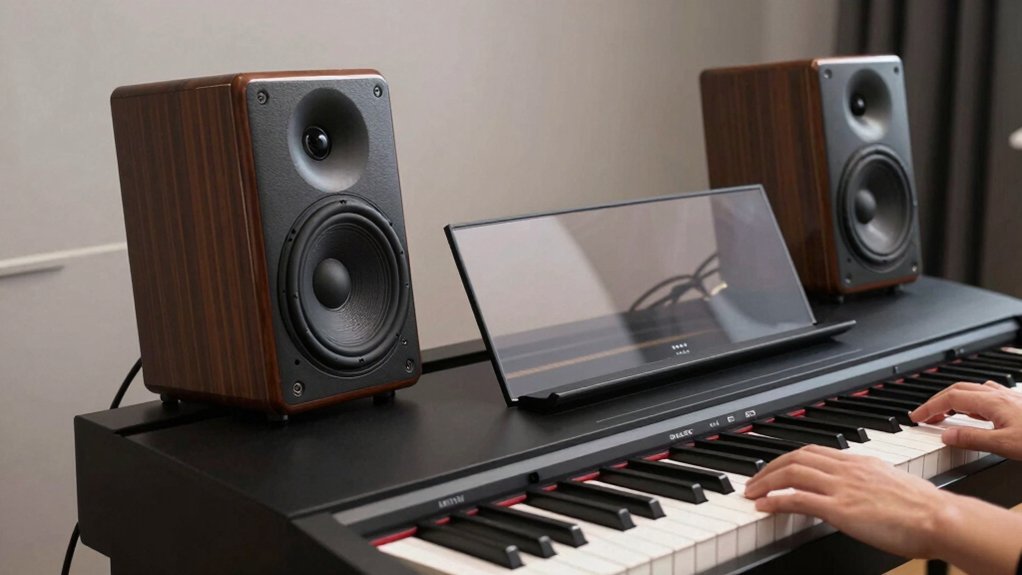
When you’re shopping for a digital piano, the built-in digital piano speakers are often overlooked in favour of flashier features like key action and sound engines, yet these speakers are responsible for everything you’ll actually hear during your practice sessions. Understanding the quality and limitations of built-in digital piano speakers is crucial because inadequate speakers can make even the most expensive sound engine fall flat, whilst decent speakers can bring budget-friendly instruments to life with surprising richness and depth that fills your practice space.
You tilt the lid and a dim, boxed room hums back something close to the piano’s voice, yet you sense the sound isn’t quite right. Built-in speakers compress space, panel, and driver, so you get a limited frequency range, weaker bass, and flatter dynamics. That makes critical practice difficult, even as you tell yourself it’s adequate for quick checks. So where do the limits sit, and what should you do next to verify them?
Built-in Piano Speakers: How They Actually Work
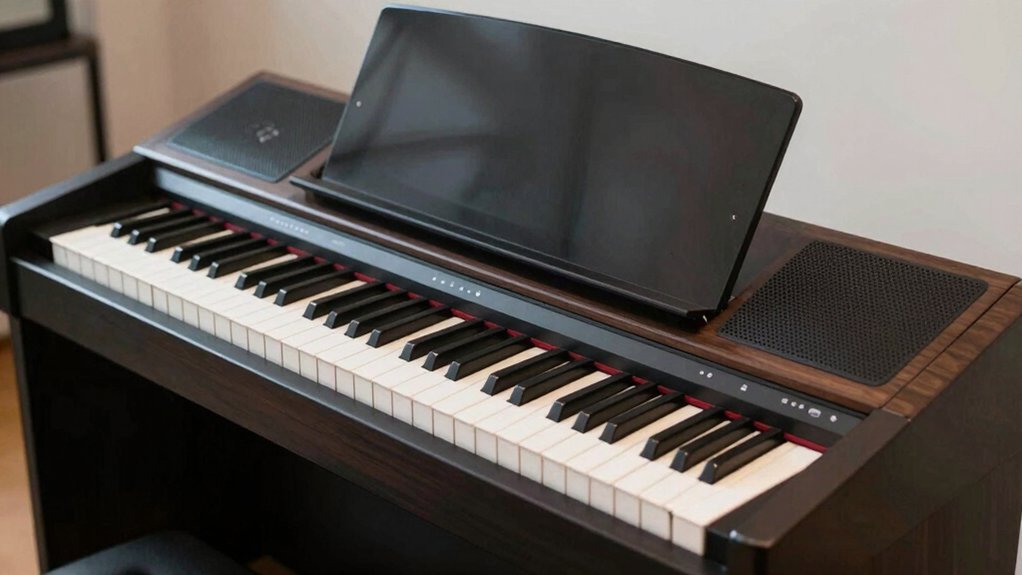
Built-in piano speakers are small, self-contained sound systems, but they aren’t just tiny versions of studio monitors. You’ll assess them by how they convert electrical signals into sound, not by how loud they get.
In practical terms, your speaker material determines frequency response limits, driver cone rigidity, and resonance behavior, while enclosure walls shape impedance and bass extension. Acoustic tuning happens through a combination of driver pairing, cabinet design, and porting choices, all aimed at minimizing distortion at typical piano transients.
You’ll notice trade-offs: compact size curbs low-end extension, yet precise midrange can improve keyboard articulation. Overall, you should expect a linear, fatigue-free listening experience for practice or early-mound checks, with caveats about depth and image stability compared to external, purpose-built monitors.
What Limits Built-in Speakers in Practice
Even in compact form, built-in speakers face practical limits that affect how you hear a piano, not just how it plays. You’ll notice reduced dynamic range because drivers operate near power ceilings, so sudden transients compress and smear.
Enclosure size matters, restricting bass and stereo imaging, which means you hear a flatter, less immersive piano string system. Material and circuit compromises introduce audible coloration or hiss in quiet passages, limiting audio fidelity when you sit closer or at higher volumes.
Thermal constraints curtail sustained loud playing, triggering occasional distortion as amps heat. Durability matters too; drivers endure vibrations and flex without lasting distortion, but cheap components lose stiffness, altering tone over time.
Frequency Response for Small Drivers
Small drivers inherently struggle to reproduce the full piano frequency range, so their frequency response is tilted and uneven. You’ll notice a pronounced roll-off on extremes, with midrange clarity taking priority over deep bass and shimmering highs.
This bias isn’t accidental; it reflects fundamental driver limitations, including cone travel limits, voice-coil heating, and mechanical damping. As a result, the frequency bandwidth available from compact enclosures is narrow, forcing compromises that color timbre and articulation.
You should expect uneven level output across notes, particularly on complex chords where simultaneous high and low frequencies demand broad excursion.
In evaluation, isolate driver performance from room influence and playback level. Document measured deviations, quantify flatness, and compare against reference curves to judge whether the speaker’s response meets your expectations.
How Enclosure Design Shapes Digital-Piano Sound
Enclosure design directly shapes how a digital piano’s sound is perceived, shaping both tonal balance and perceived loudness independent of the driver itself. You’ll notice that cabinet volume, porting, and material choice influence bass extension and upper-mid clarity, often more noticeably than driver tweaks alone.
In practice, enclosure design governs modal behavior, damping, and resonance distribution, which translates to sound shaping that favors certain frequencies over others. A compact box may dull bass and exaggerate brightness, while a larger, well-damped enclosure can restore linearity across the midrange.
However, this influence isn’t magical; it interacts with driver sensitivity, cabinet joints, and internal baffling. Objective evaluation requires measuring impulse response and tonal sweeps, isolating enclosure effects before attributing sonic differences to the speaker alone.
Room Interaction and Perceived Loudness
Room response varies with room size, furnishings, and surface materials, so you’ll see different interaction patterns across setups.
Perceived loudness depends on speaker placement, reflections, and listener position, making measurement essential beyond nominal wattage.
You’ll need to assess how room factors influence loudness and how placement tweaks can mitigate or amplify these effects.
Room Response Variations
Room response varies with room size, shape, surfaces, and speaker placement, which together determine how loud a built-in digital piano sounds in practice. You’ll notice that room acoustics influence reflections, standing waves, and perceived brightness, even when the same speaker is used.
Different wall materials and furniture density alter decay times and tonal balance, so the same note can feel louder in one setting and softer in another.
Speaker placement matters just as much: angle, distance from walls, and height change early reflections and stereo image, affecting perceived loudness without changing output.
In a methodical test, you’d control distance, measure SPL at multiple seats, and document tonal changes. The goal: identify stable, repeatable room interactions, not subjective impressions.
Perceived Loudness Factors
In practical terms, how loud a built-in digital piano sounds is shaped by how you interact with the space, not just the speaker output. Room interaction governs perceived loudness through reflections, diffusion, and foreground/background balance, which your ears interpret as intensity.
You’ll notice that room size, surface material, and furniture density modify tonal fullness and masking, sometimes exaggerating or suppressing high-frequency content. Perceived loudness also depends on dynamic range and the piano’s output stage, but the acoustic context sets the upper bound of usable level.
To assess accurately, isolate instrument response from room quirks, then evaluate consistency across common listening positions. Consider how speaker materials and acoustic tuning modify early reflections and cabinet resonance, because these choices influence how you perceive loudness without changing actual dB.
Speaker Placement Effects
Speaker placement directly shapes room interaction and, consequently, perceived loudness. You’ll evaluate how piano speakers couple with nearby walls, corners, and surfaces, because reflections color tonal balance and transient clarity.
In room acoustics terms, placement alters early reflection paths and bass reinforcement, which can exaggerate or mute dynamics. You should test on-axis listening versus off-axis positions, noting how tonal fullness shifts with distance from the speaker grill and the floor boundary.
Practical measures include a stable, non-slippery stance and ensuring toe-in is minimal to avoid exaggerated brightness. Avoid relying on symmetry alone; room treatment, furniture, and window presence matter.
Ultimately, speaker placement is a variable you can optimize to reduce masking and improve intelligibility without increasing output.
When to Rely on Internal Sound vs. External Amplification
When deciding whether to rely on built-in piano speakers or to use external amplification, start by evaluating your environment and goals. You’ll assess room size, practice timing, audience, and noise constraints, then weigh fidelity versus portability.
Built-in systems vary by speaker material and speaker size, so expectations must align with hardware limits. If you need quiet practice, internal sound may suffice; for performances, external amplification is usually essential.
Consider potential feedback, latency, and cable clutter before committing to extra gear. A methodical approach helps you avoid overspending on underpowered units or over-specced rigs.
- Suitability for room acoustics
- Desired volume without distortion
- Portability and setup speed
- Budget and upgrade path
- Long-term goals and reuse potential
Practical Steps to Optimize Built-in Speaker Sound
To optimize built-in speaker sound, start with a precise assessment of what you’re hearing and why. You’ll document discrepancies, note room interactions, and distinguish harshness from muffled bass.
Then set objective goals: improve clarity, balance, and intelligibility without external gear.
Approach with a methodical checklist: verify speaker placement, ensure driver alignment, and confirm cabinet sealing.
Test at multiple frequencies and use reference tracks you know well.
Apply acoustic tuning concepts—adjust EQ bands conservatively, prefer gradual boosts over cuts, and avoid extreme boosts that muddy transients.
Calibrate levels to prevent clipping, and monitor thermal behavior to protect speaker durability.
Finally, verify improvements across genres, recheck overlap with the piano’s timbre, and document durable settings for consistent practice sessions.
Avoid speculative tweaks; base changes on measurable results.


Auditioning Built-in Speakers for Practice and Gig Use
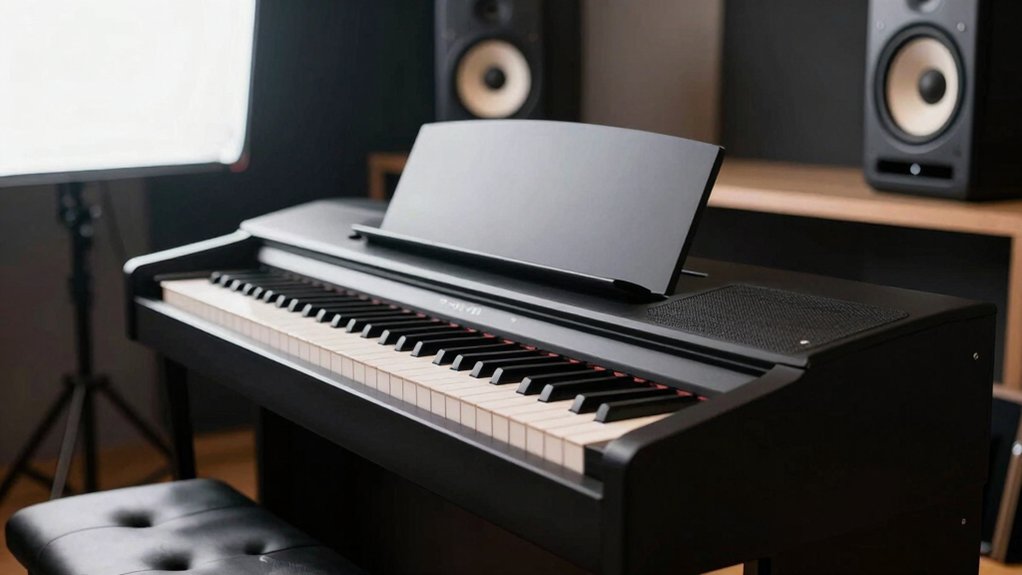
When you audition built-in speakers, evaluate how responsive they feel to your playing and how quickly transients register at practice levels versus venue volumes.
Consider stage versus practice differences by testing with your setlist, mic’d cues, and monitor needs to see if the output remains clear and controllable.
We’ll also account for portability and power needs, noting how size, weight, and amp requirements affect reliability on gigs.
Speaker Responsiveness When Listening
Evaluating built-in piano speakers for practice or gig use hinges on how quickly and accurately they respond to your playing. You’ll notice timing and nuance when the audio returns to your ears without lag or smear, which matters for rhythm and touch. Responsiveness also reveals controller and DSP limits; if the sound trails or alters dynamics, you can’t trust speaker fidelity.
Speaker clarity should stay intact at moderate volume, not just at peak loudness, so you hear intended articulation. Driver size relates to transient behavior: small drivers struggle with micro-dynamics, while larger ones better track velocity.
Evaluate with scales, not impressions, using consistent pieces and metronome. Consider cabinet damping and amp headroom as constants affecting perceived responsiveness.
- speaker clarity
- driver size
- consistent metronome pacing
- transient accuracy
- damping and headroom
Stage vs Practice Differences
Stage and practice environments impose distinct demands on built-in piano speakers, so auditioning them under both conditions is essential.
In practice rooms, you’ll hear subtler dynamics, requiring fidelity at lower volumes and a flat frequency response to avoid misleading impressions.
On stage, projection, feedback resistance, and transient handling matter more; you should test how quickly the speaker recovers from loud transients and whether the tone remains intelligible when accompanied by monitors and room reflections.
Compare perceived warmth, clarity, and consistency across genres.
Assess speaker durability under repeated on/off cycling and vibration, since gigs can stress mounts and enclosures.
Consider aesthetic design as it relates to stability and mounting options, ensuring that form doesn’t compromise acoustic performance.
Objective testing over subjective impressions yields reliable stage versus practice conclusions.
Portability and Power Needs
Portability and power requirements are practical constraints that shape how you audition built-in speakers for both practice and gigs. You’ll assess weight, cabinet size, and whether the enclosure can be carried solo or with gear.
Power needs matter for practice rooms and small venues, so compare rated wattage, headroom, and sensitivity to your piano’s output. Favor systems with stable impedance and reliable cooling to maintain acoustic integration over longer sessions.
Test at low and high volumes to gauge distortion, depth, and presence, not just loudness.
Durability matters: build quality, grill protection, and driver reliability predict long-term performance. Keep these criteria aligned with your use case.
- portability
- power headroom
- acoustic integration
- speaker durability
- durability and protection
Choosing the Right Output for Recording and Monitoring
Choosing the right output for recording and monitoring isn’t about nostalgia for your hardware; it’s about ensuring clean signal flow and accurate feedback. You should treat outputs as part of a defined chain, not a convenient afterthought.
Start with a purpose: what’re you recording, where will you monitor, and what latency is acceptable? Use balanced connections to reduce noise, and match levels to prevent clipping. Avoid chaining multiple adapters that introduce impedance and phase issues.
When you place speakers or headphones, consider speaker placement and the room’s acoustics to prevent biased monitoring. Manage sound reflection by seating and angling monitors to minimize early reflections.
Test with reference material, then iteratively adjust routing, gain staging, and monitoring distance until the signal remains faithful from instrument to capture.
Built-in Digital Piano Speakers: Are They Good Enough?
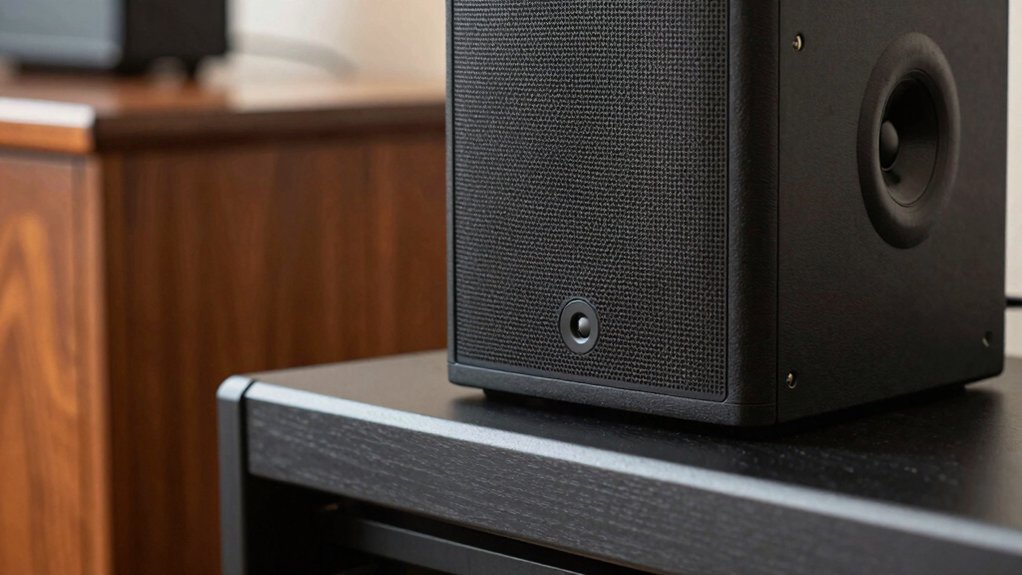
Built-in piano speakers are convenient, but you should assess them critically rather than assume they’ll cover practice and basic performance needs. In practice, these speakers often trade sound quality for compact design, and you’ll notice limited dynamic range, compression, and tonal balance at higher volumes.
Consider efficiency, cabinet construction, and driver quality as core design considerations, not afterthoughts. You’ll likely encounter phase and frequency response limitations that distort nuance in touch sensitivity and pedal sustain.
- Sound quality trade-offs impact expression
- Design considerations shape portability vs. fidelity
- Speaker size limits bass, clarity, and transient response
- Amplification and power handling constrain dynamics
- Room acoustics still dominate perceived performance
For serious practice, monitor with external speakers or headphones; built-ins suffice only for quick checks.
Conclusion
You’ve seen the limits, step by step, and you know what’s missing. Built-in piano speakers are handy for quick checks, not for real critique or stage-ready performance. They reveal flaws you’ll only fix with better monitors or headphones. Yet they’re practical, economical, and sufficient for casual practice if you manage expectations and room quirks. So, will you rely on them alone, or reserve judgment for true studio or stage monitoring? The choice quietly awaits your next audition.