Understanding why professional pianists are secretly switching to digital pianos challenges long-held assumptions about acoustic supremacy and reveals how premium digital technology has evolved beyond simple acoustic imitation into genuinely useful tools that solve real problems even for elite players.
While no serious pianist abandons acoustic instruments entirely, increasing numbers of professionals now maintain high-end digital pianos for specific practice situations, composition work, late-night sessions, and travel—applications where modern digital pianos provide practical advantages that acoustic instruments simply cannot match regardless of tonal superiority. This revealing analysis examines the specific scenarios where professional pianists choose digital over acoustic, which premium digital piano features justify the investment for advanced players, and how the gap between technologies continues narrowing in ways that surprise even skeptical traditionalists.
Like a quiet revolution you didn’t notice, digital pianos are shifting the pro piano map. You get consistent touch, studio-grade effects, and seamless live rigs without the drama of tuning or transit. But how far can a keyboard really replace a grand on stage or in the studio? The tradeoffs aren’t just feel vs. sound—they’re workflow, cost, and reliability, and these choices shape every set you might play. Keep thinking about what you actually need on tour and in the booth.
Why Pros Choose Digital Pianos: Core Capabilities and Tradeoffs
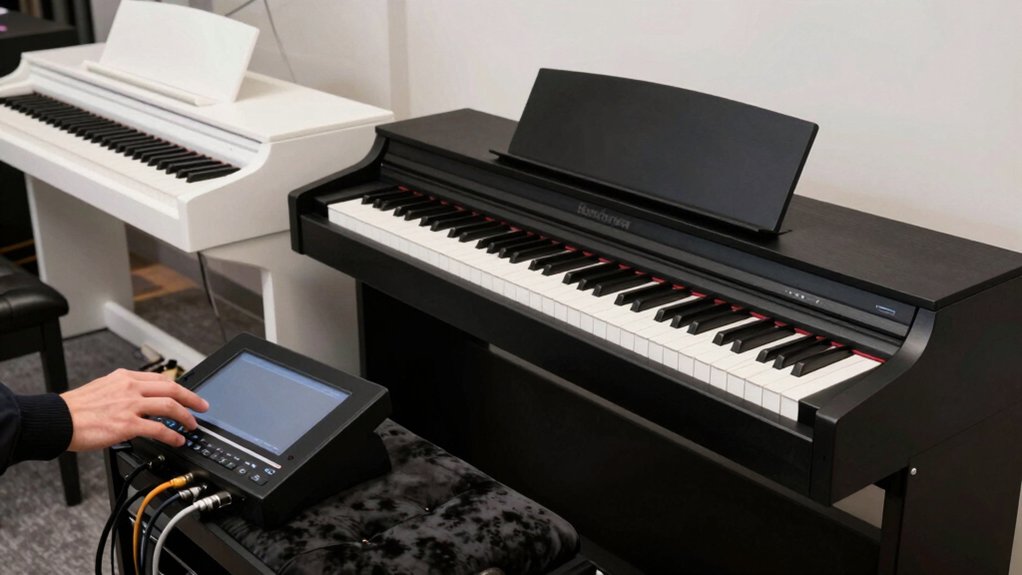
Digital pianos offer pros-focused advantages: accurate replication of weighted keys, superior dynamic range, and consistent studio-like workflows. You evaluate core capabilities and tradeoffs with a data-driven lens.
You’ll notice keyboard versatility enables rapid genre shifts without rebuilding rigs, while internal effects and routing support precise sound customization for sessions. Yet you recognize tradeoffs: tactile novelty versus acoustic-sounding inertia, a potential gap in pedal expressiveness, and reliance on software ecosystems for updates.
You quantify latency, polyphony, and sample quality to forecast live reliability and studio consistency. You compare maintenance costs, portability, and power efficiency to traditional rigs, weighing resale value and upgrade paths.
Touch and Feel: Professional Digital Pianos Versus Acoustic Grands
Even as digital pianos close the gap on many fronts, you’ll notice a distinct tactile gap when comparing touch and feel to acoustic grands. You evaluate action, key weight, and release feel with a technician’s eye, not a casual impression.
Digital keyboards simulate hammer response, but the travel, rebound, and texture still diverge from wood and string inertia. You’ll prioritize consistency across velocity layers and the predictability of aftertouch, then weigh how pedals respond under sustained, dynamic play.
Keyboard ergonomics matter: key spacing, surface texture, and duplex touch zones influence phrasing accuracy and fatigue risk. Sound customization can compensate for some acoustic shortcomings, but it won’t fully erase the physical disparity, guiding your choice toward balanced, studio-friendly models with transparent, repeatable action.
Tour Reliability: Consistency, Transport, and Setup
Tour reliability hinges on consistent onstage performance, easy transport logistics, and a streamlined setup process.
You’ll assess how digital pianos maintain steady output across venues, simplify carry and rigging, and cut setup time without sacrificing sound or control.
This focus sets the foundation for choosing gear and workflows that sustain tours under tight schedules and varying conditions.
Consistent Performance Onstage
Onstage consistency hinges on reliable gear, precise setup, and swift transport logistics, because even minor hiccups can derail a performance. You’ll evaluate instrument rigidity, firmware stability, and controller responsiveness to minimize timing deviations and pedal latency.
Digital pianos offer repeatable touch curves, preserving consistent dynamics across venues, while integrated power management reduces the risk of outages mid‑piece. You consider calibration workflows that streamline setup, enabling rapid rehearsal and soundcheck without sacrificing tone integrity.
Focus on Piano craftsmanship and Acoustic resonance as determiners of perceived realism; digital models can emulate hammer feel and sympathetic string behavior with high fidelity, yet require careful cabinet design and speaker placement to avoid phase anomalies.
Reliability also hinges on serviceability, redundancy, and remote diagnostics for continuous stage readiness.
Easy Transport Logistics
Transport logistics are the backbone of tour reliability, and you’ll measure ease of movement, setup speed, and fault tolerance that keep gigs moving smoothly.
In this subtopic, you evaluate how digital pianos simplify transit compared to acoustics, prioritizing compact form factors, modular cases, and weight distribution. You’ll quantify transport efficiency by rack-mount compatibility, flight-case durability, and rapid disassembly.
Consistent power needs, dual-voltage support, and reliable MIDI/USB routing reduce on-site troubleshooting, lowering downtime between venues.
Keyboard ergonomics matter; compact layouts, key travel consistency, and stand adaptability influence quick relocations without retooling.
Aesthetic design plays a quiet but effective role, signaling professional readiness during load-in.
The goal: predictable logistics that support backstage pacing, minimal gear-related variance, and uninterrupted performance flow.
Streamlined Setup Process
Digital pianos simplify the setup phase by prioritizing plug‑and‑play readiness and predictable rigging. You’ll notice faster assembly, consistent connections, and fewer last‑minute adjustments between venues.
With standardized ports, footprints, and quick‑release stands, transport becomes less error‑prone and more repeatable. The streamlined process minimizes contingency planning, letting you focus on performance rather than logistics.
You’ll also see fewer maintenance issues, since robust construction and common components reduce variability across rigs. While considered, aesthetic considerations don’t slow setup; designs favor compact, recyclable cases that fit transport workflows.
In practice, you gain visibility into cable routing, power distribution, and practice space layout, enabling repeatable setups across tours. That reliability translates to fewer downtime surprises and smoother tech handoffs.
Pro Studio Connectivity: MIDI, Audio Interfaces, and Plugin Integration
Connecting a digital piano to a professional studio setup hinges on robust MIDI routing, reliable audio interfaces, and seamless plugin integration. You’ll map MIDI channels to synths, controllers, and DAW tracks, ensuring low latency and stable clocking.
Audio interfaces must offer sufficient I/O, phantom power, and clean preamps to preserve dynamics, while sample-rate and bit-depth choices influence headroom for dense mixes.
Plugin integration should be interoperable with your workflow, enabling instrument sims, effects, and mix tools to live on your preferred DAW.
Focus on keyboard ergonomics during routing to prevent posture-related fatigue when performing long sessions.
For sound customization, leverage multi-timbral modes, split keys, and controller mappings to craft expressive performances without sacrificing precision or recall.
Prioritize a scalable, repeatable template for ongoing sessions.
Total Cost of Ownership: Pricing, Maintenance, and Resale Value
Pricing, maintenance, and resale value collectively define the total cost of ownership for digital pianos in a pro setup. You’ll evaluate upfront pricing insights, considering model tier, build quality, and feature sets that impact long-term usefulness.
Ongoing costs include software licenses, periodic action calibration, and occasional keyboard dusting or hardware checks—keep these predictable with a maintenance schedule.
Reliability matters: fewer moving parts often translate to lower failure frequency, reduced service bills, and steadier performance.
Resale value hinges on brand reputation, feature longevity, and market timing; you’ll benefit from models with widely supported firmware and strong aftercare.
Compare total ownership footprints across options, not just sticker prices, and map purchase-to-resale trajectories. When you plan, you’ll uncover clear resale options and total-cost transparency that favor professional workflows.
Real-World Workflows: Rigging, Monitoring, and Rehearsal Routines
You’ll assess rigging protocols currently in use and how they influence stability, cue timing, and safety during setup.
Across sessions, you’ll monitor signal integrity, power management, and latency to guarantee consistent performance.
This discussion opens on how rehearsal routines integrate these workflows to minimize downtime and maximize reliability.
Rigging Protocols In-Use
Rigging protocols in real-world workflows demand precise coordination between setup, monitoring, and rehearsal routines. You map each phase to dependability metrics: load distribution, anchor integrity, and response latency.
In practice, you verify hardware compatibility before you connect cables, ensuring Rigging safety standards are met and that redundancies survive peak loads. You select Rigging accessories with defined load ratings and fatigue histories, then pre-test under simulated conditions to confirm stability.
During setup, you document torque specs, strap alignments, and chain lengths to prevent drift during performance. Monitoring focuses on live tension, vibration signatures, and environmental shifts that could alter balance.
Rehearsals exercise quick-reset drills, fault isolation, and safe disengagement, preserving instrument integrity while preserving sonic intent.
Monitoring Across Sessions
Monitoring across sessions demands consistent data capture and comparative analysis to guarantee continuity in rigging, hardware behavior, and rehearsal outcomes. You track presets, pedal responses, and MIDI events across gigs, rehearsals, and studio days to reveal drift or harmonics shifts.
Use delta comparisons to surface when sound quality changes correlate with firmware updates or temperature fluctuations. Your workflow should enforce versioned profiles, timestamped captures, and standardized test tracks so you can reproduce results or isolate anomalies.
The process hinges on a reliable user interface that presents analytics clearly, with dashboards for tempo stability, touch consistency, and output impedance. Prioritize automation for log generation, anomaly alerting, and regression checks, ensuring teams act quickly without revalidating baselines.
Efficient monitoring keeps performances coherent and equipment reliable.
How to Choose the Right Professional Digital Piano for Your Lineup
When selecting a professional digital piano for your lineup, start by aligning performance needs with keyboard action, polyphony, and output options. You must evaluate feel, responsiveness, and consistency under diverse sessions.
Then consider how a model handles layered sounds and hardware I/O. Focus on keyboard ergonomics and sound customization to tailor control layouts and tonal shaping to your workflow.
- Compare graded hammer action and keybed stability across brands to match your technique.
- Verify polyphony and multitimbral capacity for complex performances and seamless changeovers.
- Assess connectivity, onboard effects, and software integration for studio-to-stage versatility.
This approach minimizes latency, improves expressivity, and guarantees reliable performance under pressure.
Conclusion
You’ll love how digital pianos pretend to be perfect—until you notice the glow of a perfectly tuned preset and a dozen open plugins begging for a stage debut. Yes, the touch isn’t identical, and the carbon-fiber grand remains elusive, but the reliability, routing, and resale are so delightfully boring that your tech budget finally calms down. In short: the secret isn’t realism; it’s relentless practicality dressed as artistry. Irony, meet performance continuity.